JR rail guide
Yokosuka and Sobu Rapid: Tokyo’s Underground Through Route
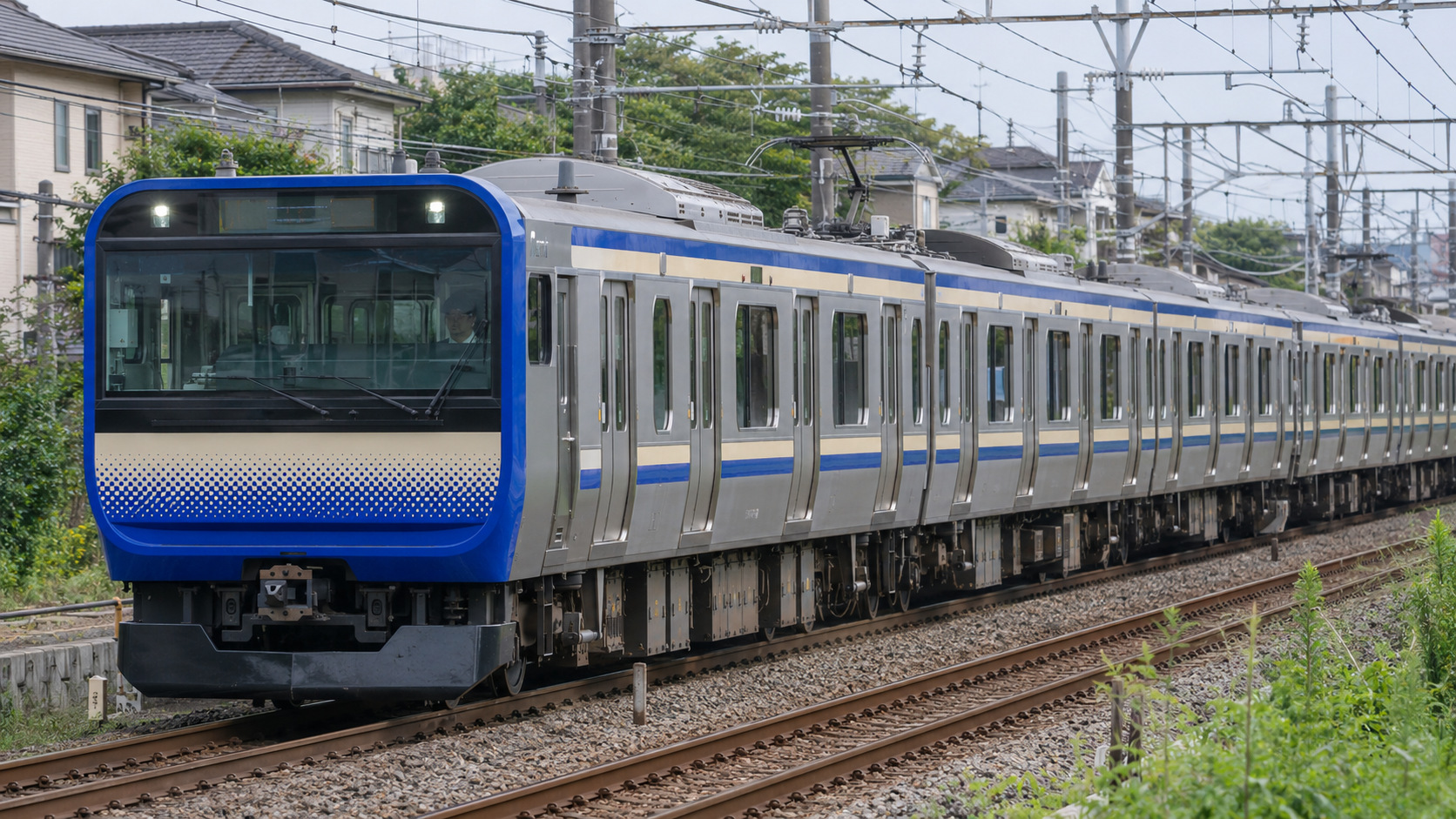
At Tokyo Station, follow Sobu Line Rapid/Yokosuka Line signs for this corridor. These trains use the Sobu underground platforms, not the Keiyo underground platforms and not the yellow Chuo–Sobu Local route through Akihabara.
The two line names describe a connected route. A suitable through train can take you from the Chiba side, through Tokyo, to Shinagawa, Yokohama or Kamakura without a change at Tokyo. But individual trains end at different stations, and “Sobu Rapid” alone does not mean “Narita Airport.”
One corridor, different destinations
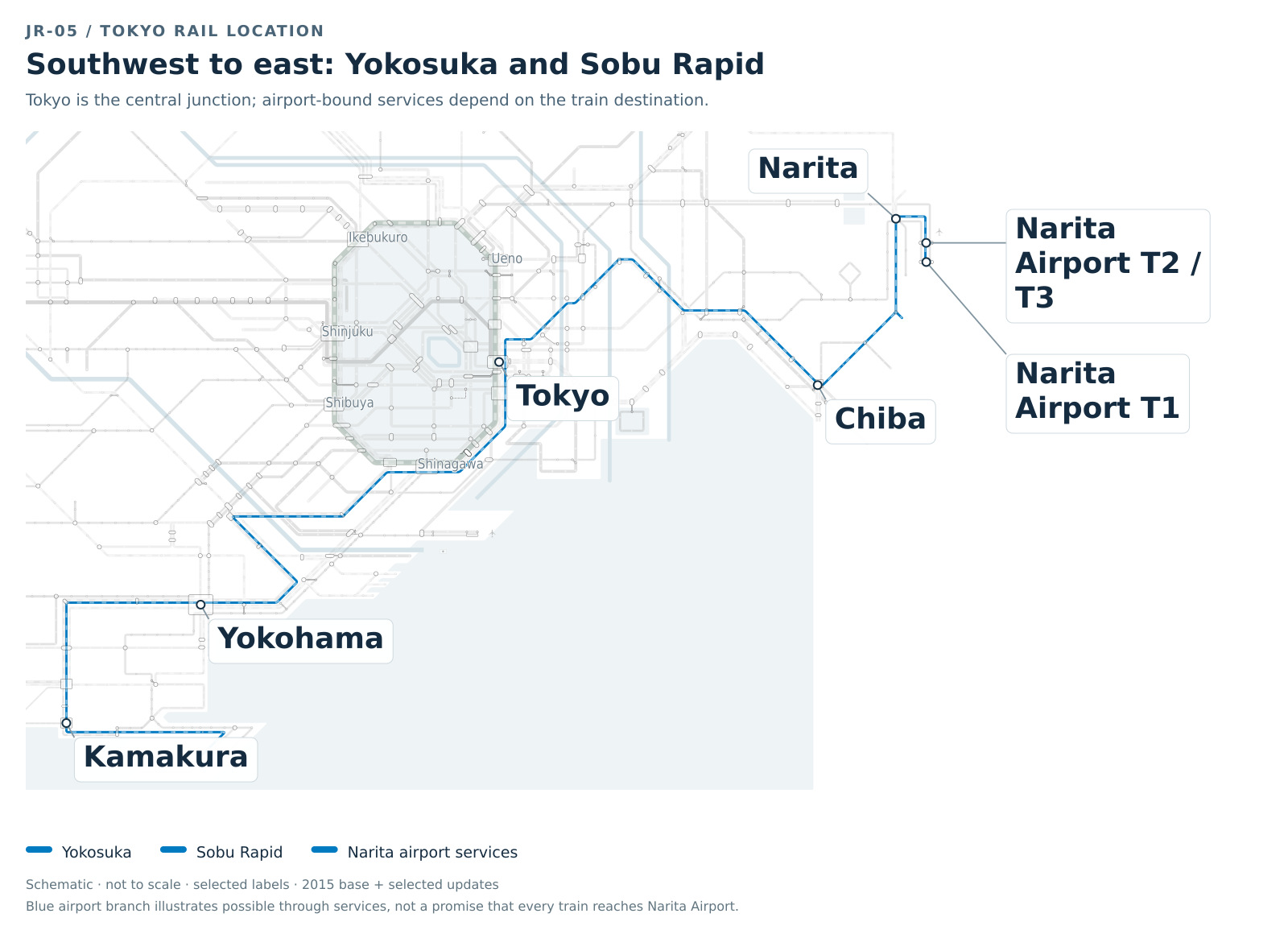
Think of Tokyo as the naming transition. East of Tokyo, Sobu Rapid runs toward Kinshicho, Funabashi and Chiba. South of Tokyo, Yokosuka services run toward Shinagawa, Yokohama and the Kamakura/Yokosuka side. Some trains run through; others start or finish partway along that corridor.
The official Tokyo timetable index lists Sobu Rapid toward Chiba and Yokosuka toward Yokohama/Kamakura separately. It also lists Narita Express, a different train product using the same underground platform family.
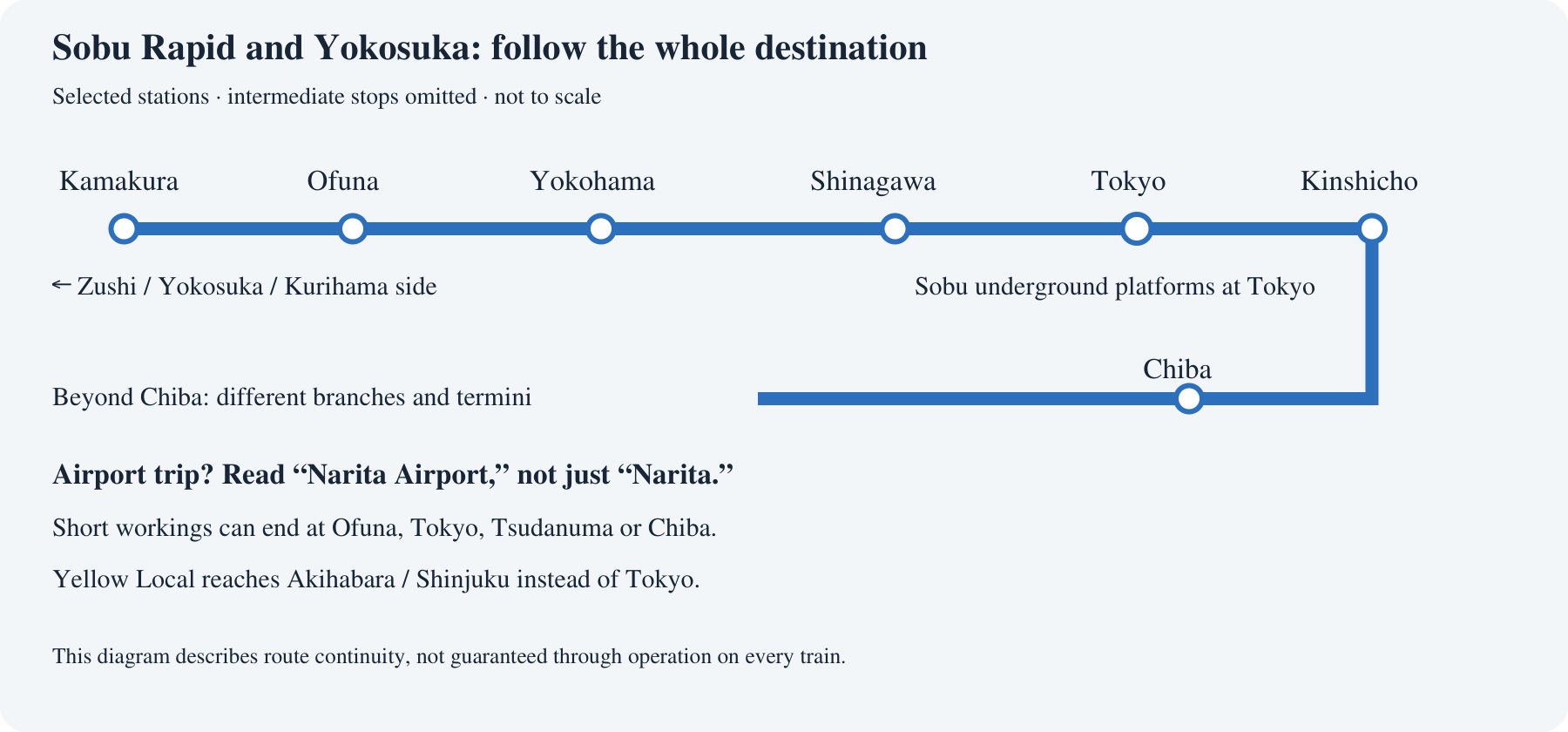
Selected stations only; not to scale. Through service depends on the individual train. The eastern branches and short workings are examples, not a promise that every train runs end to end.
Before boarding, identify three things: the station you need, the train’s final destination and its service type. If your journey extends beyond Tokyo, open the complete stopping list rather than assuming the train continues because the map’s coloured line does.
Finding the Sobu underground platforms at Tokyo
Use the official Tokyo station map to match your entrance or arrival platform with the Sobu underground area. Signs for Keiyo lead to a different underground part of the station. The word “underground” is not enough to navigate by.
Follow the railway and direction first, then confirm the platform on the current board. A journey planner’s abbreviated gate label may not match the name on a sign. If that happens, show staff the full route and your destination rather than spending time searching for an exact wording that may be an app’s label.
With large bags or a mobility need, plan the lift route from your actual starting point. A connection between two trains at Tokyo can be very different from entering from the street. A map showing lifts does not guarantee that every preferred route is step-free or that all lifts are operating on your date.
When choosing a Tokyo Station hotel base, consider the relevant entrance and the walk to these platforms. A hotel close to a Shinkansen entrance may not offer the same route to Sobu Rapid.
Sobu Rapid versus yellow Chuo–Sobu Local
Westbound from the Chiba side, the two services lead into different parts of central Tokyo. Sobu Rapid reaches Tokyo via Bakurocho and Shin-Nihombashi. Yellow Chuo–Sobu Local runs toward Ryogoku, Akihabara, Ochanomizu and Shinjuku instead.
Kinshicho is a useful decision point because both services call there. For Tokyo Station, choose the Rapid direction toward Tokyo. For Akihabara, choose a westbound Local calling at Akihabara. Do not stay on Rapid waiting for it to reach Akihabara; its central route is different.
Worked example: a hotel near Kinshicho, with a morning Shinkansen from Tokyo. A suitable Sobu Rapid reaches Tokyo directly, but your itinerary still needs the underground-to-Shinkansen interchange. A Local may look familiar from yesterday’s Akihabara trip, yet it does not provide the same direct arrival. Compare the whole journey from the Kinshicho hotel area, including the hotel walk and long-distance boarding deadline.
Kameido is a Local station, not a Sobu Rapid stop. A combined neighborhood guide does not mean every station in that neighborhood has identical service. Use the JR East network map to identify the connection, and current timetables to choose a departure.
Southbound: Kamakura, Zushi and Yokosuka are different targets
From Tokyo or Shinagawa, a suitable Yokosuka train to Zushi or Kurihama can serve Kamakura. A train ending at Ofuna stops short, so it needs an onward connection. For Yokosuka itself, a Zushi terminator also stops short. Read the destination before settling in for a long ride.
The current Tokyo Yokosuka departures include a mixture of destinations. An individual train’s details show whether it continues beyond Tokyo and how far south it reaches. Do not use a generic “Tokyo to Kamakura” travel time as a timetable.
Worked example: Tokyo to Kamakura. Select an ordinary Yokosuka departure whose stopping list includes Kamakura, board an ordinary car unless you have chosen and paid for Green, and leave at Kamakura. If you choose an Ofuna terminator because it departs earlier, add the onward train explicitly and compare the resulting arrival, including transfer time.
From a Shinagawa hotel base, you can join the Yokosuka corridor at Shinagawa rather than backtracking to Tokyo. From Shinjuku, the Shonan–Shinjuku corridor is a separate choice; do not travel to Tokyo automatically just because this guide starts there.
Yokosuka Station on JR and Yokosuka-chuo on Keikyu are different stations. Check the entrance of your actual destination before deciding which railway fits the visit. The day-trip guide is a starting point for planning beyond the train ride, not a substitute for the operator’s current departures.
Eastbound: Chiba does not mean the airport
At Tokyo, a Chiba- or Tsudanuma-bound Rapid can be right for a station along that corridor but does not reach Narita Airport. Other trains continue beyond Chiba in different directions. Check the entire destination label, including any train portion information shown on the board.
For an ordinary direct airport journey, look specifically for Narita Airport and verify the airport station you need. Narita Station serves the city; it is not the airport terminal station. A train ending at Narita is therefore a different choice from one continuing to the airport.
JR East’s current train details distinguish Narita, Airport Terminal 2 and Narita Airport as separate stops. The precise airport terminal still matters after leaving the train. Use the Narita Airport access comparison to decide among the main routes from your hotel, then confirm the selected departure on the official timetable.
Same platform family, different ticket: Narita Express
Narita Express, or N’EX, is a limited express. Its use of the Sobu underground area does not make it interchangeable with an ordinary Sobu Rapid.
If paying with a regular ticket or IC card, N’EX needs a limited-express ticket in addition to the base fare. Its accommodation is reserved-seat type; JR East also sells a seat-unspecified limited-express ticket under particular rules. That product is not the same as boarding with only a base-fare IC card. See the official N’EX ticket explanation before choosing it.
For a short ride to Shin-Nihombashi or Kinshicho, look for the ordinary Rapid that calls at your stop rather than assuming the next train in the platform area is suitable. Airport branding is a reason to recheck the train, not an instruction to board.
Green Cars and ordinary cars
Some ordinary Yokosuka/Sobu Rapid trains carry Green Cars. These require a separate Green Car ticket; the seats are unreserved and the supplement also applies while standing in the Green Car. Ordinary cars are the alternative when you do not want that extra product.
Consult the current Green Car rules for purchase and transfer conditions. Don’t carry a Chuo Line Green ticket onto a Yokosuka train at Tokyo expecting it to remain valid. The base journey and Green supplement are separate checks.
Selected stops for visitors
- Shin-Nihombashi: a useful Sobu Rapid stop when your destination is on that side of the Nihonbashi area. It is not the same station as Nihombashi on the subway.
- Bakurocho: another central Rapid stop, distinct from nearby subway station names. Use the exact station/exit in a walking plan.
- Kinshicho: the Rapid/Local choice for Tokyo versus the Akihabara corridor.
- Shinagawa: a southbound boarding point and interchange; allow time for the actual platform change.
- Yokohama: a major interchange. Yokosuka trains approach via Musashi-Kosugi and Shin-Kawasaki, so do not assume they stop at Kawasaki on the Tokaido corridor.
- Ofuna: check whether your train continues to Kita-Kamakura and Kamakura or ends here.
This is a selected list, not a complete station map.
Quick answers
Do I have to change trains at Tokyo?
Not on a suitable through service. Check the train’s actual destination and listen for termination or disruption announcements.
Can Sobu Rapid take me directly to Shinjuku?
Its ordinary central route goes through Tokyo, not Shinjuku. Yellow Local and other connections serve Shinjuku; choose the route for your destination rather than the shared Sobu name.
Is a train for Narita the same as a train for Narita Airport?
No. Narita is a city station. Verify the airport destination and terminal station before boarding.
Service and ticket sources checked 11 October 2026. Confirm current departures and station conditions for your travel date.
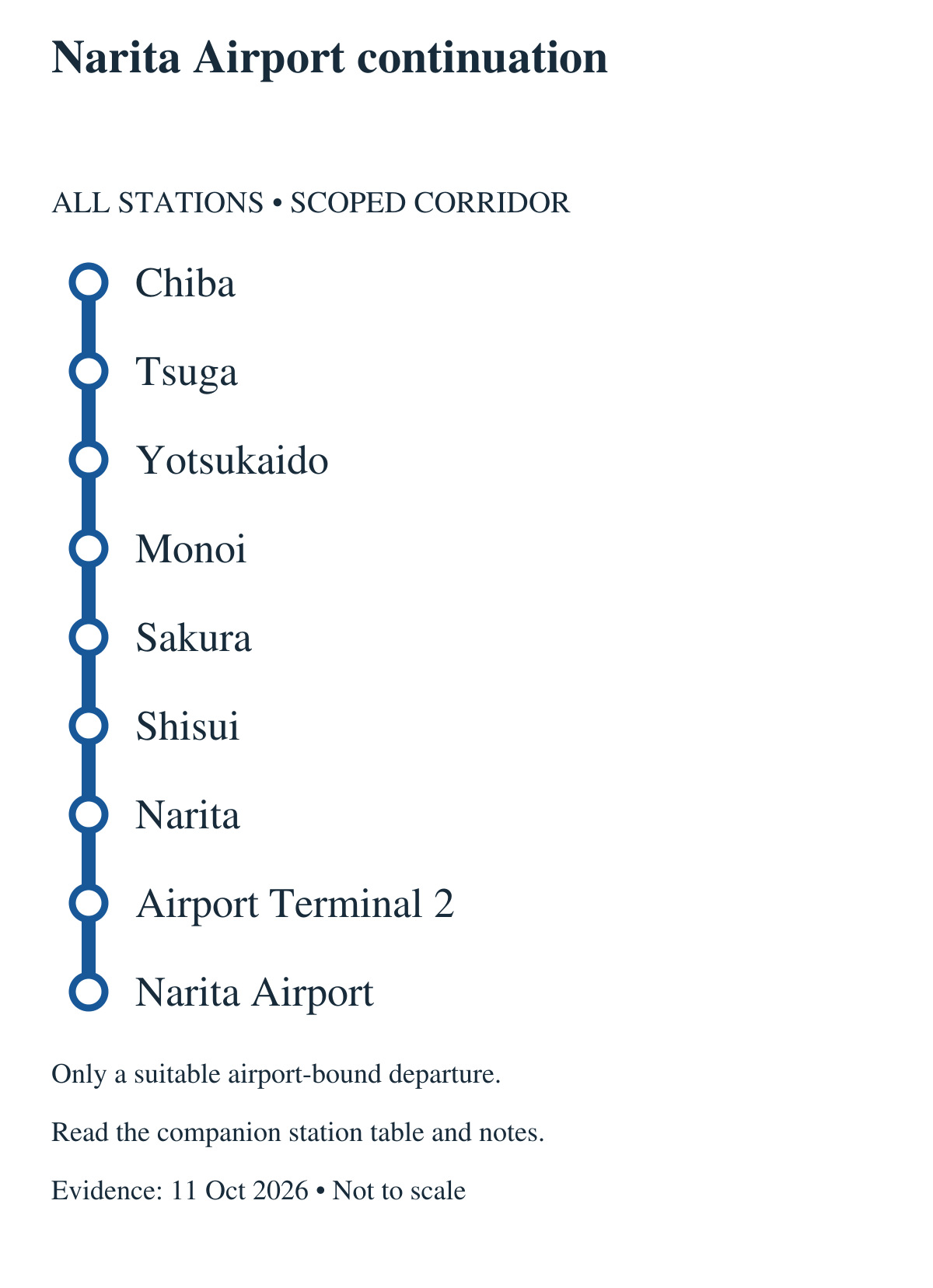
All stations within this guide route scope
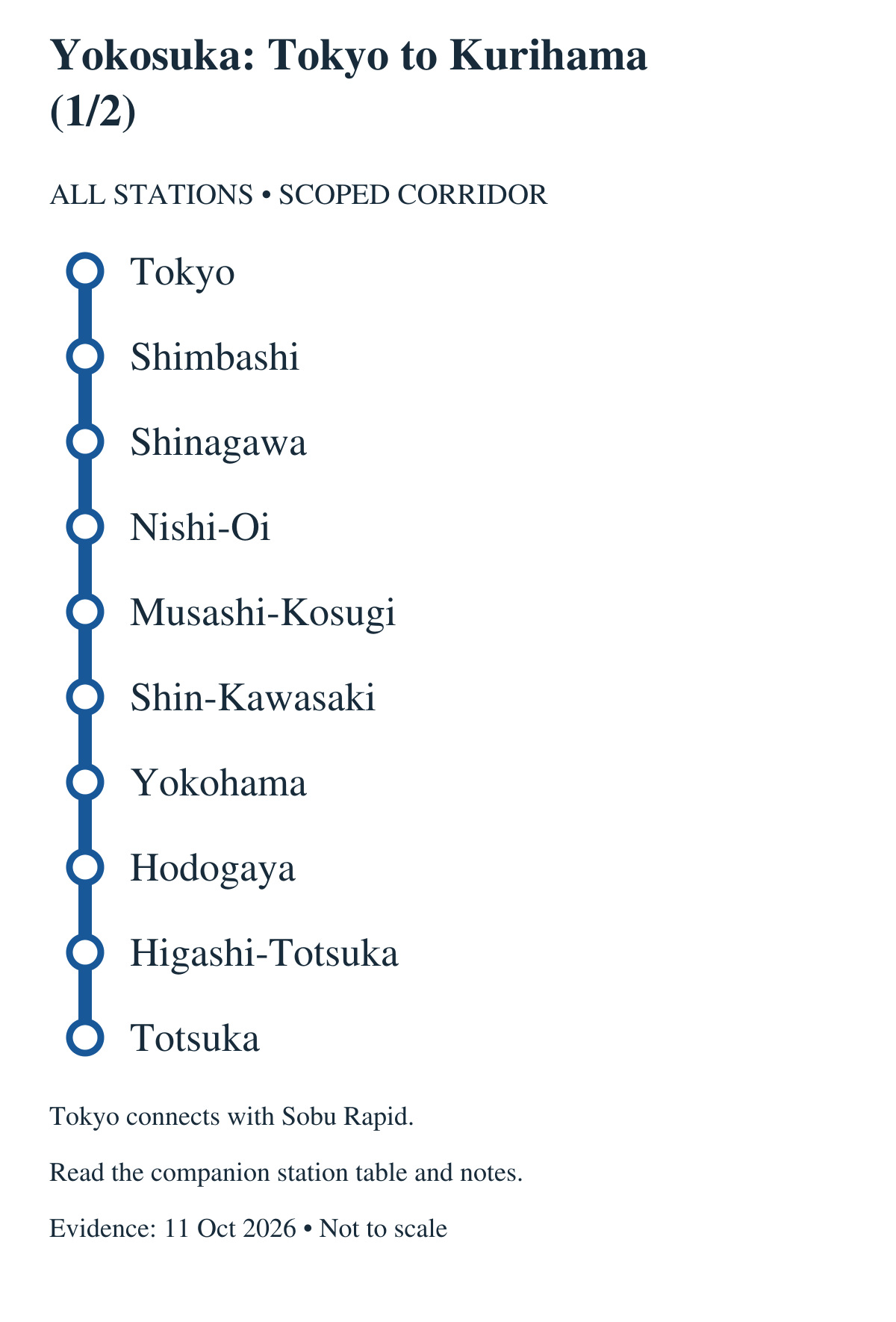
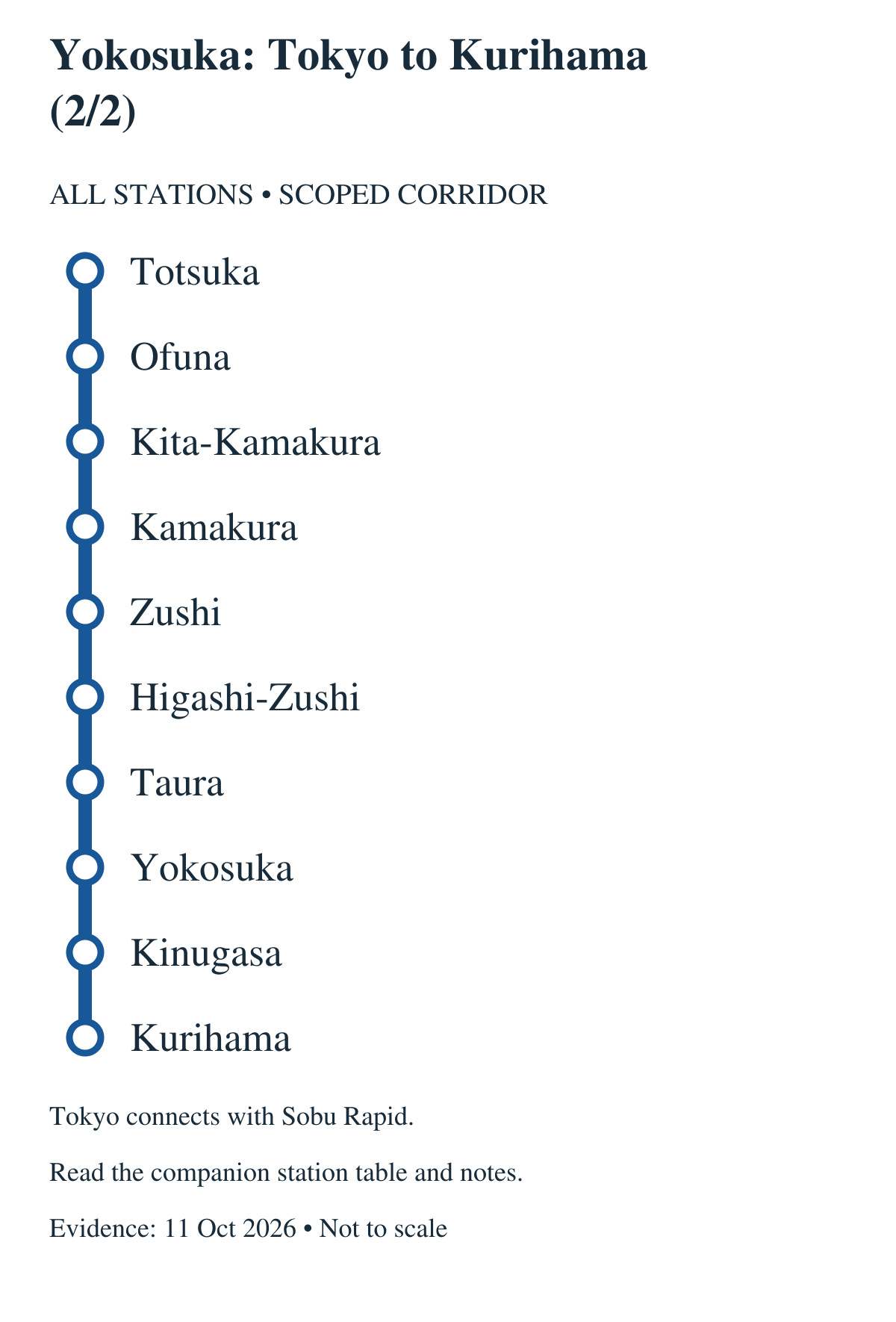
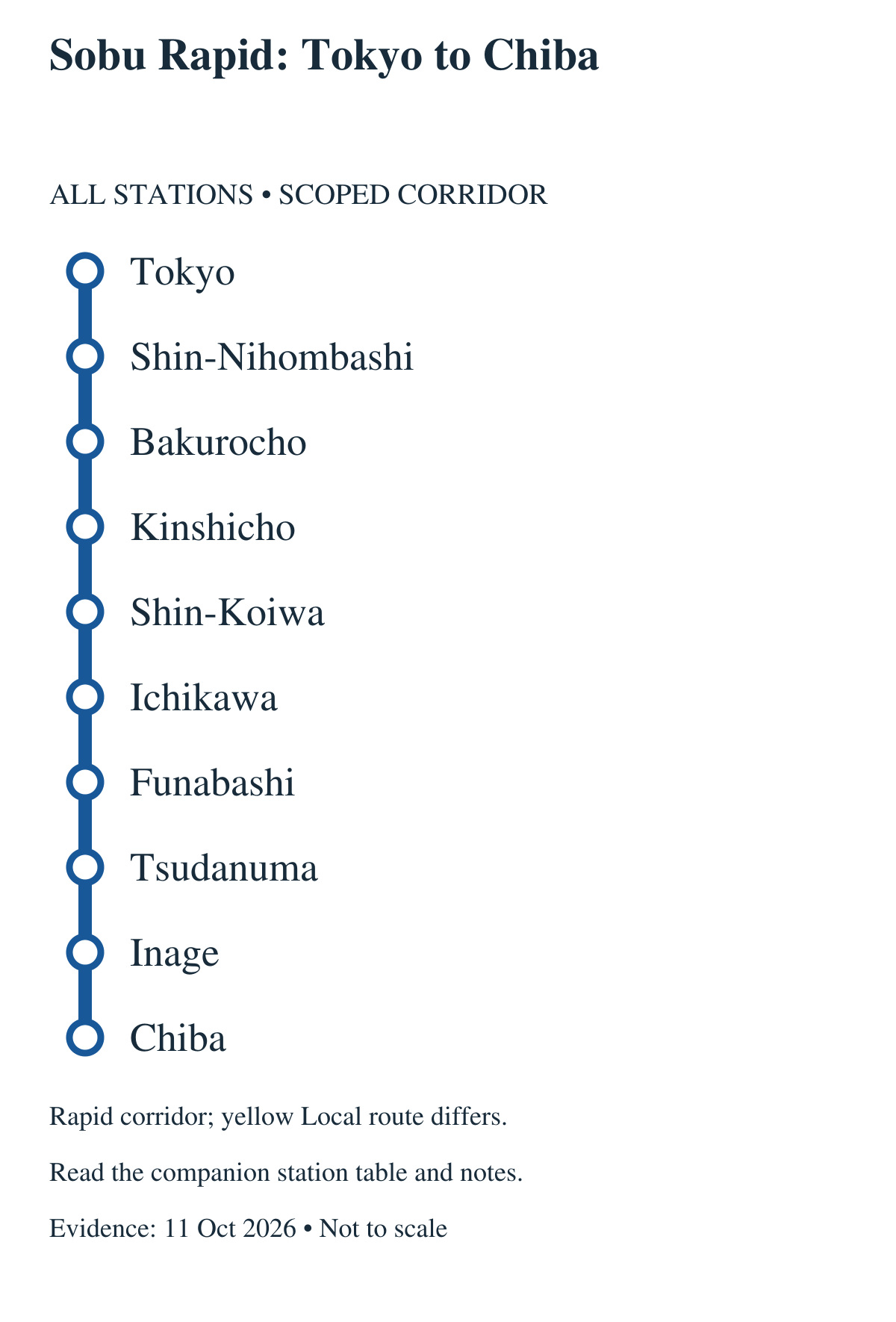
Evidence checked: 11 October 2026. Every station of the Tokyo–Kurihama Yokosuka service corridor (19), Tokyo–Chiba Sobu Rapid corridor (10), and the guide’s Narita-airport continuation Chiba–Narita Airport (9).
Original editorial diagrams; station order is factual, not to scale. No source artwork or departure-time table reproduced. Circles indicate inventory, not a universal stopping pattern. Read the service notes and station tables together with the panels.
Service and scope notes
- Tokyo connects the two named service corridors; individual trains may terminate before the map endpoint. Tokyo uses the Sobu underground area, not the Keiyo underground area.
- This is a Rapid-corridor station inventory. Yellow Sobu Local uses a different central route through Ryogoku and Akihabara. Between Kinshicho and Chiba, Local additionally serves Kameido, Hirai, Koiwa, Moto-Yawata, Shimosa-Nakayama, Nishi-Funabashi, Higashi-Funabashi, Makuharihongo, Makuhari, Shin-Kemigawa and Nishi-Chiba. These are not Rapid stops.
- Narita is the city station. Airport Terminal 2 serves airport terminals 2/3; Narita Airport serves terminal 1. Check the train destination and final airport terminal; a Narita-bound train stops short of the airport.
- The Narita-airport panel is an explicitly shown continuation, not a claim that all Sobu Rapid trains use it. Other eastern through branches (for example toward Kimitsu, Kazusa-Ichinomiya or Naruto), Narita Express stopping patterns, and the full yellow Local route are outside this map.
Yokosuka: Tokyo to Kurihama
19 stations, in order. Tokyo connects with Sobu Rapid.
| Order | Station | Japanese | Note |
|---|---|---|---|
| 1 | Tokyo | 東京 | Station in scoped inventory |
| 2 | Shimbashi | 新橋 | Station in scoped inventory |
| 3 | Shinagawa | 品川 | Station in scoped inventory |
| 4 | Nishi-Oi | 西大井 | Station in scoped inventory |
| 5 | Musashi-Kosugi | 武蔵小杉 | Station in scoped inventory |
| 6 | Shin-Kawasaki | 新川崎 | Station in scoped inventory |
| 7 | Yokohama | 横浜 | Station in scoped inventory |
| 8 | Hodogaya | 保土ケ谷 | Station in scoped inventory |
| 9 | Higashi-Totsuka | 東戸塚 | Station in scoped inventory |
| 10 | Totsuka | 戸塚 | Station in scoped inventory |
| 11 | Ofuna | 大船 | Station in scoped inventory |
| 12 | Kita-Kamakura | 北鎌倉 | Station in scoped inventory |
| 13 | Kamakura | 鎌倉 | Station in scoped inventory |
| 14 | Zushi | 逗子 | Station in scoped inventory |
| 15 | Higashi-Zushi | 東逗子 | Station in scoped inventory |
| 16 | Taura | 田浦 | Station in scoped inventory |
| 17 | Yokosuka | 横須賀 | Station in scoped inventory |
| 18 | Kinugasa | 衣笠 | Station in scoped inventory |
| 19 | Kurihama | 久里浜 | Station in scoped inventory |
Sources: JR East Yokosuka–Sobu Rapid train timetable.
Sobu Rapid: Tokyo to Chiba
10 stations, in order. Rapid corridor; yellow Local route differs.
| Order | Station | Japanese | Note |
|---|---|---|---|
| 1 | Tokyo | 東京 | Station in scoped inventory |
| 2 | Shin-Nihombashi | 新日本橋 | Station in scoped inventory |
| 3 | Bakurocho | 馬喰町 | Station in scoped inventory |
| 4 | Kinshicho | 錦糸町 | Station in scoped inventory |
| 5 | Shin-Koiwa | 新小岩 | Station in scoped inventory |
| 6 | Ichikawa | 市川 | Station in scoped inventory |
| 7 | Funabashi | 船橋 | Station in scoped inventory |
| 8 | Tsudanuma | 津田沼 | Station in scoped inventory |
| 9 | Inage | 稲毛 | Station in scoped inventory |
| 10 | Chiba | 千葉 | Station in scoped inventory |
Sources: JR East Yokosuka–Sobu Rapid train timetable.
Narita Airport continuation
9 stations, in order. Only a suitable airport-bound departure.
| Order | Station | Japanese | Note |
|---|---|---|---|
| 1 | Chiba | 千葉 | Station in scoped inventory |
| 2 | Tsuga | 都賀 | Station in scoped inventory |
| 3 | Yotsukaido | 四街道 | Station in scoped inventory |
| 4 | Monoi | 物井 | Station in scoped inventory |
| 5 | Sakura | 佐倉 | Station in scoped inventory |
| 6 | Shisui | 酒々井 | Station in scoped inventory |
| 7 | Narita | 成田 | Station in scoped inventory |
| 8 | Airport Terminal 2 | 空港第2ビル | Station in scoped inventory |
| 9 | Narita Airport | 成田空港 | Station in scoped inventory |
Sources: JR East Narita Airport train timetable.