Private rail guide
Tokyu Toyoko Line to Yokohama or Shin Yokohama

By Coverstories Editorial
For Yokohama Station or Chinatown, choose a train that continues along the Toyoko Line toward Yokohama. For the Tokaido Shinkansen, search for Shin-Yokohama and check that your train reaches it. These journeys separate at Hiyoshi, so boarding the next southbound Toyoko train is not enough. Tokyu explicitly warns passengers about this fork. Tokyu Toyoko Line
The return journey needs a second check: a train from Shin-Yokohama toward Tokyo may run via Shibuya or Meguro. Match the route to the station you actually need, even when the large destination display names somewhere much farther away. Sotetsu Shin-Yokohama station
The fork that changes your trip
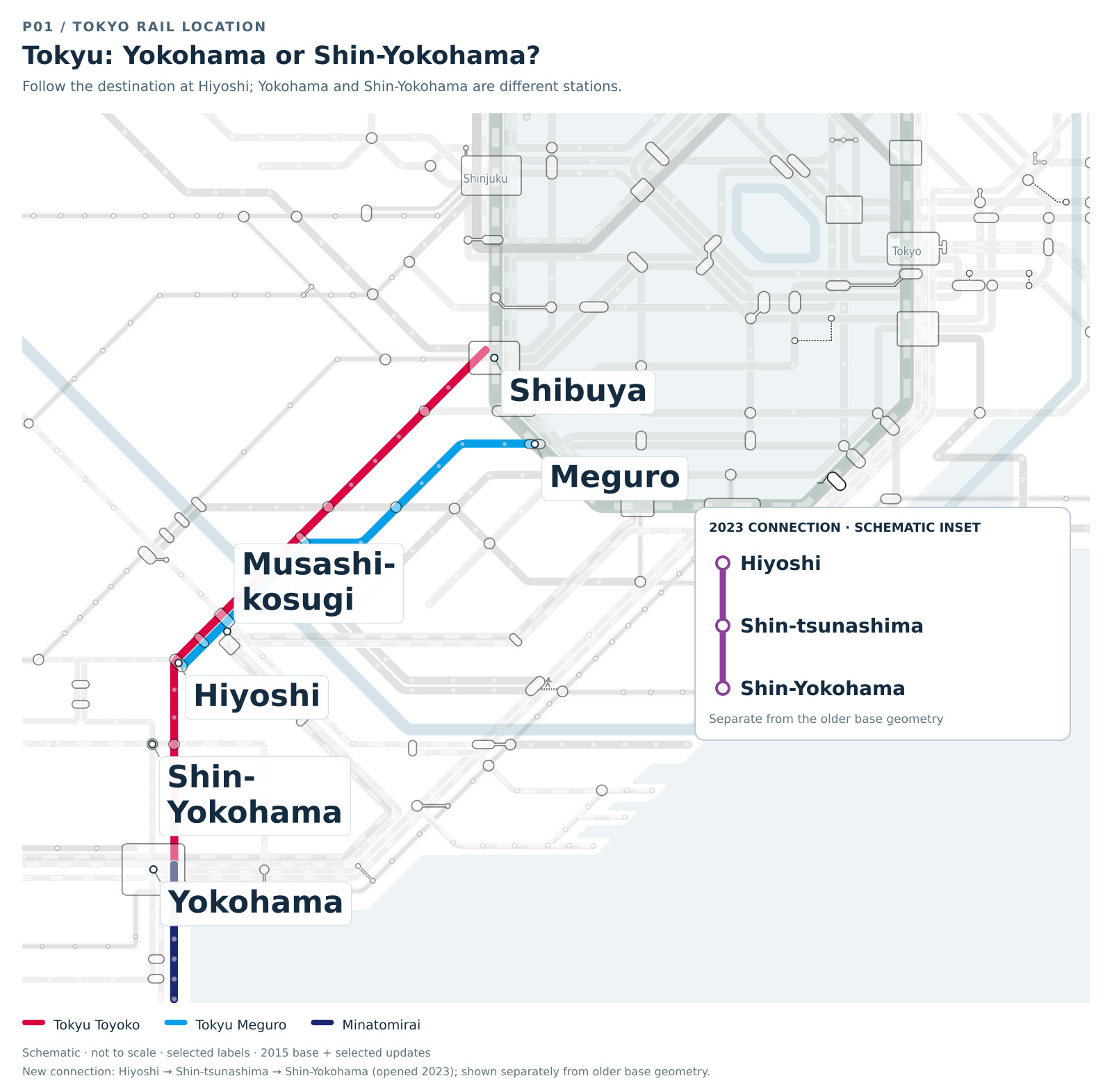
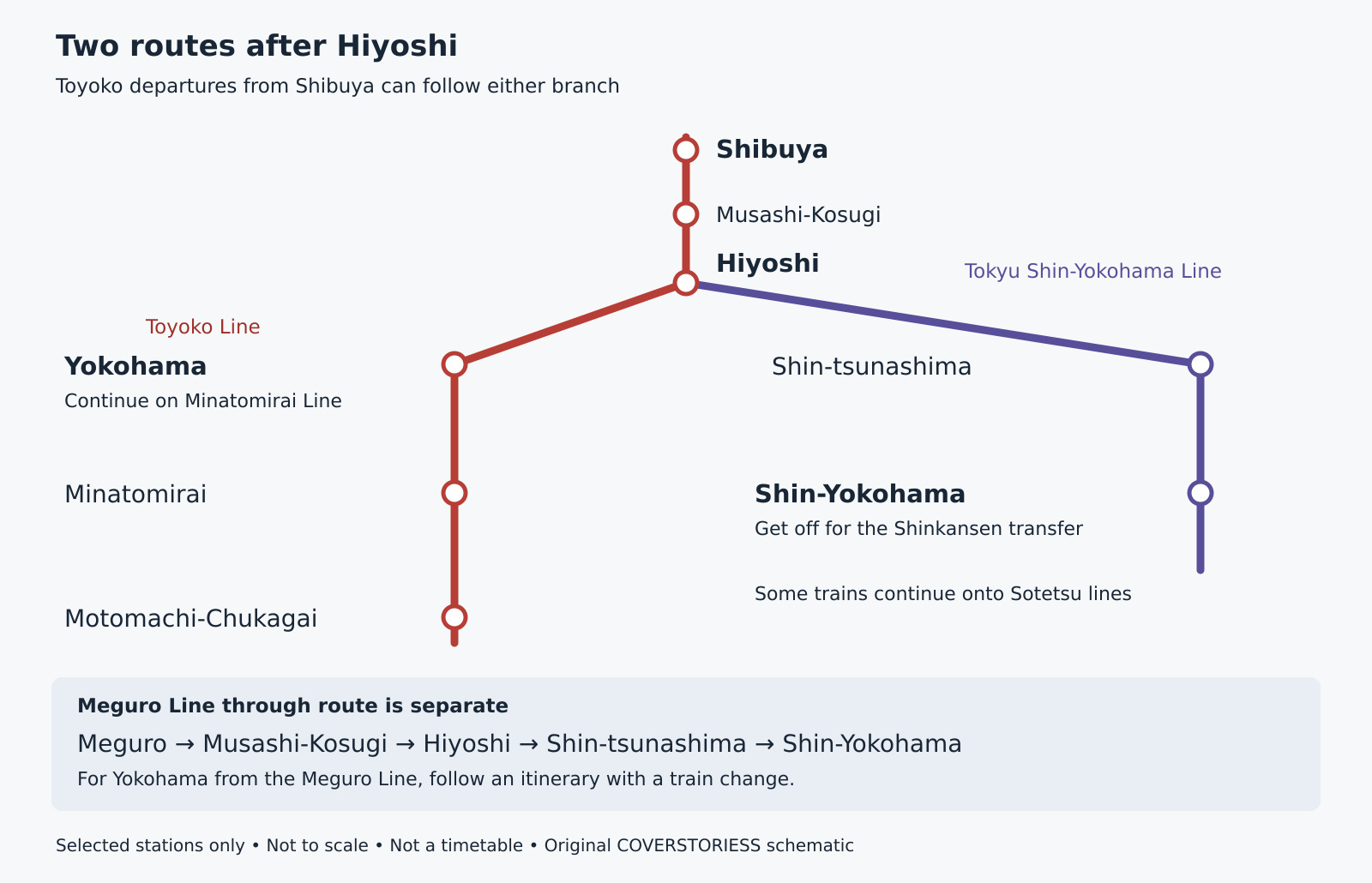
Simplified service-path diagram, not a geographic map or timetable. Intermediate stations are omitted. Lines show possible routes, not a promise that every train runs through. Geometry checked against the Tokyu network and Minatomirai route map.
Yokohama (横浜) and Shin-Yokohama (新横浜) are separate stations. Keep the full name in your journey search and on any screenshot you show staff. “Yokohama” as a city destination is too broad when you have a reserved train to catch.
On the Shin-Yokohama branch, the stations are Hiyoshi, Shin-tsunashima and Shin-Yokohama. Tsunashima on the Toyoko route and Shin-tsunashima on this branch also have different names; do not silently substitute one for the other. Tokyu Shin-Yokohama Line
From Shibuya to Chinatown or Minatomirai
Set your destination to Motomachi-Chukagai (元町・中華街) for a Chinatown visit, or Minatomirai (みなとみらい) for that station. A search ending at Yokohama Station leaves another part of the trip to plan. The Minatomirai Line continues from Yokohama through the waterfront area to Motomachi-Chukagai. Minatomirai stations and connections
At Shibuya, follow signs for the Tokyu Toyoko Line (東急東横線). Keep the selected departure open while comparing the platform board: the departure time, train type and destination together identify the service. A destination of Motomachi-Chukagai is the useful sign for a through journey to Chinatown. If your train terminates earlier, the itinerary needs a later train or a change.
Do not choose solely by the words Express or Limited Express. They describe a stopping pattern, and you still need the correct route and a stop at your destination. Use the current Toyoko line information and the station departure board rather than treating the fastest-sounding label as an instruction to board.
For example, imagine leaving a Shibuya hotel for lunch in Chinatown. Before entering the station, save an itinerary ending at Motomachi-Chukagai. At the platform, compare the approaching train with that itinerary. If its details differ, check the full stop list instead of assuming it is an interchangeable departure. During the ride, an operator-name change at Yokohama does not itself tell you to get off; follow the itinerary’s actual transfer instruction.
If you are still choosing a base, the Shibuya hotel and station-access guide helps with the separate decision of which side of the station suits your hotel. Add that walk to your planning rather than starting the day-trip clock on the platform.
From Shibuya to a Shinkansen at Shin Yokohama
Search for Shin-Yokohama as the local-train destination, then plan the Shinkansen boarding step separately. A Toyoko departure can continue onto the Tokyu Shin-Yokohama Line, but other departures continue toward Yokohama. Tokyu branch warning
A direct itinerary is useful with luggage because it removes a train change. It is not necessarily the right choice if waiting for it leaves too little time before your reserved Shinkansen. Compare actual departures for your date and time, including any itinerary with a change, before choosing.
Read beyond the final destination. A train continuing past Shin-Yokohama onto the Sotetsu network can still serve your stop. Conversely, a destination name you recognize is no substitute for checking the selected train’s stop list. The official Shin-Yokohama station map distinguishes the Tokyu direction toward Hiyoshi from the Sotetsu direction toward Nishiya and Futamatagawa.
The same discipline applies when boarding at Musashi-Kosugi or changing at Hiyoshi. Confirm both the next train and where your itinerary expects you to leave it. Do not add an improvised Hiyoshi change unless the train you are on actually stops there; the Toyoko Line has different stopping patterns.
From Shin Yokohama back to Shibuya or Meguro
At Shin-Yokohama, first find the Tokyu direction toward Hiyoshi (日吉). Then distinguish Toyoko Line (東横線) from Meguro Line (目黒線) through services. Sotetsu’s station information lists both, and Tokyu’s map labels the Tokyo-bound direction with Hiyoshi, Shibuya and Meguro. Sotetsu station information · Tokyu station map
For Shibuya (渋谷), choose an itinerary via the Toyoko Line, either directly or with the change shown. For Meguro (目黒), look for the Meguro Line route. The Meguro Line connects onward to the Tokyo Metro Namboku and Toei Mita lines, which helps explain why the train’s final destination may be beyond Meguro. Tokyu Meguro Line
Suppose you arrive by Shinkansen and your hotel is described as “Ebisu and Meguro.” Check its exact nearest station before buying a ticket or descending to the platform. Meguro, Nakameguro and Ebisu are different targets. A broadly named hotel area should not decide which train you board. Use the Ebisu and Meguro hotel-access guide alongside the hotel’s own address and directions.
If your selected route continues on JR after Shibuya or Meguro, open that transfer step rather than assuming the Tokyu train becomes a JR service. The JR Yamanote Line guide covers the onward loop-line journey.
When a line name changes on the same train
Through running lets one train continue onto another company’s tracks. That can turn a long destination name into something useful: it tells passengers farther along the route where the service ends. You only need to establish whether your stop lies on this particular service and whether a change is required before it.
In a journey app, expand the itinerary. Look for an explicit stay-on-board instruction, a transfer symbol, or a new departure. Several line names do not necessarily mean several trains. But do not infer “stay seated” just because consecutive segments share a station. Platform announcements and service changes can override an itinerary saved earlier.
A practical check is to name the station where you next get off. If you cannot answer that from the screen, resolve it before boarding. This is more useful than trying to memorize every distant through-service destination.
Give the Shinkansen transfer its own margin
Tokyu’s Shin-Yokohama station has underground platforms and a separate onward route to the JR station. Its current station page links a floor plan with elevators and barrier-free-route markings. Inspect the route before travelling if you have a suitcase, stroller or mobility requirement. Elevator availability on a map is not a guarantee that every part of your intended journey will be step-free on the day. Shin-Yokohama station facilities and map
Choose an earlier local-train arrival when missing the Shinkansen would disrupt the trip. Allow for finding the route, dealing with your Shinkansen ticket or reservation, reaching the correct platform and locating your carriage. A tight app connection may leave little room for those tasks. There is no single transfer time that is suitable for every traveller.
Before departure, save your Shinkansen train number, departure time and booking details somewhere you can open quickly. If you expect to collect a ticket, find out where and how beforehand. A report of someone else’s fast transfer does not establish a dependable connection with your luggage and ticket arrangements.
Fares and the wrong branch
A through train does not make the companies’ fare boundaries disappear. Use a ticket or payment method valid for the complete journey. The Minatomirai operator recommends a transit IC card such as Suica or PASMO for journeys involving other railway companies; its guidance also explains interline paper tickets. Minatomirai riding guidance
Our Suica and PASMO guide covers the stored-value-card basics. If using another payment method or a pass, check that product’s current coverage instead of assuming the train’s through service extends the ticket’s validity.
If you realize you boarded the wrong branch, get off at a station where the train stops, move clear of the doors and rerun the journey from there. Check whether returning or taking a different connection works better now. Ask staff about any ticket adjustment before passing through gates if you are unsure. Do not rush onto the opposite platform or attempt to bypass a barrier.
Questions before boarding
Is Shin Yokohama another name for Yokohama Station
No. Enter the full station name that matches your booking. Shin-Yokohama is the Shinkansen transfer target discussed here; Yokohama is a different station on the Toyoko route.
Must I change when the operator name changes
Only if your itinerary or the train’s instructions require it. A through service can cross an operator boundary while you stay on board. Check the next station where you must get off.
Does a Tokyo Subway Ticket cover the whole journey
No. The Tokyo Subway Ticket covers Tokyo Metro and Toei Subway lines. Tokyu, Sotetsu and the Minatomirai Line are outside that scope. A train continuing out of the subway network does not extend the pass. Tokyo Subway Ticket coverage
Route and ticket-scope sources checked on 12 October 2026 Japan time. This guide is based on operator information, not a timed transfer test. Check current departures and disruption notices on your travel day.