Tokyo subway guide
Oedo Line Without the Wrong Turn: Tochomae, Shinjuku and Kuramae
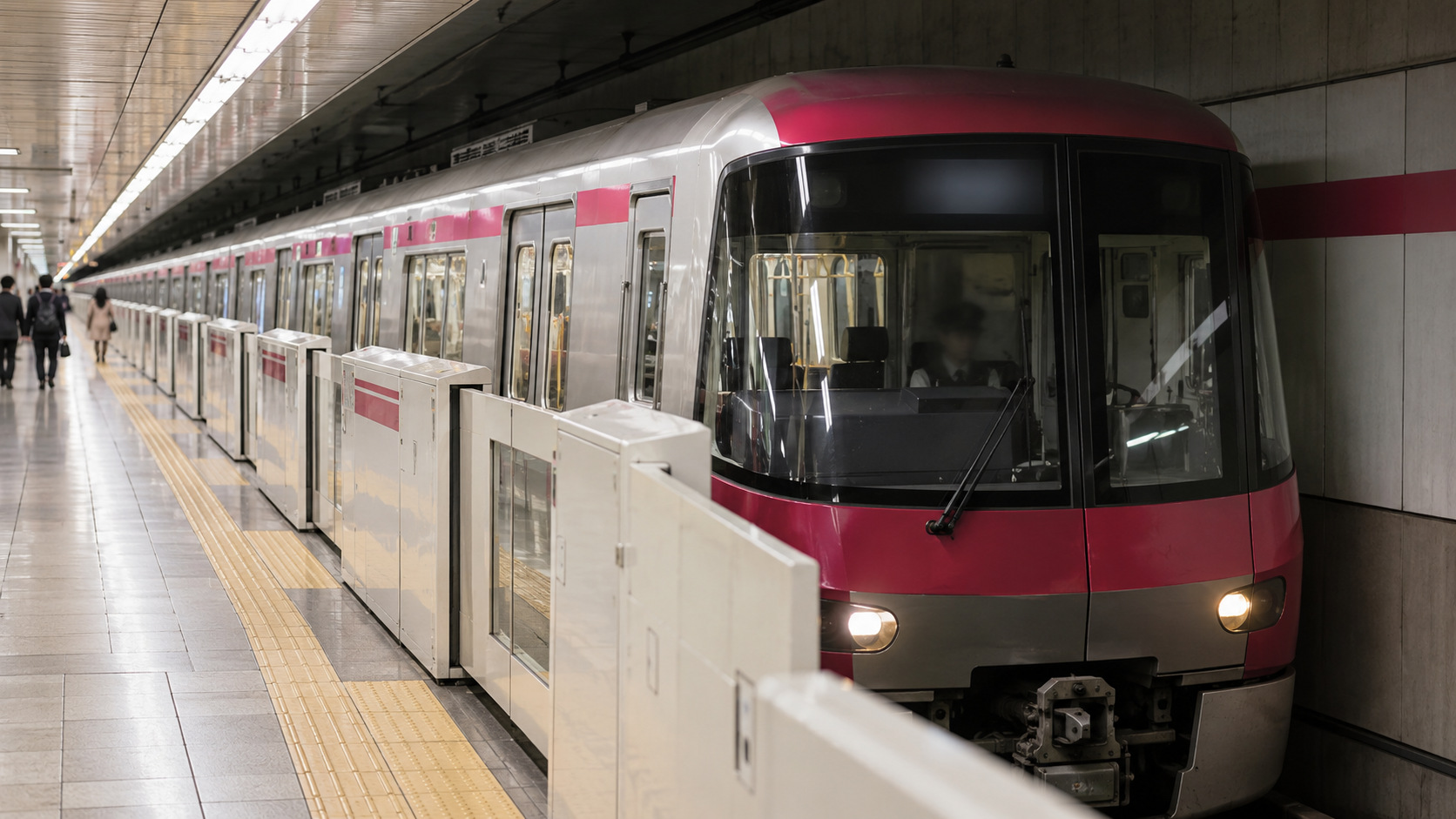
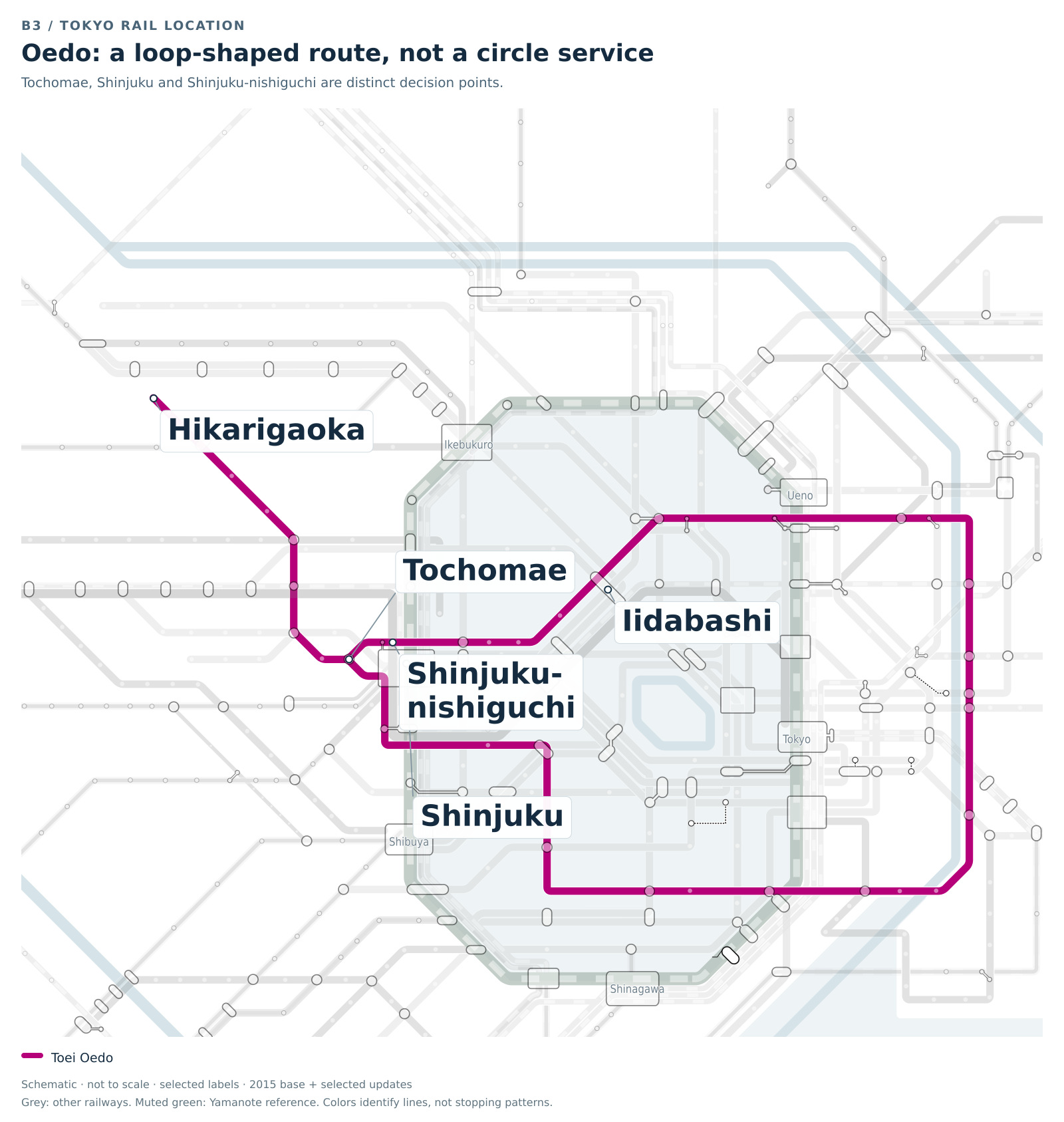
On the Oedo Line, choose your direction by the stations on the way, then check the train’s destination. Its loop-shaped map is misleading if you expect trains to circle indefinitely. Tochomae is both a junction and the end of some journeys, and “Shinjuku” and “Shinjuku-nishiguchi” are different Oedo stations.
For a hotel trip, those details matter more than memorizing the whole line. A train can be heading toward the right side of Tokyo yet take you around much more of the route than you intended.
The loop is not a continuously circulating service
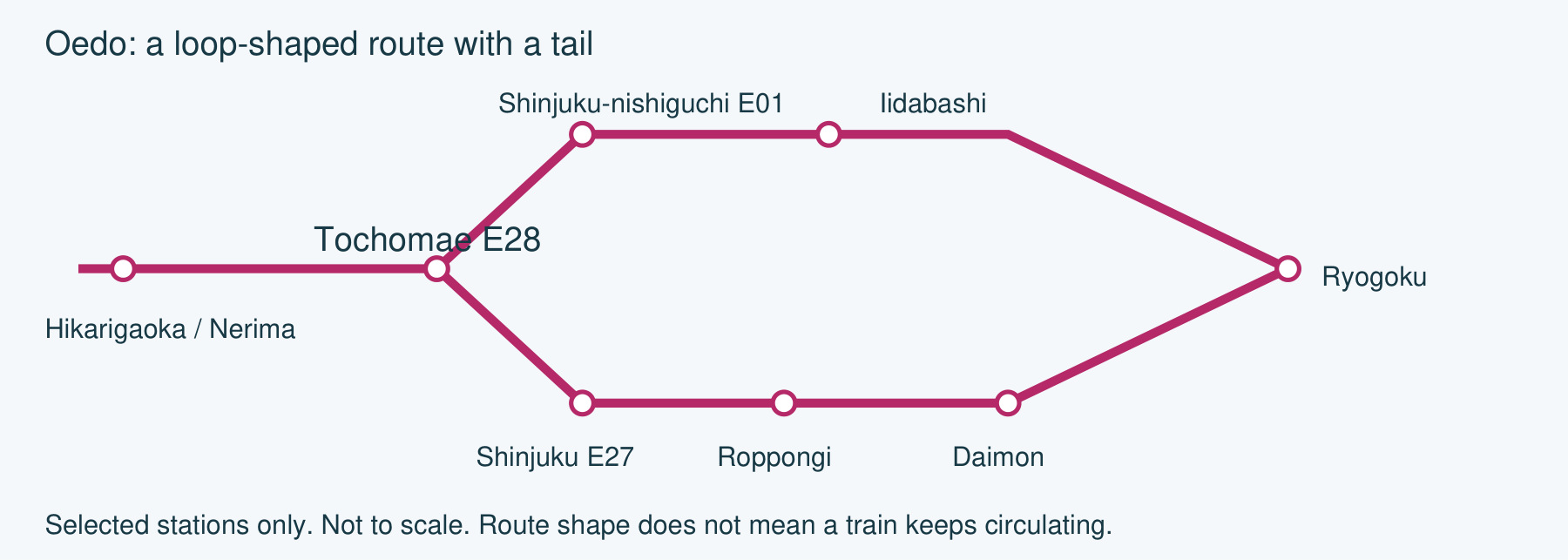
Oedo has a loop-shaped section and a tail toward Hikarigaoka; trains do not circle indefinitely. Our Metro versus Toei overview covers that network warning. For boarding, use Toei’s station sequence and the destination shown at Tochomae.
At Tochomae, read the direction names
The Tochomae timetable separates three directions:
- Nerima and Hikarigaoka
- Roppongi and Daimon
- Iidabashi and Ryogoku
Those names are more useful than a guess about clockwise or anticlockwise travel. On the station display, find the direction containing your next part of the route. Then confirm that this departure reaches your stop.
Hikarigaoka or Nerima to Iidabashi
Compare a change at Tochomae with staying on the incoming train. The shorter side of the folded route toward Iidabashi goes through Shinjuku-nishiguchi. A train coming from the Hikarigaoka tail normally proceeds from Tochomae toward Shinjuku and Roppongi, the other side of the long route. Changing at Tochomae for the Iidabashi direction avoids treating the loop as one undifferentiated ride.
This is a route-shape comparison, not a fixed connection time. Ask the planner for your actual origin and departure so you can see the transfer it proposes. Do not rush between trains because an online answer claims the change takes a universal number of seconds.
Roppongi to the Hikarigaoka side
The opposite mistake is assuming every passenger must change at Tochomae. From Roppongi, a Hikarigaoka-bound train travelling through Shinjuku can continue past Tochomae onto the tail. If the actual destination and route match your journey, remain aboard. The station name appearing twice in an explanation of the network does not create a transfer by itself.
Tochomae to Iidabashi
Use the Iidabashi/Ryogoku direction. The timetable checked for this article says its departures originate at Tochomae and use platform 2. Treat that as a way to understand the published arrangement; check the current platform board before boarding. Operational changes take priority over a saved platform number.
The same timetable includes a late train whose destination is Tochomae after the long section, explicitly without an onward Hikarigaoka connection. That is a good reason to plan the complete late-night return, rather than merely confirming that another Oedo departure exists.
Shinjuku and Shinjuku-nishiguchi are not interchangeable
Both names can look plausible when your hotel says “Shinjuku.” They are distinct station choices, with different positions on the Oedo route and different walks afterward. If the hotel’s instructions name Shinjuku-nishiguchi, do not silently replace it with Oedo Shinjuku. Likewise, a hotel route from JR Shinjuku does not start at the Oedo platform.
For a trip from Roppongi, compare the actual arrival station and hotel entrance. Oedo Shinjuku is reached before Tochomae in that direction. Reaching Shinjuku-nishiguchi by the short side involves the junction rather than simply continuing as though the next station name were another exit of Shinjuku.
Save the hotel’s station code or full station name with its access instructions. Then use the station-navigation guide to think through the platform-to-street part. A train planner’s arrival time and a hotel’s walk from an exit measure different parts of the trip.
Kuramae: one interchange label, a street-level transfer
Kuramae connects the Oedo and Asakusa lines, but the two sets of station facilities are separate. The interchange involves leaving one station section and walking at street level to the other. Read the official Kuramae station map before choosing the route with bags or in rain.
This does not mean the connection is invalid. Toei’s PASMO guide specifically addresses the outside-gate Kuramae interchange. It does mean that an interchange symbol on a map is not a promise of an indoor corridor.
The practical choice depends on what you are trying to avoid. If your priority is fewer trains and your hotel is near Kuramae itself, arriving on the appropriate line may be a good fit. If you are only using Kuramae to change between Asakusa and Oedo with heavy luggage, compare an itinerary via another interchange, such as Daimon, for your exact journey. Do not assume the alternative is always faster: its extra rail distance, direction and station movement also count.
There is no single “best carriage for Kuramae” answer covering both lines, directions, stair routes and elevator routes. First decide which platforms you are travelling between and whether stairs are acceptable. Only then use the station map to choose the relevant exit and boarding position.
Choosing an Oedo hotel base
For Roppongi, Akasaka and Azabu hotels, use the precise station in the property’s instructions. Roppongi and Azabu-juban are Oedo stations; Roppongi-itchome is a different station on the Namboku Line. A neighborhood name cannot substitute for an arrival line.
For Asakusa-area hotels, an Oedo itinerary may bring you to Kuramae rather than Asakusa. That can work for some properties, but compare the actual final walk. Do not add a transfer just to make the station name match the neighborhood if the hotel’s own access route already works from Kuramae.
For a hotel beside the western tail, consider both the outbound sightseeing trip and the evening return. A route that works neatly toward Roppongi can have a different decision at Tochomae when your destination is on the Iidabashi side. Save each direction separately.
A boarding check you can do at the platform
- Find your exact destination station on the Oedo route, including its E number.
- Read the station names in the platform direction, especially at Tochomae.
- Confirm the particular train runs far enough. A direction heading is not the final destination.
- Check any transfer and the walk at the arrival station before comparing total convenience.
The Metro versus Toei guide covers operators and ticket scope. Oedo belongs to Toei; this article’s direction advice does not make every Metro-only ticket valid on it.
Quick answers
Do I always change at Tochomae?
No. Some journeys pass through on the correct train. Others benefit from a change to reach the other side of the folded route. Use the actual origin, destination and service.
Can I stay aboard for another lap?
Do not plan that way. Trains have destinations and can terminate at Tochomae. Follow the destination display and announcements.
Is Kuramae a bad transfer?
It is a street-level transfer whose suitability depends on your journey, luggage and mobility needs. Compare it with a real alternative rather than rejecting or recommending it universally.
Research checked 11 October 2026. This is a map-and-timetable-based guide; walking times and elevator availability have not been field-tested.