Tokyo subway guide
Why Your Tokyo Train Changes Line Names Without a Transfer
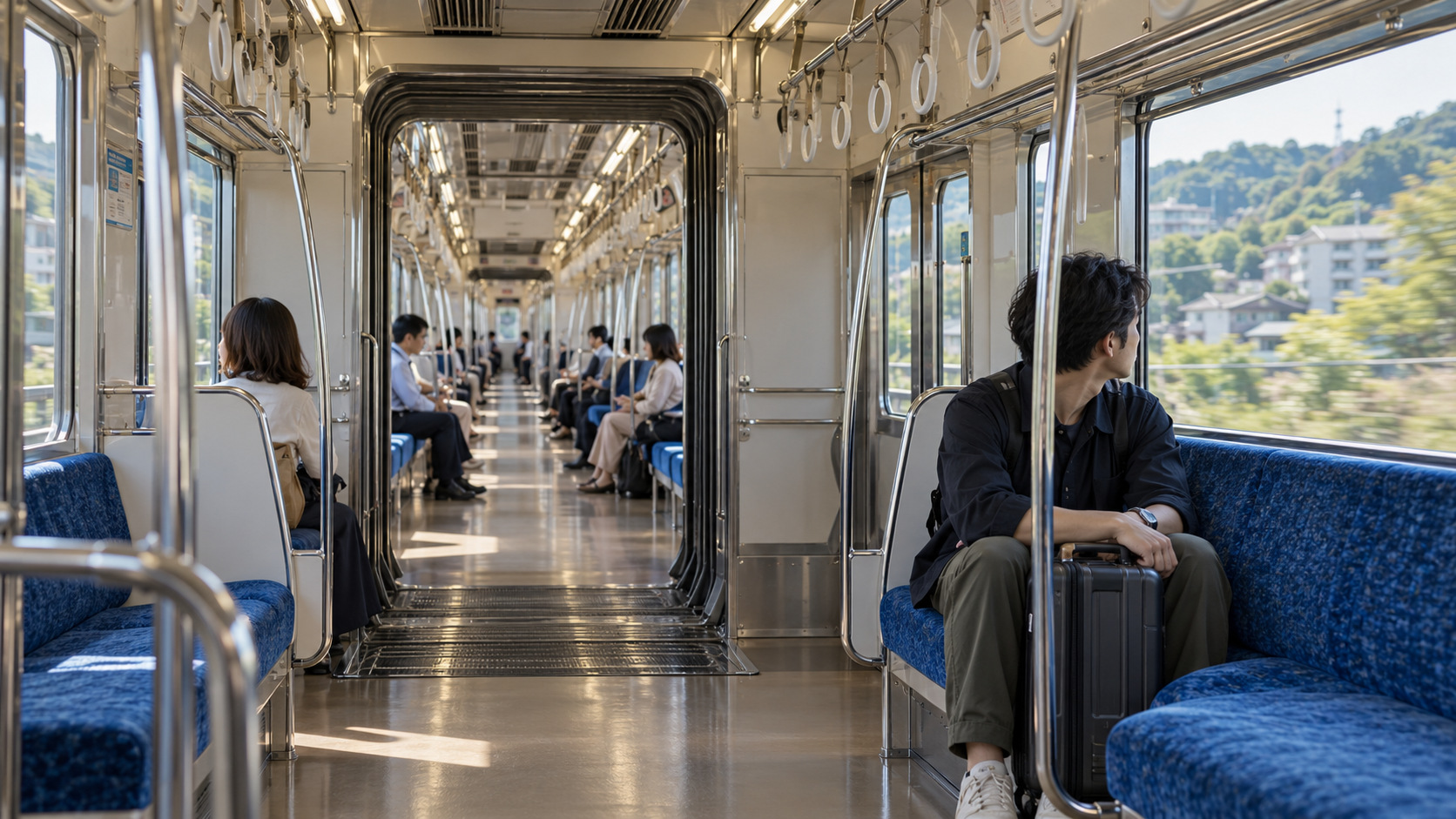
A new line name in your route does not necessarily mean a new train. If the itinerary for your departure says to remain on board, the same train can cross from Tokyo Metro onto another railway. You stay seated, but the ticket boundary still matters.
Before boarding, check the train’s final destination and its stops. A platform marked “for Shibuya” can serve both trains that finish at Shibuya and trains continuing well beyond it. The railway connection exists; that does not mean every departure uses it.
Read four things, in this order
Suppose your route runs from Ikebukuro through Shibuya toward Yokohama. Read the departure as four separate pieces:
- Departure: the particular train your route planner selected, including the correct weekday or holiday schedule.
- Train type: Local, Express or another stopping pattern. Your station must be a stop on that train.
- Destination: where this train actually finishes, not merely the direction printed above the platform.
- Boundary: the station where the line or operator changes. Check whether the itinerary says to stay aboard or change trains.
Do not use the color of the carriage as a shortcut. Tokyo Metro’s through-service network includes trains continuing onto several other operators. A vehicle can be working on a line different from its owner’s home railway.
The useful distinction is between a line boundary and a transfer. A boundary divides the railway’s operating or fare territory. A transfer is something you physically do: leave one train and board another. Sometimes both happen at the same station. Sometimes only the boundary changes.
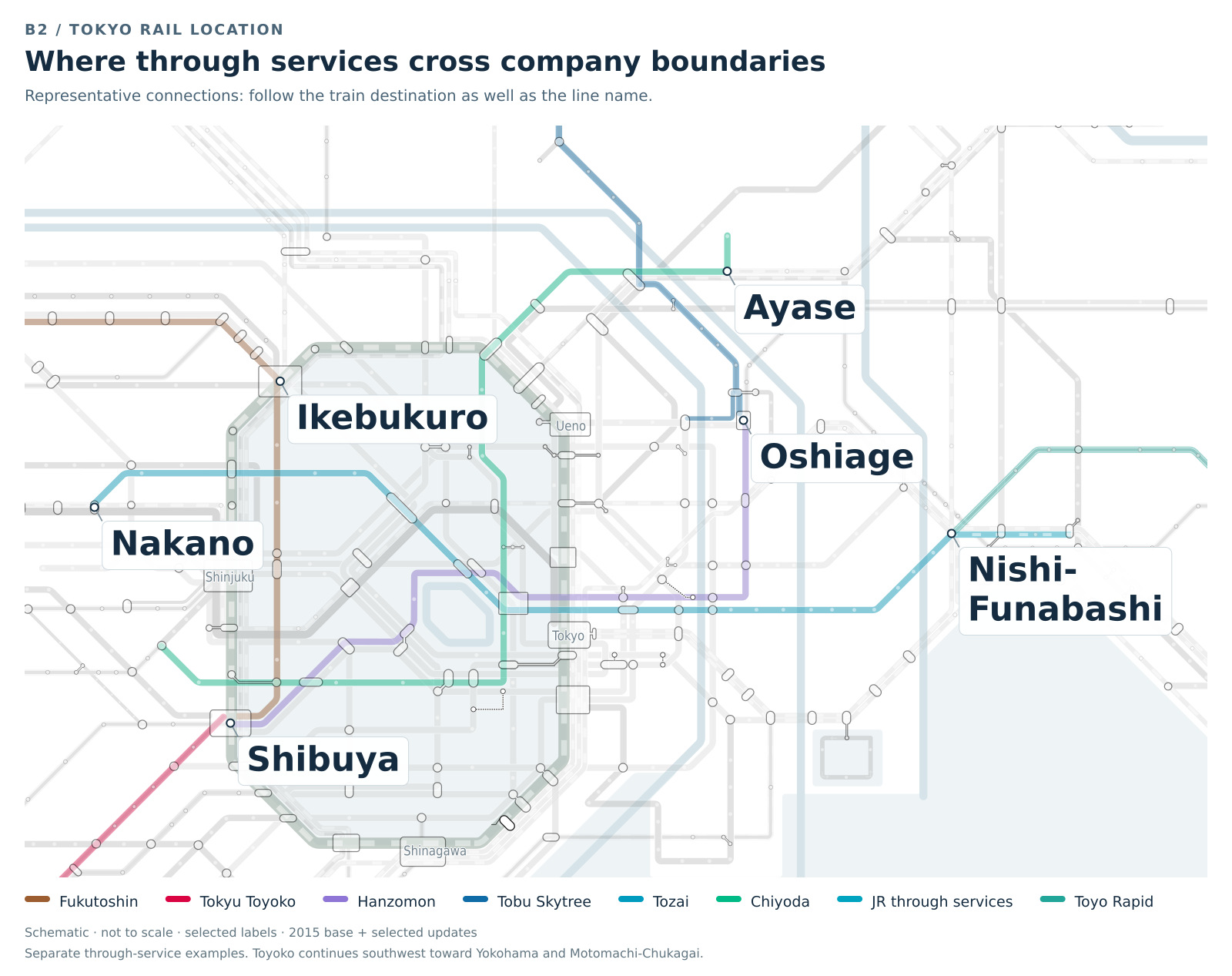
At Shibuya: Fukutoshin becomes Toyoko
The Fukutoshin Line connects with the Tokyu Toyoko Line at Shibuya. A suitable through train can carry you across that boundary without a change. A train that terminates at Shibuya cannot.
The difference is visible in the March 2026 Ikebukuro timetable. In its weekday southbound table, the 12:07 is marked for Shibuya. The 12:11 is an Express, F-Liner service with the unmarked destination, Motomachi-Chukagai. These are examples of how to read the published timetable, not a promise that those departures will operate unchanged on your travel day.
For a trip ending at Shibuya, either may be relevant. For a trip continuing toward Yokohama, the destination difference changes what you must do. Do not board the Shibuya-terminating train expecting its name to change automatically into an onward service.
Also check the intermediate stop you need. An Express can be useful for Shinjuku-sanchome but the same advice does not work for every hotel station on the Fukutoshin Line. The official stop table is the deciding source, rather than the most prominent destination on the board.
If you are returning to a Shibuya hotel, check the arrival line as well as the station name. Finishing at Shibuya on Fukutoshin/Toyoko platforms does not put you in the same place as arriving on the Ginza Line.
At Oshiage: Hanzomon becomes Tobu
A route can show Hanzomon followed by Tobu at Oshiage while telling you to stay aboard. That combination is consistent with the through-service network. You should still check that the selected departure goes beyond Oshiage.
Tokyu’s Shibuya Hanzomon-direction timetable, revised 14 March 2026, gives a useful contrast: the weekday 12:02 carries the Minami-kurihashi destination mark, while the 12:07 is unmarked, meaning Oshiage. The first is an example of an onward Tobu working; the second ends at the Metro boundary.
The red Express marking on a through working does not turn every part of the journey into an express subway ride. Use the Hanzomon station list and the actual itinerary for the section you are riding. Train-type labels can describe the service on the connected railway.
For a hotel near Suitengumae, Oshiage itself is beyond your destination. An unfamiliar final destination such as Minami-kurihashi is therefore not automatically a reason to reject the train. The question is whether it travels through and stops at your station before reaching that destination.
At Nakano, Nishi-funabashi and Ayase: the map endpoint can mislead
The Tozai network connects with JR at Nakano and Nishi-funabashi, and with Toyo Rapid Railway at Nishi-funabashi. These are different onward directions. Do not read “through service” as permission to ignore which one your train takes. For a journey wholly between Tozai stations, first solve the stopping-pattern question; east of Toyocho, a Rapid can pass hotel-area stops that a Local serves. Start with the Tozai line and stop table.
On the Chiyoda Line, Kita-ayase and a continuation toward JR stations are different choices. The current Chiyoda line information shows the Kita-ayase branch and JR connection at Ayase. If you need a JR station beyond Ayase, do not board a Kita-ayase-bound train merely because it is heading north on Chiyoda. Older online answers describing Kita-ayase only as a shuttle are not a safe guide to current departures.
These examples explain why a simplified subway map cannot answer every boarding question. It shows the network. The destination display tells you which part of that network this train is using.
Staying aboard does not extend a subway pass
The Tokyo Subway Ticket covers Tokyo Metro and Toei Subway lines. It does not become a Tokyu, Tobu, JR or Toyo pass because your train continues onto those tracks. Check how to pay for travel beyond the covered lines with station staff for the ticket medium you hold.
For a paper pass, keep it available and ask staff how to settle the uncovered section before trying to exit. Do not improvise by tapping an unrelated IC card after entering with paper: the two media do not automatically record one continuous journey together. If you plan to combine tickets, have staff confirm the method for the exact products you hold.
A regular stored-value transit IC card and a pass loaded onto an eligible PASMO are also different arrangements. Metro’s PASMO pass announcement describes automatic adjustment from the stored balance for supported passes loaded on that card. It is not a rule for holding a separate paper pass alongside an IC card. Bank-card tap-to-ride and QR tickets have their own terms.
For the broader buying decision, see our Tokyo subway ticket guide and Tokyo Metro versus Toei overview.
Check the return before leaving the hotel
Save the full station name and line for the trip back, especially when your hotel is near a smaller stop. A direct outbound ride does not prove that the next return train uses the same branch or stops at the same stations.
Before boarding home, compare the destination display with the route you saved. If the train ends early, get off when instructed and follow the current onward guidance. If through services are disrupted, a normally direct ride may need a change; use the live operator notice and station announcements rather than an old screenshot.
For luggage, a through train can remove a transfer, but it cannot remove the walk from your arrival platform to the hotel. The station-navigation guide helps with that separate part of the journey.
Quick answers
Should I get off whenever the line name changes?
No. Follow the itinerary for the actual departure. Stay aboard when it explicitly describes a through service and the train’s destination matches. Leave the train if it terminates or the current announcement tells passengers to change.
Can I choose any train on the correct line?
No. It can end before your station, take another branch or skip your stop. Read destination and stopping pattern separately.
Does a through train mean one operator’s fare?
No. Physical continuity and ticket coverage are separate. Check every operator section in the route, including any part outside your pass’s valid area.
Research checked 11 October 2026. Timetable examples explain published departure labels; confirm the schedule and service information for your own journey.