JR rail guide
Saikyo to Rinkai: Direct Trains from Shinjuku to Odaiba
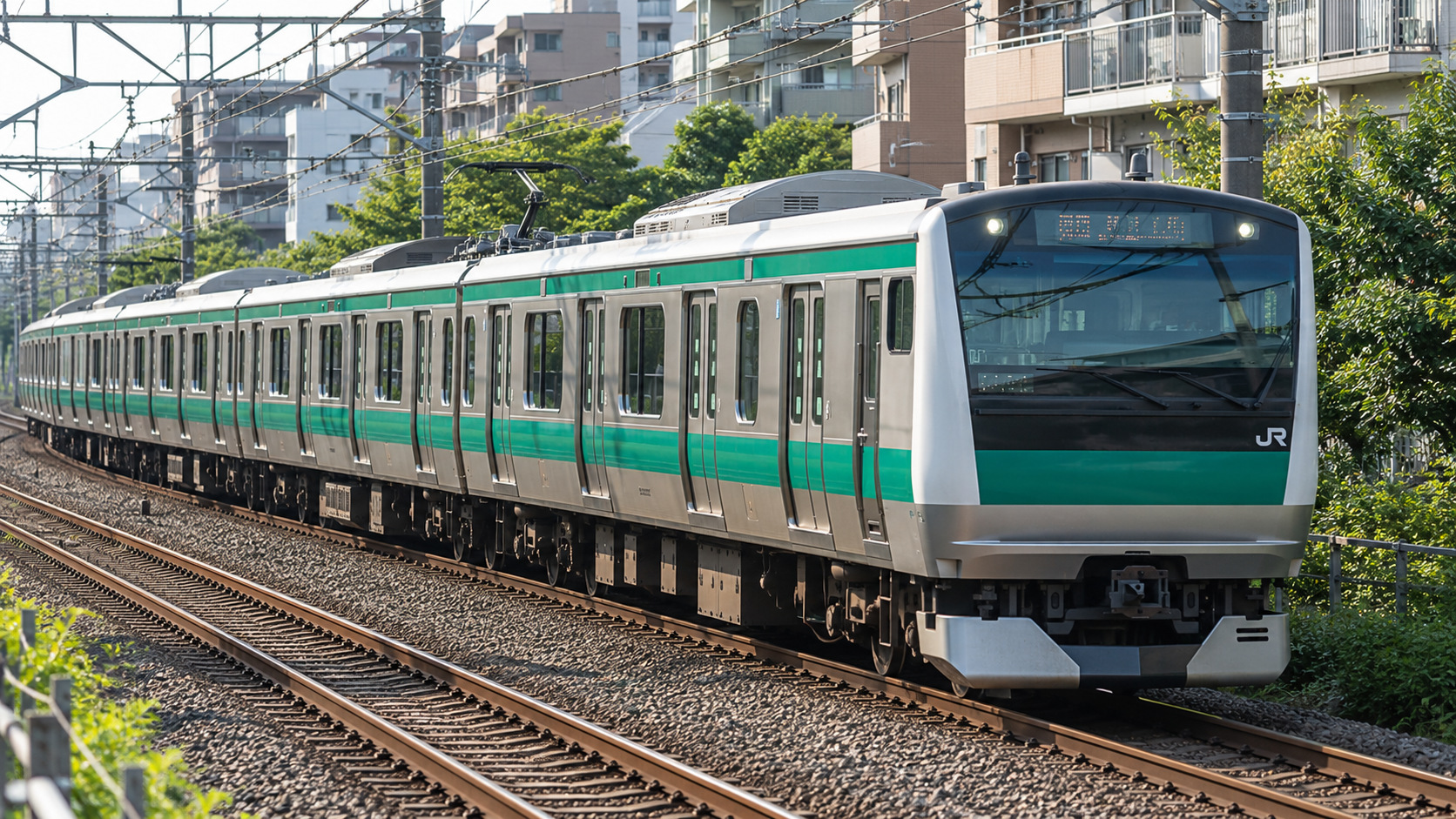
From Shinjuku, a Shin-kiba-bound Saikyo–Rinkai through train can take you to Tokyo Teleport for Odaiba without changing at Osaki. A train ending at Osaki cannot. Read the destination before boarding, then check that your chosen station is on the stopping list.
The other important detail is the fare. At Osaki the route crosses from JR to the Rinkai Line, operated by Tokyo Waterfront Area Rapid Transit. Staying on the same train does not turn the whole trip into a JR-only journey.

Three departure-board choices at Shinjuku
For a trip toward Odaiba or Ariake, look beyond “Saikyo Line.” These destination categories lead to different decisions.
- Shin-kiba: the through-service destination to look for. A suitable train continues onto Rinkai, serving Tokyo Teleport and Kokusai-tenjijo.
- Osaki: the train ends before your bay-area station. You need an onward Rinkai train toward Shin-kiba.
- A Sotetsu destination such as Ebina: a different through route toward Kanagawa. It is not a direct Odaiba train, even if it uses some of the same JR stations first.
The Rinkai operator’s Osaki guide explains the connection with Saikyo services. Sotetsu’s railway information identifies its separate JR through operation. Use the departure display’s train type, destination and stops together; carriage colour is a poor substitute.
A suitable direct train may remove one transfer, but it is not automatically the first arrival. Compare a complete route if a Shin-kiba service is not next. With luggage, avoiding an extra change may be worth a longer wait; that is a choice to make with the actual departures in front of you.
Osaki is both an interchange and an operator boundary
A direct train changes line and operator context at Osaki. Passengers for Rinkai stations can stay aboard the correct through service. If the train terminates there, leave the train and follow the Rinkai direction for Tokyo Teleport, Kokusai-tenjijo and Shin-kiba.
Don’t rely on an old platform number from a forum answer. Read the station’s current board, particularly during service disruption. A platform used by a through train at one time is not a permanent instruction for every departure or transfer.
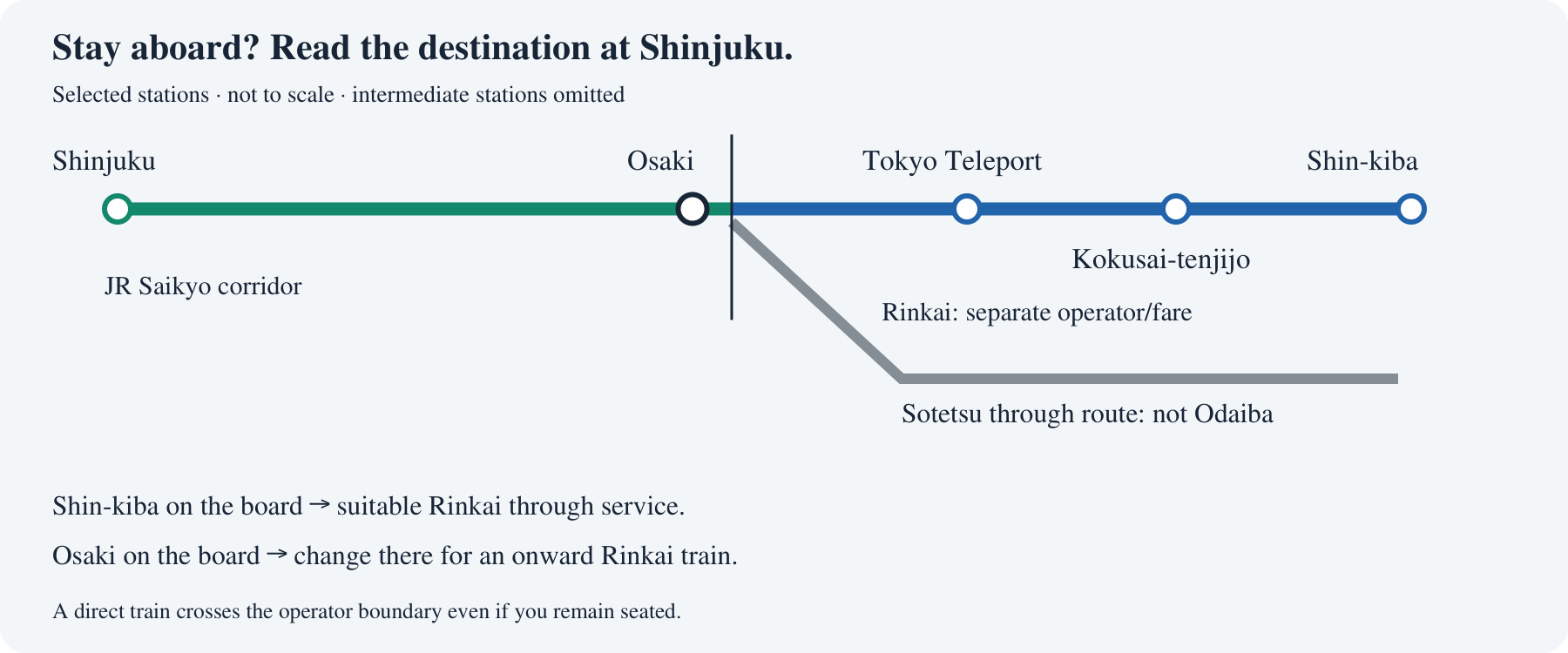
Selected stations and route choices; not every station or service is shown. The operator boundary applies whether or not you change trains.
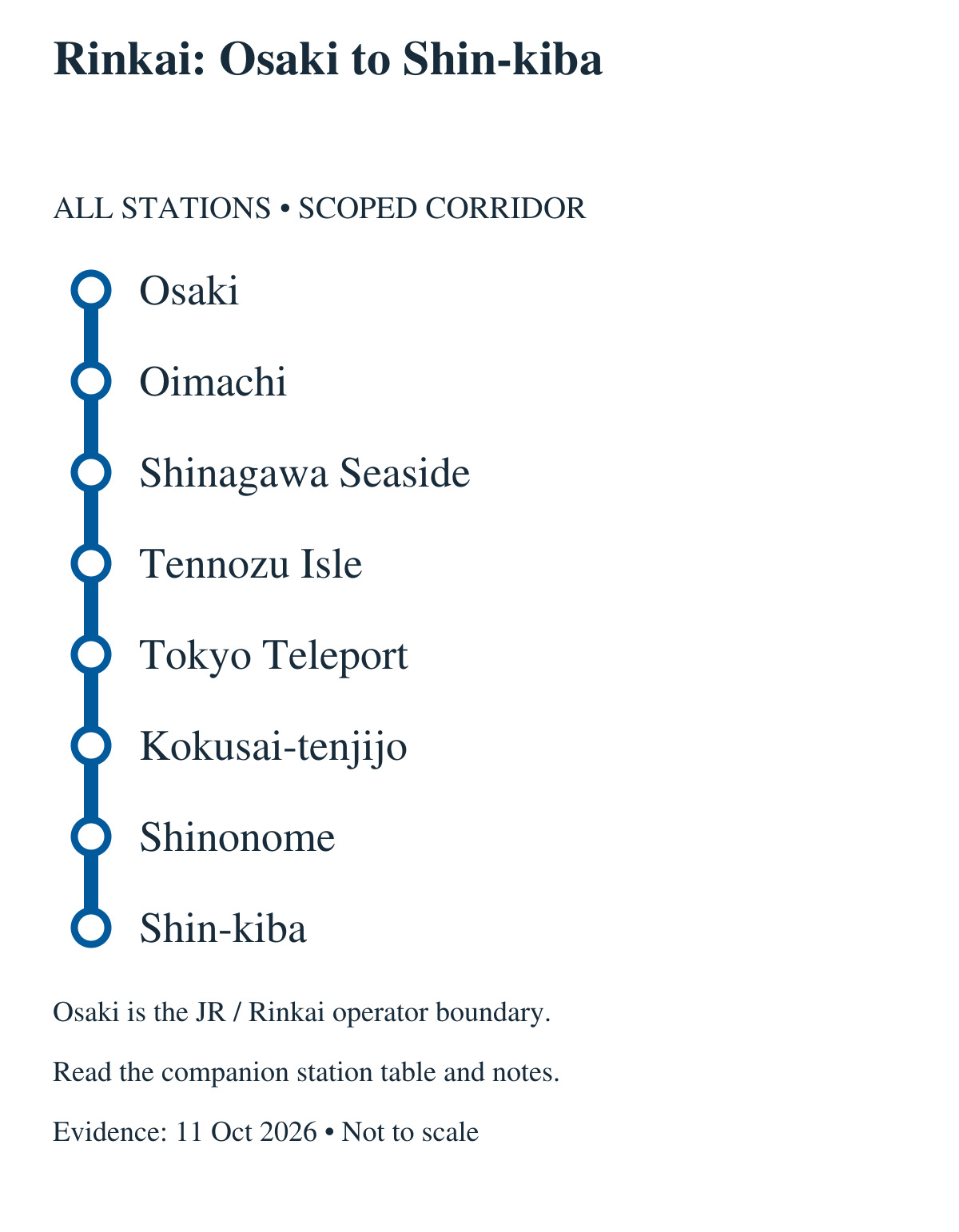
The Rinkai Line itself runs between Osaki and Shin-kiba. Its station order toward Shin-kiba is Osaki, Oimachi, Shinagawa Seaside, Tennozu Isle, Tokyo Teleport, Kokusai-tenjijo, Shinonome and Shin-kiba. This complete Rinkai list does not imply a complete list of Saikyo stops north of Osaki. Use the official Rinkai network information for station maps and current departures.
Tokyo Teleport, Kokusai-tenjijo or a Yurikamome station?
Odaiba is an area, not one station. Tokyo Teleport is the Rinkai stop commonly used for the Odaiba side. Kokusai-tenjijo serves the Ariake exhibition area. They are different stops, and neither means you have reached every waterfront attraction’s entrance.
For Tokyo Big Sight, the venue lists Kokusai-tenjijo on Rinkai and Tokyo Big Sight Station on Yurikamome as rail approaches. Check your event’s hall and entrance against the venue’s official access map. A rail arrival time is not the time you will reach registration inside a large exhibition hall.
Yurikamome and Rinkai are different systems. A hotel beside Daiba or Ariake on Yurikamome is not necessarily beside Tokyo Teleport or Kokusai-tenjijo. Before selecting a train, put the hotel’s or venue’s exact entrance into your route plan. The Odaiba hotel-area guide can help compare the broader base, while the operator and venue maps should settle the specific arrival station.
Worked trip: Shinjuku to Tokyo Teleport
Begin at the JR portion of Shinjuku Station. Follow the southbound Saikyo/Rinkai departure information, then find a Shin-kiba-bound service that lists Tokyo Teleport. Board that train and remain aboard at Osaki unless an announcement says the through service has changed. Leave at Tokyo Teleport.
If the suitable departure instead ends at Osaki, plan the second train before boarding. At Osaki, use signs and current displays to find Rinkai toward Shin-kiba. You are looking for Tokyo Teleport on its stops, not simply another train going south from central Tokyo.
On arrival, choose the exit and walking route for your actual destination. Save both that map and the return route before you leave the station. This is particularly helpful when the name on your hotel booking is “Odaiba” but the building is elsewhere in the waterfront area.
For a Shinjuku hotel base, include the initial walk to JR. If starting near Ikebukuro, the same destination check applies to southbound through services; do not assume every Saikyo departure continues to the bay.
IC cards, ordinary fares and the pass question
For an ordinary fare journey using an accepted IC card throughout, use the same card at entry and exit. Ensure it has enough balance for the whole route. The Rinkai fare page provides its current fares and IC-card information; a JR-only fare estimate is not the total for travel onto Rinkai.
Passes need to be checked by exact product name:
- Nationwide JAPAN RAIL PASS: the non-JR Rinkai section requires separate payment. Its official scope rules explain that through-running onto private railways can incur extra fares; Rinkai is not an included exception.
- JR TOKYO Wide Pass: its official coverage list explicitly includes the Rinkai Line.
- Another regional pass, day ticket or subway ticket: check that product’s coverage, rather than borrowing the rule from either pass above.
When combining a pass with a separately paid section, show the pass and explain your starting point to staff. Do not assume that tapping an IC card only at your final exit will reconstruct a pass-covered journey correctly. Ask how to settle the uncovered sector before attempting a gate arrangement you haven’t used before.
Our JR Pass guide covers the wider purchase decision; the Suica and Pasmo guide covers ordinary stored-value travel. A pass can include a line without being good value for your particular itinerary.
Northbound: the return destination matters too
At Tokyo Teleport or Kokusai-tenjijo, choose the direction toward Osaki for central Tokyo. A through service may continue to Shinjuku, Ikebukuro, Omiya or Kawagoe, but some services end earlier. Check that your station appears, not just that the train is on the right side of the platform.
If you want Kawagoe, do not treat Omiya as an equivalent terminus. A Kawagoe-bound through service can be useful, while an Omiya-bound journey needs an onward connection. Once at Kawagoe, the rail segment is only part of a town visit; plan the route from that station to your destination separately.
For an evening event, check the final workable itinerary all the way home. Direct through services can stop operating before the last train on an individual section. A saved outbound itinerary is not evidence that the reverse direct train will exist late at night.
What changes during disruption?
Through-running can be suspended while trains still operate within the Rinkai Line. The operator’s service-information page explicitly distinguishes this situation. It may mean a change at Osaki rather than a complete absence of trains, but check the live instructions before travelling.
Do not promise yourself that another JR service beside it will be unaffected. Ask station staff about the currently available route and any ticket treatment before leaving for an alternative operator.
Quick answers
Do I always need to change at Osaki?
No. Stay aboard a suitable Shin-kiba-bound through service. Change if your train ends at Osaki or the current operating plan requires it.
Is Rinkai part of JR because a JR train runs on it?
No. The train’s through operation does not change the operator boundary or your ticket’s coverage.
Is Kokusai-tenjijo the same as Tokyo Big Sight Station?
No. Kokusai-tenjijo is on Rinkai; Tokyo Big Sight Station is on Yurikamome. Both are listed by the venue as approaches, with different onward walks.
Service, venue and pass sources checked 11 October 2026. Recheck the exact pass and travel-date service before departure.
All stations within this guide route scope
Evidence checked: 11 October 2026. All 19 Saikyo service-corridor stations Osaki–Omiya, the 6-station Kawagoe continuation Omiya–Kawagoe and all 8 Rinkai stations Osaki–Shin-kiba.
Original editorial diagrams; station order is factual, not to scale. No source artwork or departure-time table reproduced. Circles indicate inventory, not a universal stopping pattern. Read the service notes and station tables together with the panels.
Service and scope notes
- Osaki is the JR/Rinkai operator boundary. A suitable through train continues; other departures terminate. A line on this diagram is not a guarantee of through service or pass validity.
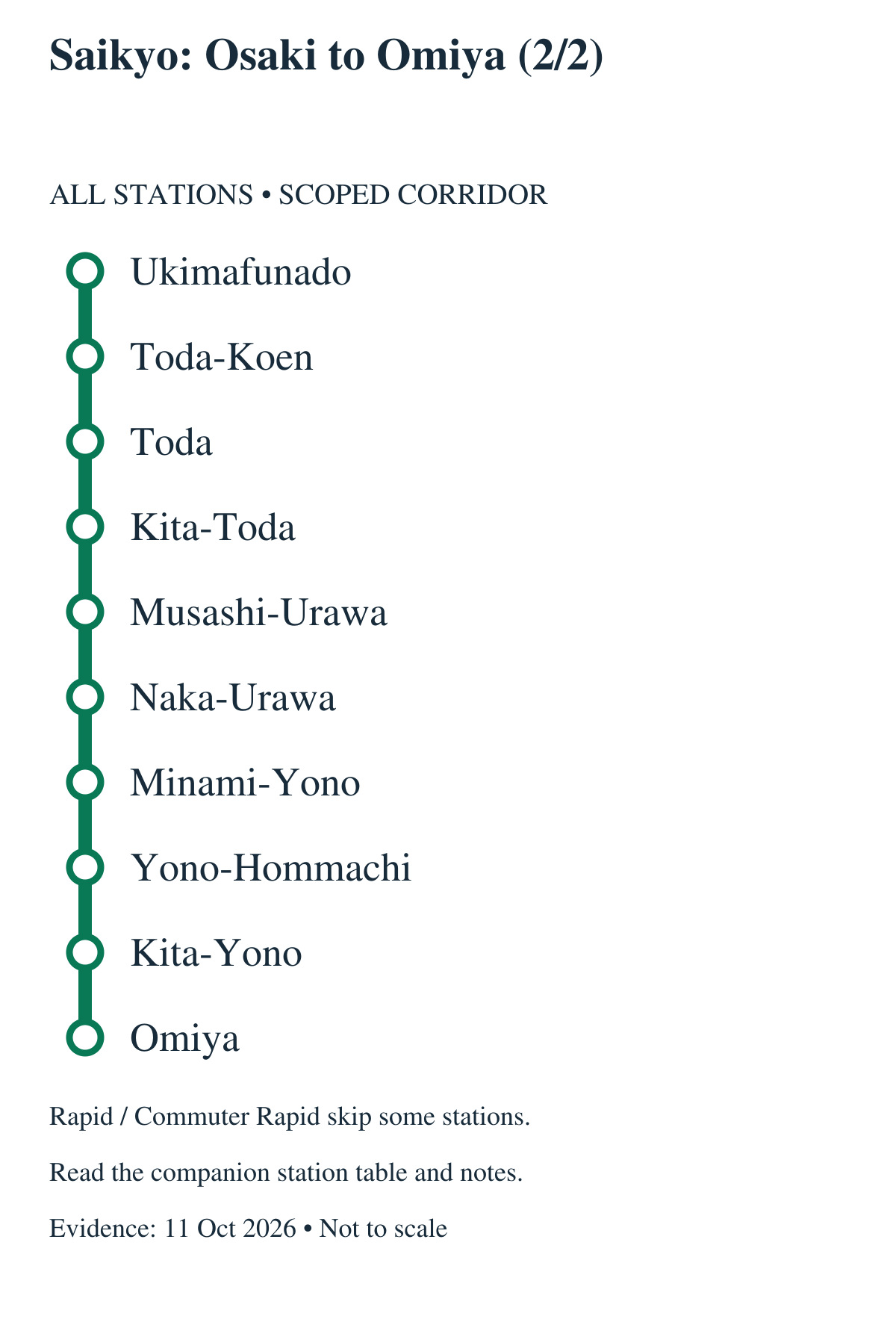
- Saikyo Local serves every shown station along its operated section. Rapid and Commuter Rapid skip stations north of Akabane; consult the actual stopping list. The October grid separately verifies the four Rapid-skipped stations Kita-Akabane, Ukimafunado, Toda and Kita-Toda rather than omitting them from the map.
- Rinkai trains call at its eight stations even when a through train has a Rapid label for the JR section. Stops and service changes must still be checked for the travel date.
- Sotetsu-bound JR through trains follow a different route after Osaki. The Sotetsu route and Kawagoe Line west of Kawagoe are outside this map.
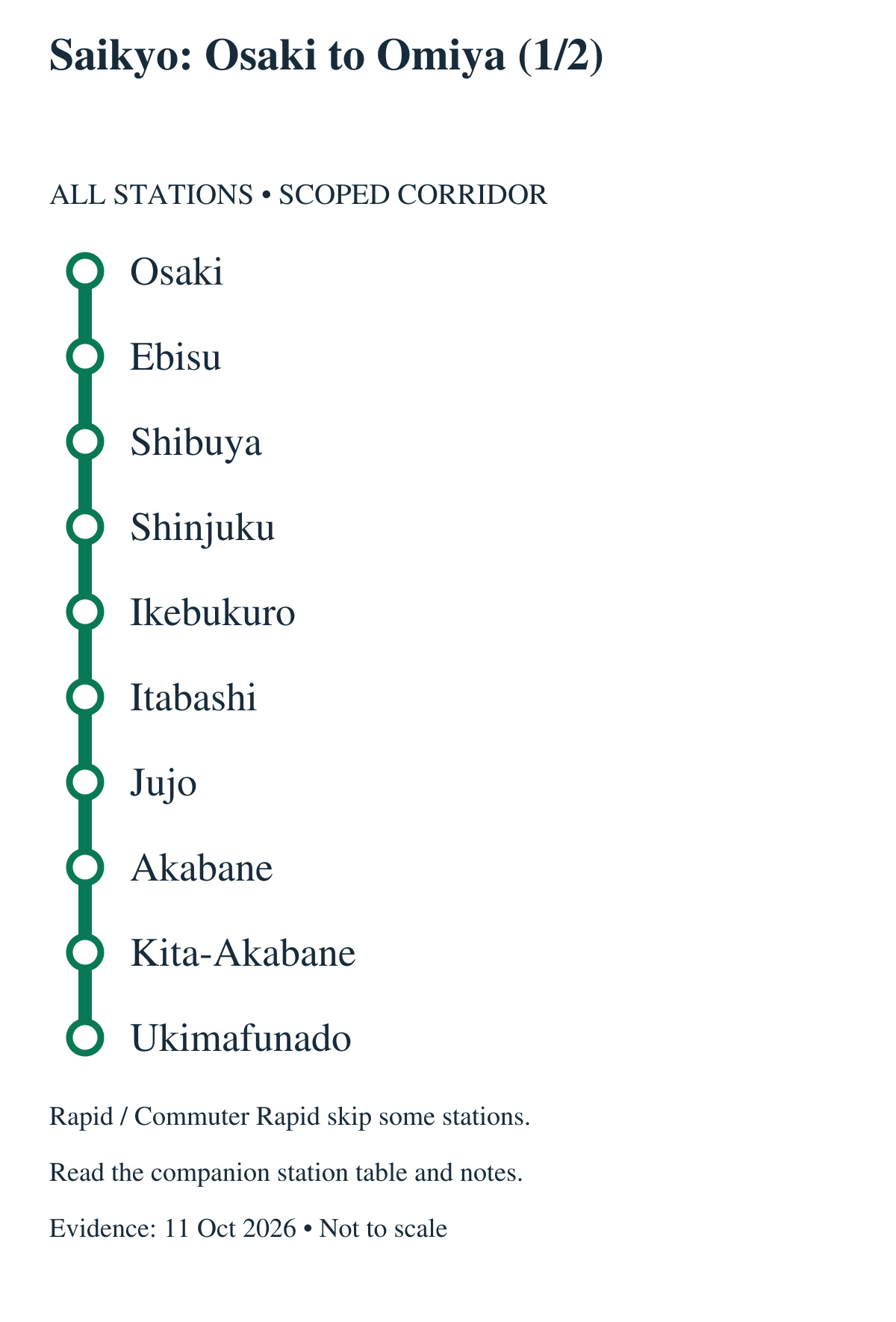
Saikyo: Osaki to Omiya
19 stations, in order. Rapid / Commuter Rapid skip some stations.
| Order | Station | Japanese | Note |
|---|---|---|---|
| 1 | Osaki | 大崎 | Station in scoped inventory |
| 2 | Ebisu | 恵比寿 | Station in scoped inventory |
| 3 | Shibuya | 渋谷 | Station in scoped inventory |
| 4 | Shinjuku | 新宿 | Station in scoped inventory |
| 5 | Ikebukuro | 池袋 | Station in scoped inventory |
| 6 | Itabashi | 板橋 | Station in scoped inventory |
| 7 | Jujo | 十条 | Station in scoped inventory |
| 8 | Akabane | 赤羽 | Station in scoped inventory |
| 9 | Kita-Akabane | 北赤羽 | Station in scoped inventory |
| 10 | Ukimafunado | 浮間舟渡 | Station in scoped inventory |
| 11 | Toda-Koen | 戸田公園 | Station in scoped inventory |
| 12 | Toda | 戸田 | Station in scoped inventory |
| 13 | Kita-Toda | 北戸田 | Station in scoped inventory |
| 14 | Musashi-Urawa | 武蔵浦和 | Station in scoped inventory |
| 15 | Naka-Urawa | 中浦和 | Station in scoped inventory |
| 16 | Minami-Yono | 南与野 | Station in scoped inventory |
| 17 | Yono-Hommachi | 与野本町 | Station in scoped inventory |
| 18 | Kita-Yono | 北与野 | Station in scoped inventory |
| 19 | Omiya | 大宮 | Station in scoped inventory |
Sources: JR East October 2026 Saikyo timetable.
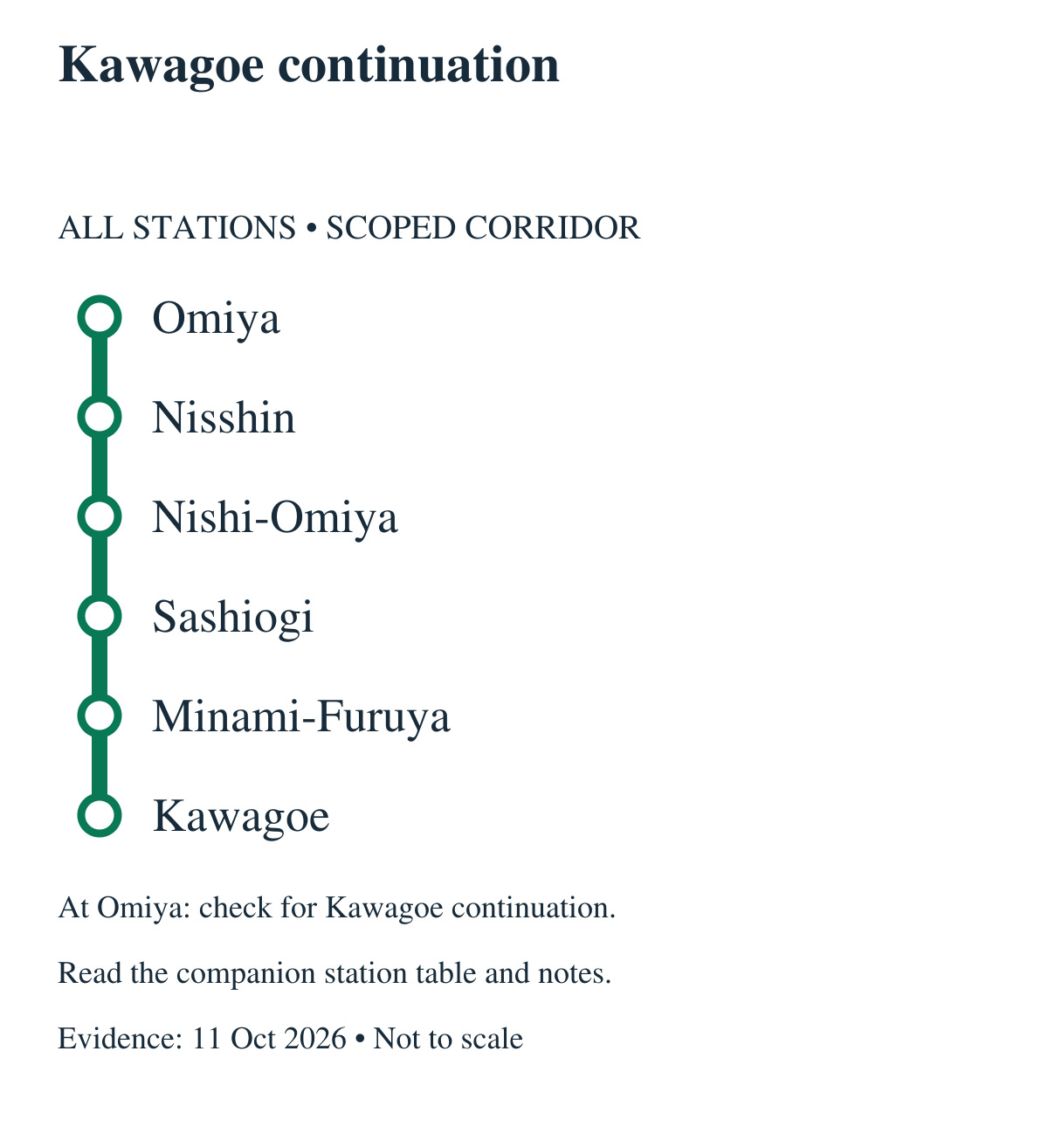
Kawagoe continuation
6 stations, in order. At Omiya: check for Kawagoe continuation.
| Order | Station | Japanese | Note |
|---|---|---|---|
| 1 | Omiya | 大宮 | Station in scoped inventory |
| 2 | Nisshin | 日進 | Station in scoped inventory |
| 3 | Nishi-Omiya | 西大宮 | Station in scoped inventory |
| 4 | Sashiogi | 指扇 | Station in scoped inventory |
| 5 | Minami-Furuya | 南古谷 | Station in scoped inventory |
| 6 | Kawagoe | 川越 | Station in scoped inventory |
Sources: JR East October 2026 Saikyo timetable; JR East Saikyo Rapid train timetable.
Rinkai: Osaki to Shin-kiba
8 stations, in order. Osaki is the JR / Rinkai operator boundary.
| Order | Station | Japanese | Note |
|---|---|---|---|
| 1 | Osaki | 大崎 | Station in scoped inventory |
| 2 | Oimachi | 大井町 | Station in scoped inventory |
| 3 | Shinagawa Seaside | 品川シーサイド | Station in scoped inventory |
| 4 | Tennozu Isle | 天王洲アイル | Station in scoped inventory |
| 5 | Tokyo Teleport | 東京テレポート | Station in scoped inventory |
| 6 | Kokusai-tenjijo | 国際展示場 | Station in scoped inventory |
| 7 | Shinonome | 東雲 | Station in scoped inventory |
| 8 | Shin-kiba | 新木場 | Station in scoped inventory |
Sources: Tokyo Waterfront Area Rapid Transit route map; JR East Saikyo Rapid train timetable.