Tokyo subway guide
Fukutoshin Line: Will This Train Stop at Your Hotel Station?
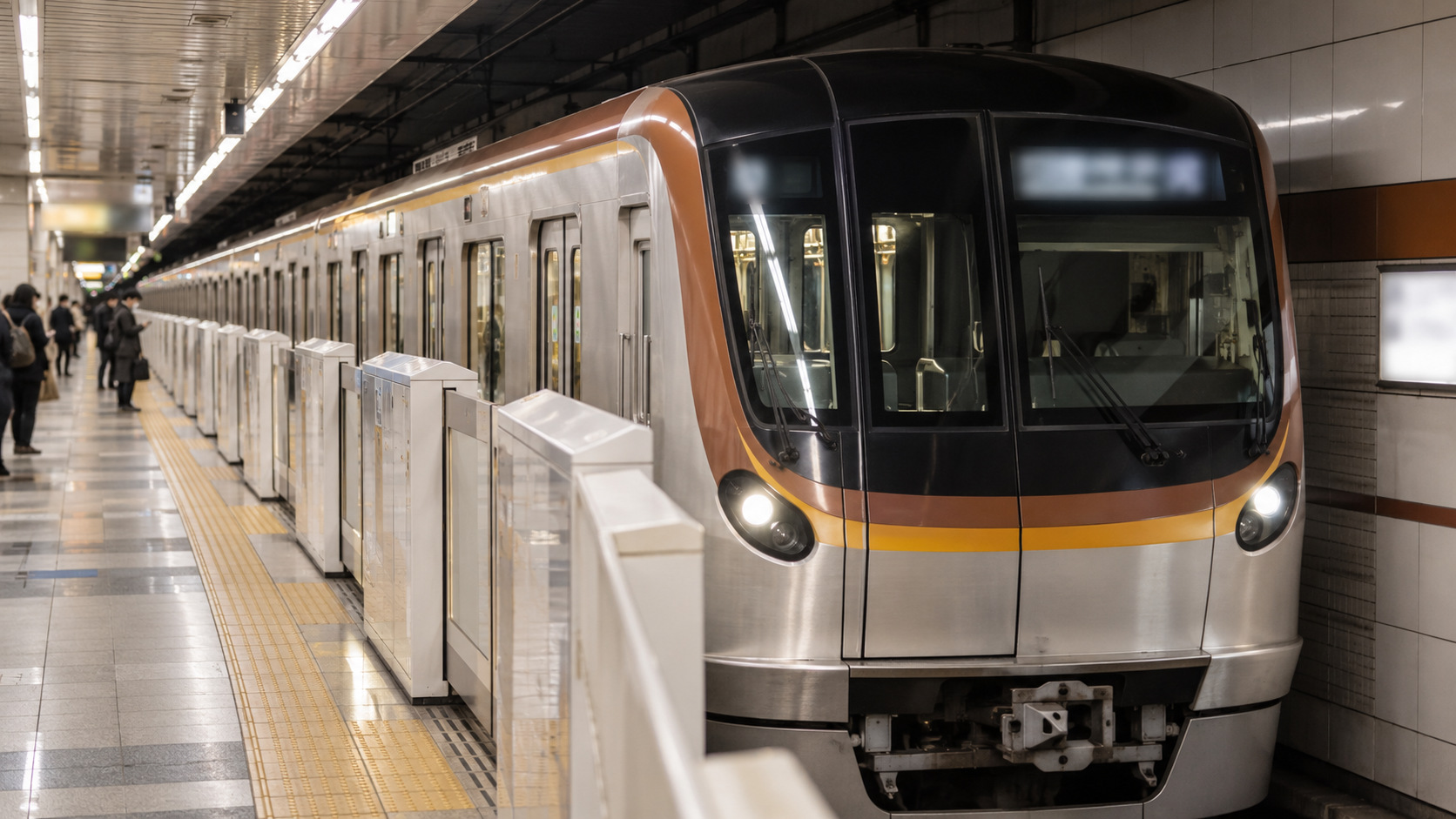
On the Fukutoshin line, check the stopping pattern and the final destination separately. An Express can pass your hotel station even while travelling in the right direction. A Local can serve every stop on its route but finish at Shibuya instead of continuing toward Yokohama.
For Higashi-shinjuku or Kita-sando, choose a Local that reaches your station. For an onward trip beyond Shibuya, check that the train actually continues onto the Tokyu Toyoko line. These two checks prevent different mistakes.
Start with the exact station, not “Shinjuku”
The Fukutoshin line serves Shinjuku-sanchome and Higashi-shinjuku. It does not serve JR Shinjuku station. The difference matters when a hotel description gives the neighborhood more prominence than its recommended station.
For example, Sotetsu Fresa Inn Higashi Shinjuku’s access page places the property beside Higashi-shinjuku exit B2. That makes Higashi-shinjuku a meaningful arrival target. Choosing a train because it stops at Shinjuku-sanchome would leave a different final journey.
A hotel’s exit-to-door description also does not measure the walk from your train. Keep the exit reference, then check the station’s signed route from the arrival platform. With a large suitcase or step-free access needs, consult the Higashi-shinjuku accessibility guide rather than assuming the shortest exit route is the appropriate one.
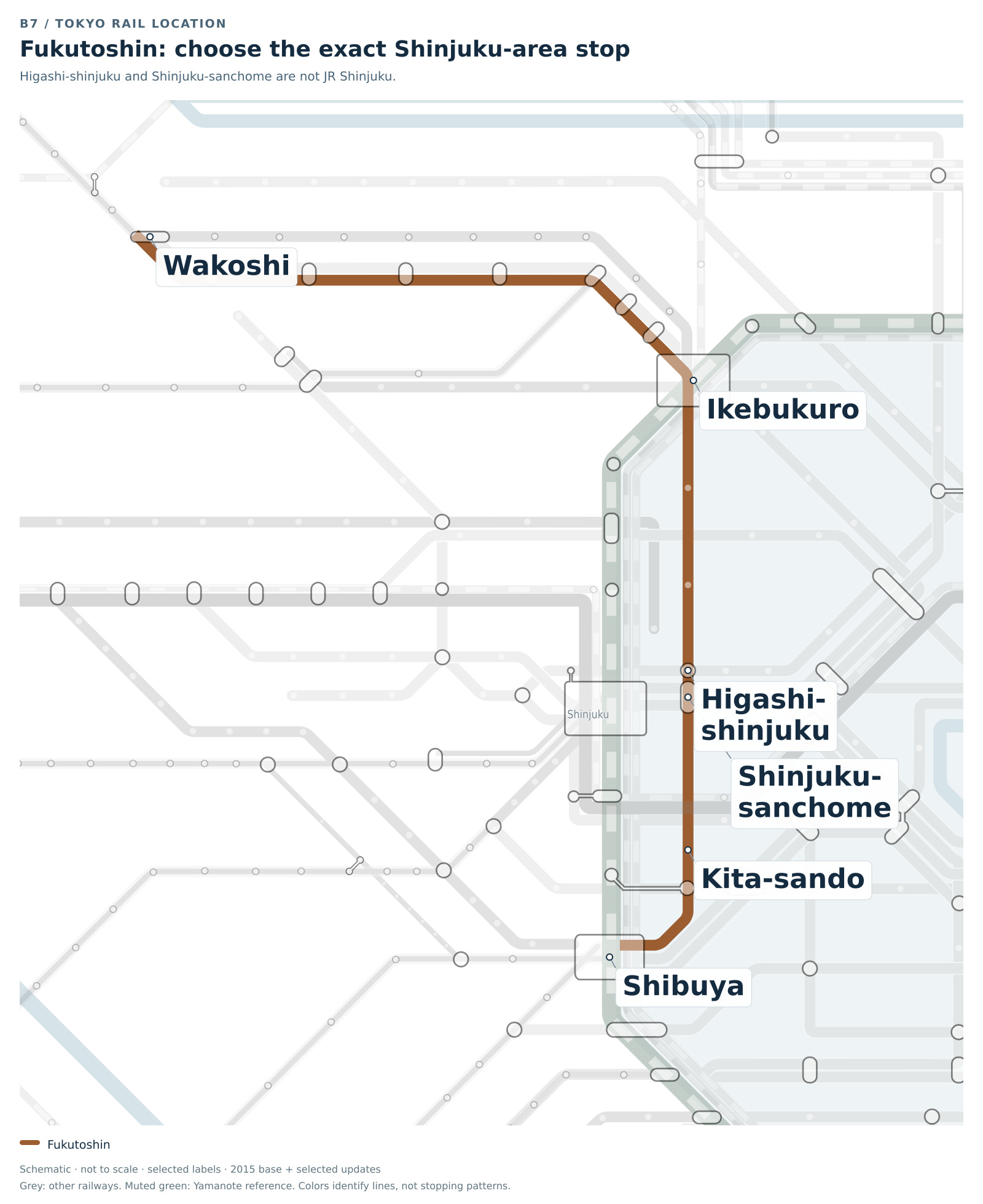
Local, Express and Commuter Express
Tokyo Metro’s official Fukutoshin stopping table distinguishes three ordinary service patterns:
- Local: calls at every station along the route it operates.
- Express: serves Wakoshi, Kotake-mukaihara, Ikebukuro, Shinjuku-sanchome, Meiji-jingumae and Shibuya.
- Commuter Express: adds the stations between Wakoshi and Kotake-mukaihara, but has the same stops as the Express between Kotake-mukaihara and Shibuya.
Higashi-shinjuku and Kita-sando are Local stops. So are Senkawa, Kanamecho, Zoshigaya and Nishi-waseda. Neither “Express” nor “Commuter Express” is a safe default for those stations.
The useful habit is to check your station on the departure’s stop list. Memorizing every station is unnecessary. A destination such as Motomachi-Chukagai tells you where the train finishes, not whether it calls at the smaller station you need along the way.
Worked example: Ikebukuro to a Higashi-shinjuku hotel
Tokyo Metro’s Ikebukuro timetable, revised in March 2026, shows a weekday southbound Local at 12:02 and an Express F-Liner at 12:11. Both are shown for Motomachi-Chukagai through the timetable’s destination legend.
If your destination is Higashi-shinjuku, the Local serves it. The later Express does not. “They both go to Yokohama” would therefore be the wrong basis for choosing between them.
This example is a reading exercise, not a claim about which departure you should catch on your travel date. Check the live board and journey planner. If an app recommends an Express followed by a Local connection, weigh the transfer against staying on a suitable Local, especially on an arrival day with luggage. A small scheduled saving may be less useful than avoiding a platform change and an extra departure to identify.
If you have already boarded the wrong Express
Suppose you leave Ikebukuro on an Express intending to get off at Higashi-shinjuku. Once you recognize the mistake, do not expect the train to stop there because the station name appears on the line map. Check the next stop and replan from it.
In normal operation the next Express stop south of Ikebukuro is Shinjuku-sanchome. From there, a northbound Local can take you back to Higashi-shinjuku. Follow the station’s signs for the opposite direction, then confirm “Local” on the departure. If you are unsure how to change platforms, show staff your intended station before leaving the paid area.
The same principle works for Kita-sando: identify a stopping service rather than repeatedly boarding the next train with the right line color.
Shibuya: a line boundary is not always a transfer
The Fukutoshin and Tokyu Toyoko lines connect at Shibuya. On a through service, you stay on the same train as its line name changes. You do not need to walk to a second platform just because a journey planner displays two line names.
But some trains finish at Shibuya. The same March 2026 Ikebukuro timetable includes a weekday 12:07 Local marked for Shibuya, between departures that continue farther south. A Local label does not promise a through journey.
For a trip toward Yokohama, check three things before boarding:
- Does the train continue beyond Shibuya?
- Does its route lead to your intended destination?
- Does its stopping pattern serve the particular station you need?
Do not treat “beyond Shibuya” as synonymous with “Yokohama station.” The connected network has more than one onward route. Use the specific departure’s destination and stop list instead of inferring the journey from the operator logo on the carriage.
Our Shibuya hotel-base guide is useful if Shibuya is your destination rather than a line boundary. For the walk out of the station, save the hotel’s recommended exit before arrival; a through train’s operational convenience does not shorten the passage to street level.
Returning from Yokohama: plan the hotel stop again
A successful outward trip does not establish that every return train will reverse the same journey. A northbound Toyoko service can terminate at Shibuya; another can continue onto the Fukutoshin line. A through service can then run Express through a station where your hotel requires a Local.
For a Higashi-shinjuku hotel, search all the way to Higashi-shinjuku, not just to Shibuya. If the proposed train ends at Shibuya, follow the onward Fukutoshin departure information. If it continues as an Express, follow the planned Local connection and verify that the next train calls at Higashi-shinjuku.
This is also why saving only a screenshot of the outbound train is a weak return plan. Save the hotel station and exit, then check a current route for the time you actually leave. Do not assume a late-evening connection will match a midday example.
F-Liner and S-TRAIN are different products
F-Liner is the name applied to certain faster through services. It is not a reserved-seat upgrade: Tokyo Metro’s Fukutoshin service brochure explains that no additional F-Liner charge applies. You still need a valid fare or ticket for the full route you travel.
S-TRAIN is a separate, paid, reserved-seat service with its own stops and operating arrangements. Tokyo Metro’s current S-TRAIN guide says the separate reserved-seat ticket is needed before boarding. Do not use the ordinary Express stopping list above to decide where an S-TRAIN will call.
If all you want is a routine Local trip back to your hotel, you do not need to turn a named premium service into part of the plan.
Your subway pass does not expand with the train
The Tokyo Subway Ticket covers Tokyo Metro and Toei subway lines. An onward trip over Tokyu or Yokohama Minatomirai Railway tracks is outside that coverage, even if you remain seated throughout Shibuya.
Check the additional fare and your ticket’s handling instructions before the trip, or ask staff. Our Metro versus Toei guide explains the network distinction; the station-navigation guide helps with the platform and exit signs along the way.
Quick questions
Does a Fukutoshin Express stop at Higashi-shinjuku or Kita-sando? No. Choose a suitable Local or follow a checked connection to one.
Do I always change trains at Shibuya? No. Stay aboard a through service when it is the correct train for your destination; change if your train terminates there or your route requires it.
Can I use a train for Motomachi-Chukagai to reach Shinjuku-sanchome? A suitable southbound Fukutoshin service can serve Shinjuku-sanchome on the way. Check the specific stop list rather than being put off by the distant endpoint.
Does F-Liner mean I need a reservation? No. S-TRAIN is the separate reserved-seat service. In either case, ensure your ticket covers the route and any applicable service requirements.