Tokyo subway guide
Tokyo Subway Transfers Outside the Gates When Your Fare Continues
By Coverstories Editorial
At five designated Tokyo Metro interchanges, the useful question is which gate and connecting line to use. A qualifying change within 60 minutes can continue the Metro fare: keep an ordinary paper ticket from the orange transfer gate, or use the same Suica or PASMO for both taps. Check the official designated list. For the general station and fare-gate overview, see our station navigation guide.
The important word is designated. A nearby station, a shared neighborhood name, or a walking connection shown on your phone does not automatically make two rides one fare.
This guide covers pay-as-you-go transport IC cards and ordinary paper tickets. A bank card tapped directly at the gate uses a different service; see the bank-card note below. Rules checked October 12, 2026, Japan time.
Before you walk through the gate
Check these four things while you can still ask the station attendant:
- The next line and operator. “Yurakucho Line” tells you more than “Yurakucho.” Write down the line, station and destination direction from your route.
- The interchange pair. Compare both station names with Metro’s designated transfer list. Different names can be valid; similar names can still mean different journeys.
- Your ticket medium. Paper-ticket passengers need the orange transfer gate for an outside-gate Metro-to-Metro change. With an IC card, use the same card at both gates and follow the signs for the designated interchange; ask staff if the correct gate is unclear. Tokyo Metro transfer-time guide
- Your next entry time. Think of the deadline as getting through the connecting line’s entrance gate, not reaching its platform. Set a reminder if you are likely to lose track of time.
Follow signs for the connecting line rather than the exit nearest your hotel. For help distinguishing concourses, exits and platforms, use our Tokyo station navigation guide.
Paper tickets and IC cards behave differently
With a regular paper ticket
For an eligible Metro-to-Metro transfer, insert the ticket into an orange transfer gate and take it back. Keep it for the next entrance gate. The ticket must cover the fare as far as the interchange; if it does not, settle the difference before leaving. Metro’s ordinary-ticket rules allow continuation only through the specified interchanges and within the transfer window. Ordinary ticket conditions
If the gate keeps your ticket when you expected to transfer, stop and speak to staff. Show the route you intended to take. Do not buy another ticket first and assume a refund will be available later.
With Suica or PASMO
Tap out and tap into the connecting line with the same transport IC card. You do not need to buy a paper transfer ticket. At the designated interchange, Tokyo Metro says that taking more than 60 minutes ends the through-fare calculation and starts a new fare. The orange-gate instruction in its guide is stated for paper tickets; follow the current station signs or ask staff which IC gate to use. Tokyo Metro transfer-time guide
Keep enough balance to exit at the transfer station. If the balance is short, use the adjustment or charging facilities rather than switching payment methods halfway through. Metro PASMO guidance
A fare appearing when you tap out is not, by itself, proof that the transfer has failed. Judge the completed journey, including its later charge, rather than adding the standalone fares for two separately searched rides. That distinction is why a route app can show a lower total than your own two-ticket calculation. Toei explains that eligible interoperator discounts are applied at the destination. Toei IC transfer guidance
Five interchanges where the names or gates can mislead you
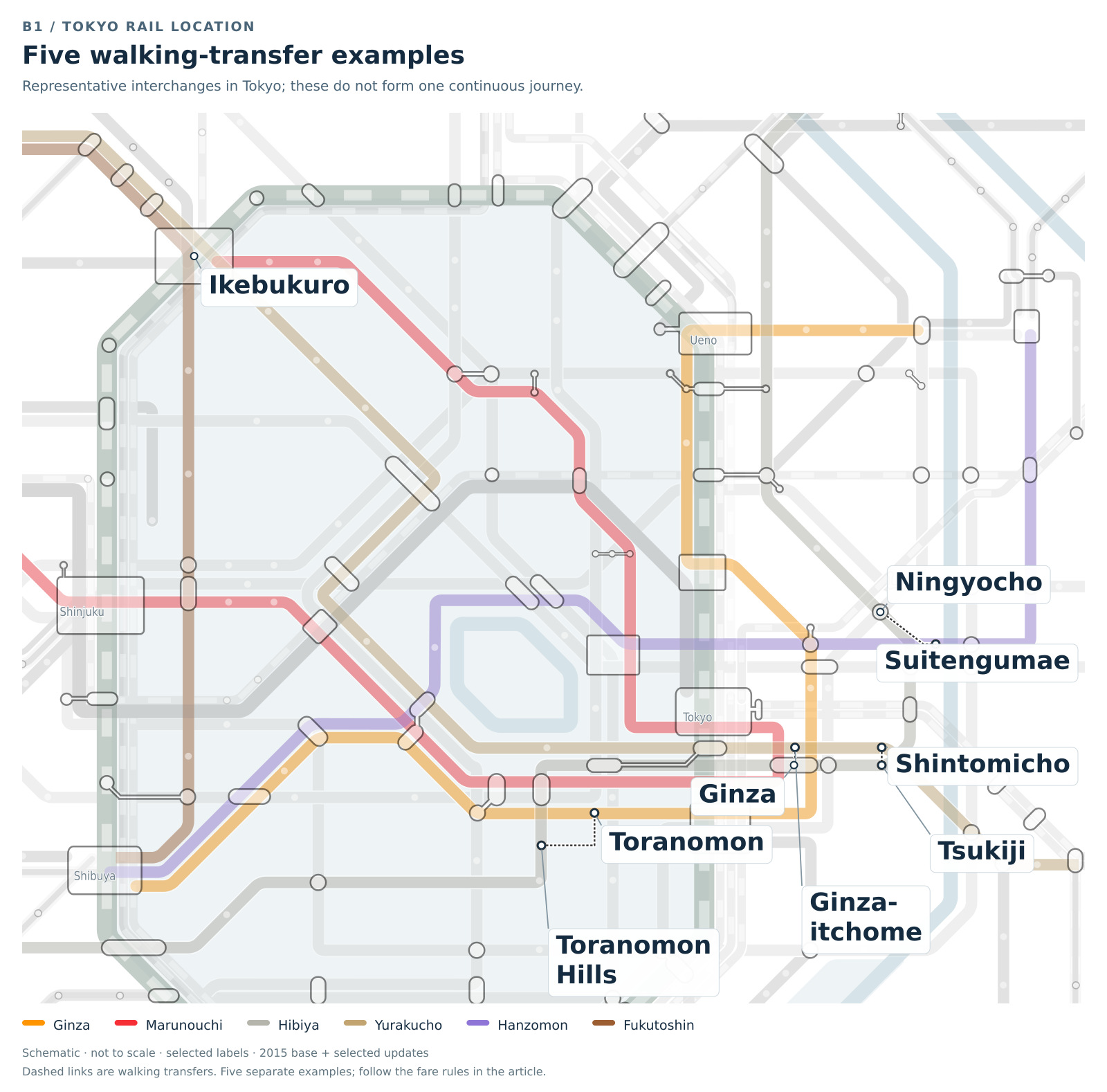
These are selected examples, not a replacement for the full official list. The scenario times below are illustrations of the rule, not measured walking times.
Ginza to Ginza-itchome
Ginza serves the Ginza, Marunouchi and Hibiya lines; Ginza-itchome supplies the Yurakucho Line connection. Tokyo Metro identifies the two as a transfer pair. Tokyo Metro’s designated transfer list
Suppose your route changes from the Ginza Line to the Yurakucho Line here. Exiting Ginza at 10:00 and entering Ginza-itchome at 10:15 fits the transfer window. Both taps belong to the specified change. Walking to whichever station looks closest on the street is not an equivalent test.
For a hotel stay, choose your departure station before leaving the lobby. You may avoid a transfer altogether by walking directly to the line you need. Our Ginza hotel base guide helps place the surrounding stations in the context of where you stay.
Ningyocho to Suitengumae
This is the Hibiya-to-Hanzomon Metro connection. Ningyocho also connects with the Toei Asakusa Line, so “change at Ningyocho” is incomplete information: check the line name. Ningyocho station connections
If your itinerary says Suitengumae, follow that station name and the Hanzomon Line signs. Entering the Asakusa Line instead changes the operator and the fare calculation. When comparing nearby hotels, the Hamacho and Ningyocho base guide is the more useful next step than memorizing every exit.
Tsukiji to Shintomicho
The designated pair joins the Hibiya Line at Tsukiji with the Yurakucho Line at Shintomicho. Tsukiji’s official connecting-station information
A market visit and a transfer are different itinerary decisions. If you plan to eat and browse, price the onward ride as a new journey rather than building the day around an expiring transfer allowance. This is particularly sensible when a queue could consume the time you expected to use for walking.
Toranomon to Toranomon Hills
Toranomon is the Ginza Line station; Toranomon Hills is the Hibiya Line station. The operator lists them as an interchange. Toranomon station connections
Match the whole station name when reading your route. A hotel or building with “Toranomon” in its name does not tell you which platform you need. Check the station diagram before picking a street exit, especially with luggage.
Ikebukuro between the Metro lines
Ikebukuro has Marunouchi, Yurakucho and Fukutoshin Line services. Metro’s Ikebukuro station guide
The designated outside-gate list includes Marunouchi–Fukutoshin and Marunouchi/Fukutoshin–Yurakucho changes. A route taking you past fare gates between those lines is not automatically wrong. Follow the named Metro line through the concourse rather than entering JR because its gates are familiar. Eligible line combinations
Metro to Toei is a different fare question
Metro–Toei is a different fare question from the five Metro-to-Metro examples above. The combined-fare discount and connecting-ticket conditions depend on the payment medium and designated interchange. Use our Metro versus Toei overview and official connecting-ticket rules; ask staff before leaving a gate if your paper through-ticket is unclear.
A JR connection does not become a subway transfer
Do not carry this Metro-to-Metro rule over to a JR ride. A route that includes JR has a different operator component; even an underground walk between stations does not turn it into one continuous Metro fare. Search the whole origin-to-destination itinerary with the actual interchange, then check what your ticket covers. Tokyo’s official subway overview
The same caution applies to bank-card taps. Metro’s Tap to Ride service has its own supported-operator list and excludes travel onward onto JR East. A bank card stored on your phone is not the same ticket medium as mobile Suica. Check the official Tap to Ride coverage and restrictions before starting a mixed-operator trip.
If the route or charge looks wrong
Before another tap, show station staff your starting station, intended destination, connecting line and the card or ticket you used. Include the approximate time you left the previous gate. “I am changing to the Yurakucho Line at Ginza-itchome” gives them a much clearer problem than “my ticket stopped working.”
If you exceeded the Metro transfer limit, an ordinary paper ticket requires a new ticket for the onward ride; an IC journey is split and a new fare is calculated. Tokyo Metro’s explanation
For a deliberate lunch, shopping stop or hotel visit, plan the stop honestly and compare the resulting fares. The useful saving is a correctly completed designated transfer, not the assumption that every exit comes with a free hour outside.