JR rail guide
Chuo Line Rapid: Which Train to Take from Tokyo and Shinjuku
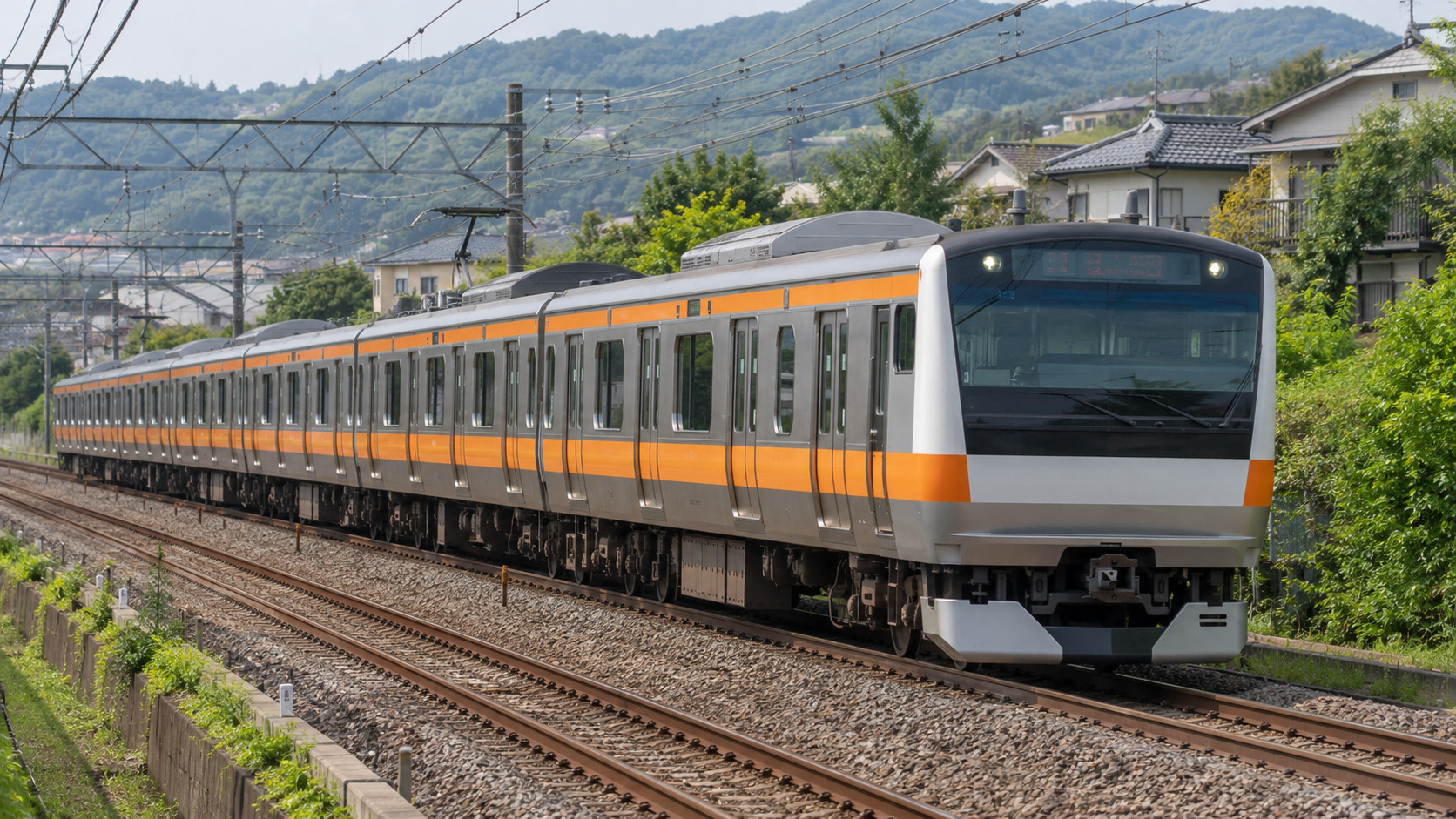
For Kichijoji, choose a train whose stopping list includes Kichijoji. For Takao, check both the stopping pattern and the destination: an Ome-bound train leaves the Takao route at Tachikawa. Those two checks matter more than the orange stripe.
Chuo Rapid connects Tokyo and Shinjuku with western Tokyo. It shares part of its corridor with the yellow Chuo–Sobu Local, but the two services are not interchangeable. Rapid skips central stations that Local serves; Special Rapid skips additional western stops. A train can also end before your destination.
Read the board in this order
Start with your destination station, then read the train’s final destination and service type. Open its stopping list if you are unsure. A terminus beyond your stop is useful only when the train follows the correct branch and actually calls there.
At Tokyo, follow Chuo Line Rapid signs to the above-ground platforms. Do not follow Sobu underground signs because the words “Chuo–Sobu” appear in your notes. At Shinjuku, follow the Chuo Rapid direction for Nakano, Mitaka and Tachikawa when heading west; Tokyo is the opposite direction. Use the current departure display for the platform. The Tokyo station map and Tokyo timetable index separate these services.
If your hotel is in the Shinjuku station area, check the walk to a JR entrance as part of the trip. “Near Shinjuku” does not identify a platform, and a route from another railway’s entrance may involve a substantial walk.
Rapid versus Special Rapid
These are stopping-pattern names. Special Rapid is not the same thing as a limited express.
- Rapid: the ordinary orange-line option. It serves Kichijoji, but its treatment of three stations west of Nakano changes on Saturdays and holidays.
- Chuo Special Rapid: useful for stations including Mitaka, Kokubunji and Tachikawa; it skips Kichijoji and Ogikubo.
- Ome Special Rapid: also skips Kichijoji and Ogikubo, then continues onto the Ome Line after Tachikawa.
- Other labels, including Commuter Rapid or Commuter Special Rapid: read that train’s stops instead of applying the daytime Special Rapid rule.
For a straightforward Shinjuku–Kichijoji trip, a Rapid calling at Kichijoji avoids the need to plan a second train. A Special Rapid can take you past Kichijoji to Mitaka. It is not a better choice merely because the departure is earlier. Compare a complete itinerary if considering a change.
For Tokyo–Tachikawa, a suitable Special Rapid can be useful, but the display still needs to show a destination that reaches Tachikawa. An ordinary Rapid ending at Musashi-Koganei will not get you all the way there. Current examples and destination labels are available through JR East’s Chuo departures; the train details show each stop.
The weekend trap: Koenji, Asagaya and Nishi-Ogikubo
Rapid trains call at these three stations on the ordinary weekday pattern but pass them on the Saturday/holiday pattern. The yellow Chuo–Sobu Local serves them on both patterns. This is not a rule that every orange train stops on weekdays: Special Rapid still has its own stopping list.
The current station timetables distinguish the patterns at Koenji, Asagaya and Nishi-Ogikubo. Around New Year and other special operating dates, check the timetable for the actual date rather than guessing from the day of the week.
Worked example: Tokyo to Koenji on a holiday. Use a Chuo Rapid service that calls at Nakano, then change to the westbound Chuo–Sobu Local and leave at Koenji. Starting in Shinjuku, a westbound Local calling at Koenji removes that change. Neither plan needs a Special Rapid simply to travel one Local stop beyond Nakano.
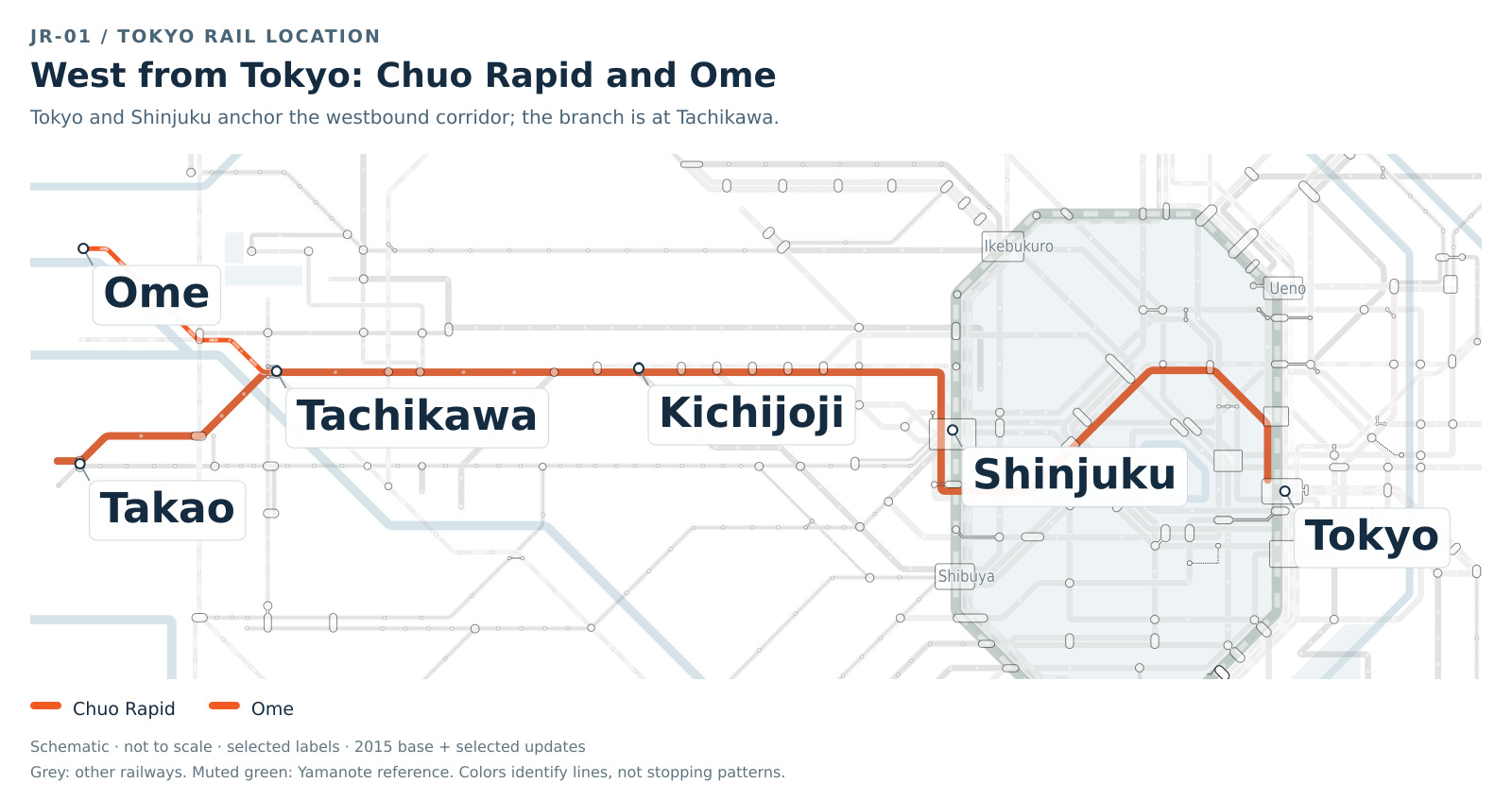
Where the westbound route divides
The important branch decision is at Tachikawa. The Chuo route continues toward Hachioji and Takao. The Ome route turns toward Haijima and Ome. “Westbound” alone is therefore not enough for a Takao trip.
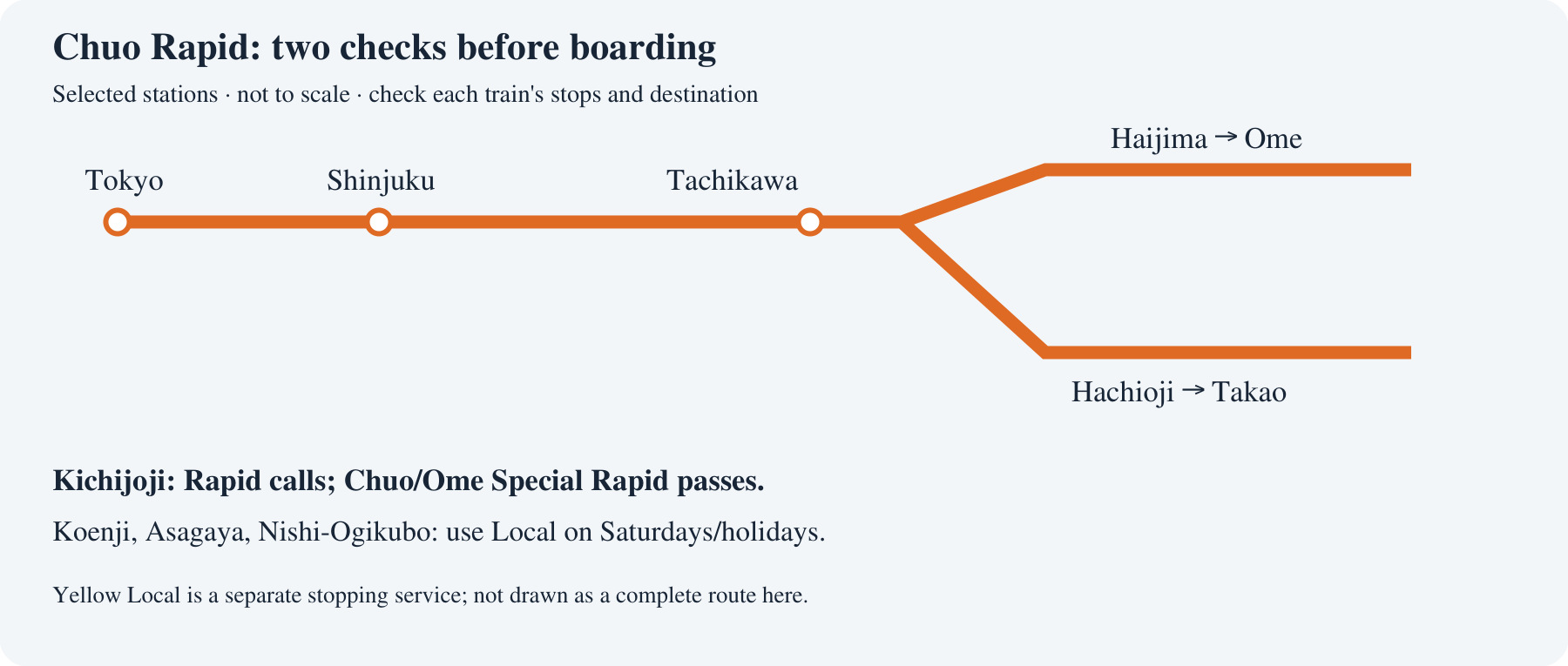
Selected stations only; intermediate stations omitted. This is a route-choice schematic, not a full station map or platform plan.
A Takao-bound Rapid or Chuo Special Rapid that calls at your boarding station is a direct option for Takao. If the display says Ome, use a verified transfer at Tachikawa or choose a different departure. Shorter destinations such as Toyoda and Hachioji also require an onward train for Takao. Don’t assume the route’s name means every departure runs its full length.
For a mountain visit, Takao Station and Takaosanguchi Station are different. JR Chuo trains take you to Takao; Keio’s Takao Line serves Takaosanguchi. Decide which trailhead or attraction you need before choosing the railway. Keio’s Takao area access guide explains that side of the journey. The day-trip planning guide helps put the rail segment into a wider outing.
Ordinary car, Green Car or limited express?
An ordinary car on a Rapid or Special Rapid does not need a limited-express ticket. Some Chuo services also carry Green Cars, which require a Green Car ticket in addition to the base fare. Their seats are unreserved; buying that ticket does not reserve a particular seat. The charge also applies if you stand in a Green Car.
Azusa and Kaiji are limited expresses with their own ticket requirements. Do not board one with only an ordinary commuter journey loaded into your plan. A Green Car on an orange commuter train and a limited-express seat are separate products.
If you want to avoid extra charges, use an ordinary car and check the carriage markings before boarding. If choosing Green, read the current JR East Green Car rules. In particular, a Chuo Green ticket cannot simply be carried onto another line’s Green Car at Tokyo or Shinjuku. For ordinary IC-card travel, see the Suica and Pasmo guide.
Useful stops, with a reason to choose them
This is a selected list, not every station on the line.
- Tokyo: a starting point for westbound Chuo Rapid and a connection with long-distance services. Budget for the actual interchange, not just train time.
- Ochanomizu: a useful connection with Chuo–Sobu Local for stations such as Akihabara. Confirm the direction after changing.
- Shinjuku: a western-Tokyo departure point with many railway lines. Read both operator and destination signs.
- Nakano: a practical Rapid/Local decision point, especially for a weekend trip to Koenji.
- Kichijoji: a Rapid stop that Special Rapid bypasses. It is the clearest example of why a faster train type can be the wrong train.
- Mitaka: served by Rapid and the daytime Special Rapid patterns discussed here; also the western endpoint of the Chuo–Sobu Local corridor.
- Tachikawa: the branch check for Chuo versus Ome destinations.
- Takao: the JR station; onward access to Takaosanguchi requires a separate Keio journey.
If you board the wrong train
Look at the next station on the onboard display. If you have not yet passed a suitable interchange, use the stopping list to decide where to change. After overshooting Kichijoji on a Special Rapid, for example, get off at Mitaka and check an eastbound train that calls at Kichijoji.
Ask staff about the ticket or fare treatment of a mistaken journey. Do not assume that reversing direction is automatically free, and don’t leave through the gates just to look for the opposite platform without checking. Our station-navigation guide covers how to use line, direction and exit signs together.
Questions that matter before boarding
Does Rapid mean the train stops at every station after Shinjuku?
No. The Saturday/holiday pattern skips Koenji, Asagaya and Nishi-Ogikubo, and other train types skip additional stops. Read the service type as well as the destination.
Can I use Chuo Rapid to get directly to Akihabara or Suidobashi?
No. Those stations belong to the Local corridor rather than the Chuo Rapid stopping route. Build the change into your itinerary; don’t board an orange train expecting it to follow every yellow-line station.
Is a Green Car necessary for a longer ride?
No. It is an optional paid carriage choice on trains that carry it. Ordinary cars remain available, and neither choice guarantees an uncrowded journey.
Plan the rest of your Tokyo stay
Compare the Tokyo Station hotel base for an eastern start and the Shinjuku hotel base for western departures. For trips around the central loop rather than across the city, use the Yamanote Line guide.
Service and ticket sources checked 11 October 2026. Recheck the official timetable and service notices for your travel date.
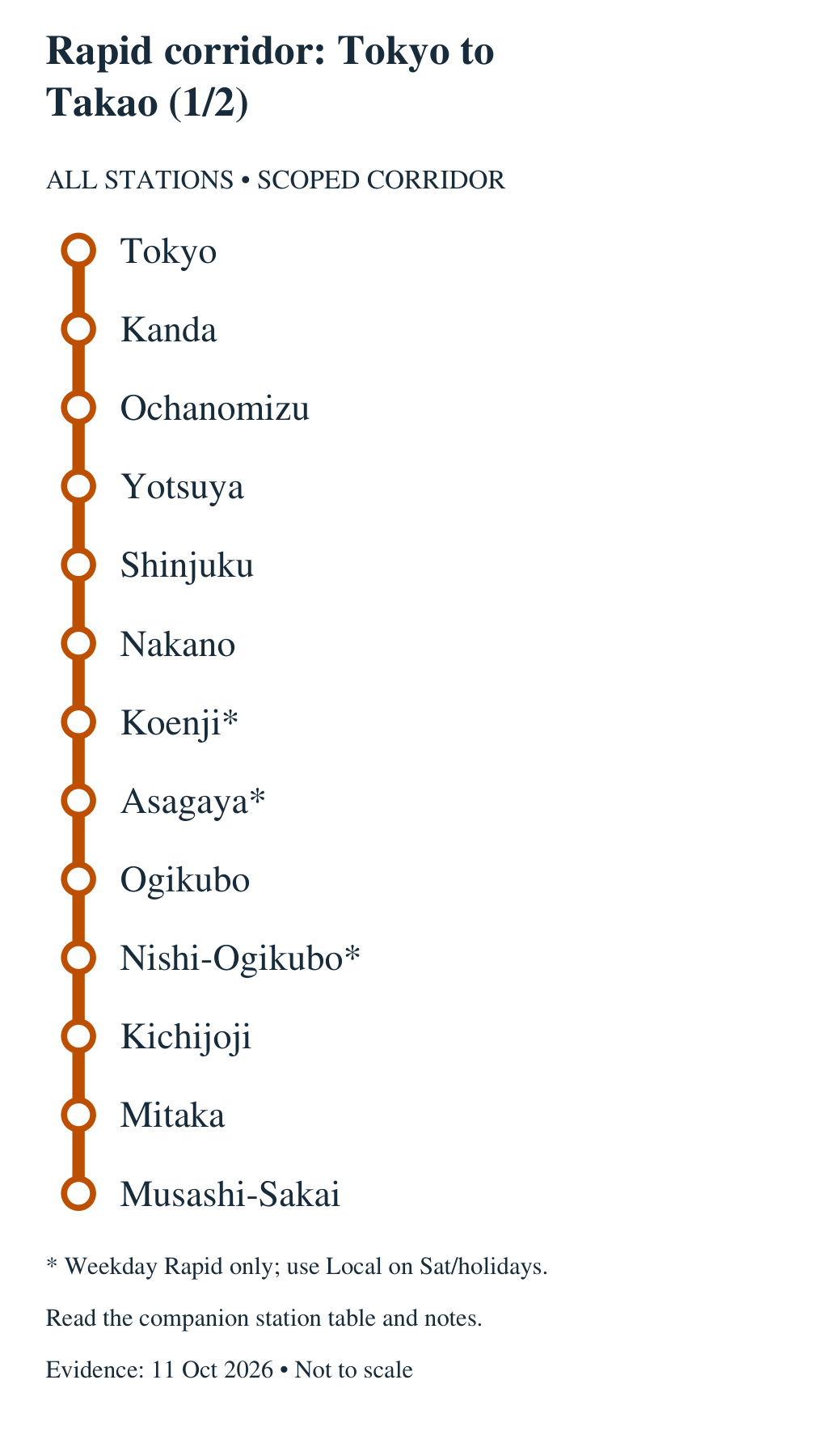
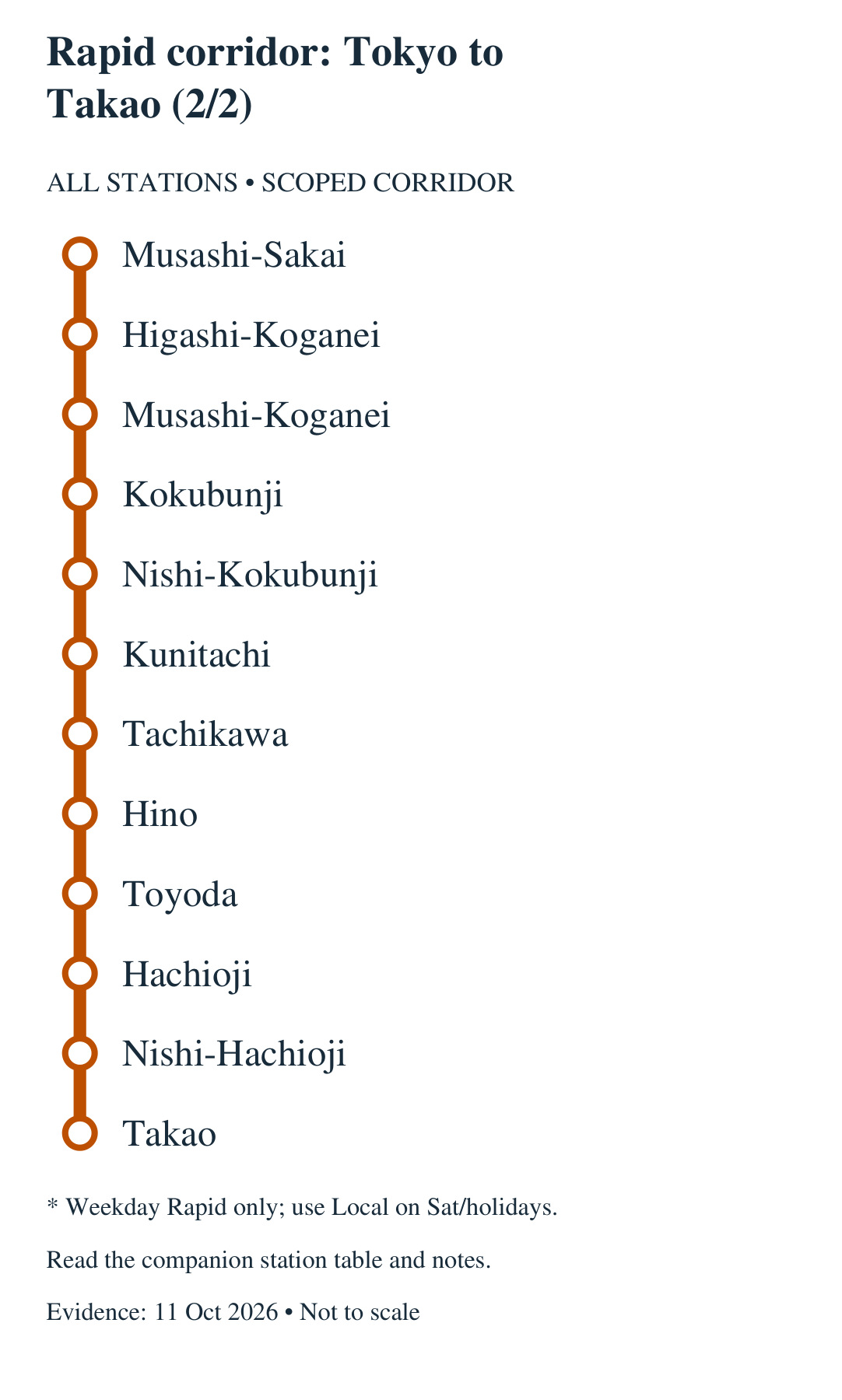
All stations within this guide route scope
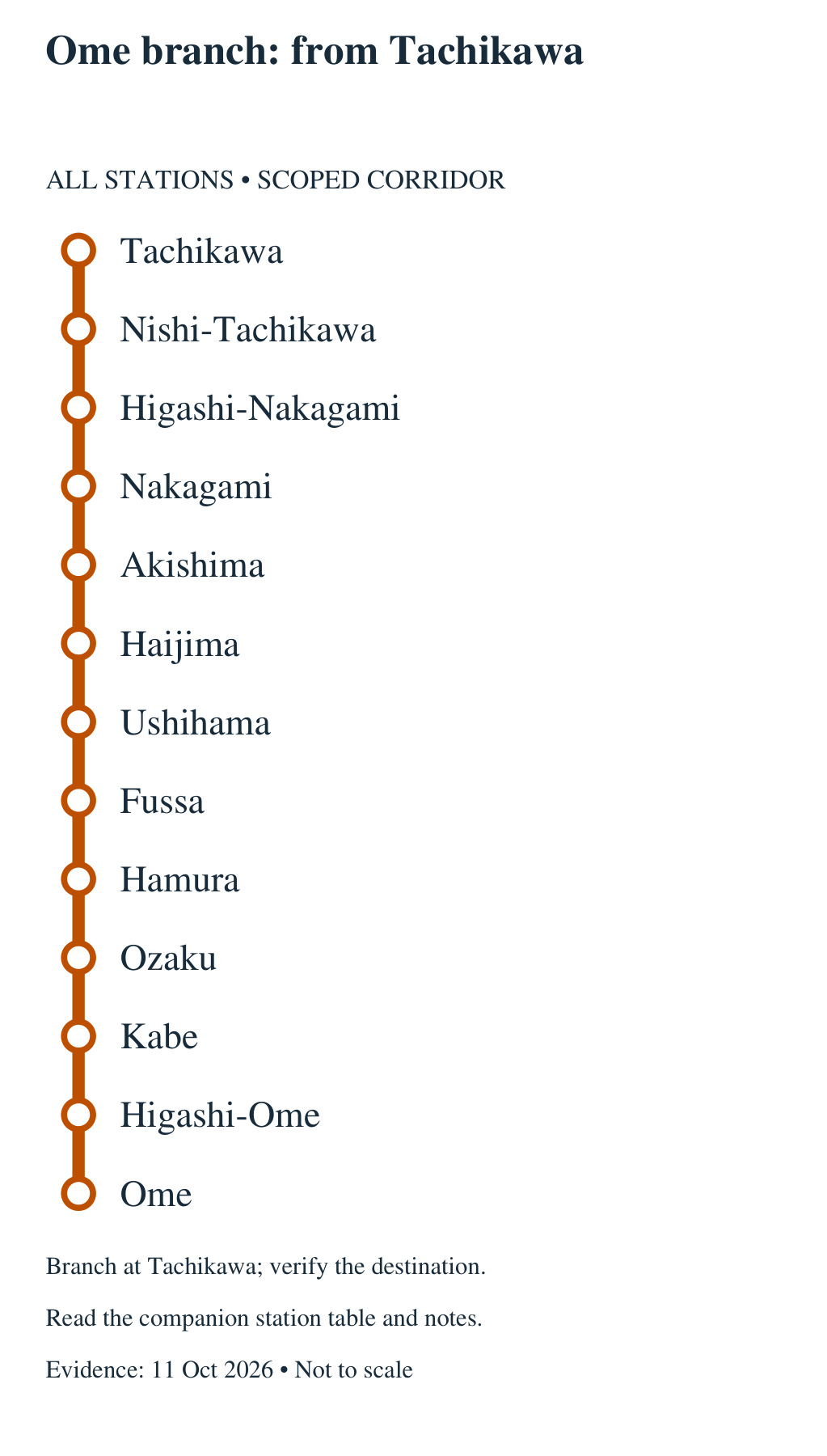
Evidence checked: 11 October 2026. Complete Rapid-platform station inventory Tokyo–Takao (24 stations), plus the Tachikawa–Ome branch (13 stations including Tachikawa). This is the route scope of this guide, not the entire Chuo Main Line or Ome Line.
Original editorial diagrams; station order is factual, not to scale. No source artwork or departure-time table reproduced. Circles indicate inventory, not a universal stopping pattern. Read the service notes and station tables together with the panels.
Service and scope notes
- Koenji, Asagaya and Nishi-Ogikubo: ordinary Rapid calls on weekdays; on Saturdays and holidays use the yellow Chuo–Sobu Local. Special/Commuter services have other stopping patterns. The circles show stations, not a promise that every service calls.
- Chuo Special Rapid and Ome Special Rapid skip intermediate stations. Verify your departure; the Ome branch leaves the Takao route at Tachikawa.
- The yellow Local has extra central stations absent from this Rapid inventory: Suidobashi, Iidabashi and Ichigaya between Ochanomizu and Yotsuya; Shinanomachi, Sendagaya and Yoyogi between Yotsuya and Shinjuku; Higashi-Nakano between Shinjuku and Nakano. This map does not turn those stations into Rapid stops.
- Routes beyond Takao or Ome, the Itsukaichi branch and special through services are outside this explicitly bounded map. Takao is not Takaosanguchi.
Rapid corridor: Tokyo to Takao
24 stations, in order. * Weekday Rapid only; use Local on Sat/holidays.
| Order | Station | Japanese | Note |
|---|---|---|---|
| 1 | Tokyo | 東京 | Station in scoped inventory |
| 2 | Kanda | 神田 | Station in scoped inventory |
| 3 | Ochanomizu | 御茶ノ水 | Station in scoped inventory |
| 4 | Yotsuya | 四ツ谷 | Station in scoped inventory |
| 5 | Shinjuku | 新宿 | Station in scoped inventory |
| 6 | Nakano | 中野 | Station in scoped inventory |
| 7 | Koenji | 高円寺 | See service-exception note (*) |
| 8 | Asagaya | 阿佐ケ谷 | See service-exception note (*) |
| 9 | Ogikubo | 荻窪 | Station in scoped inventory |
| 10 | Nishi-Ogikubo | 西荻窪 | See service-exception note (*) |
| 11 | Kichijoji | 吉祥寺 | Station in scoped inventory |
| 12 | Mitaka | 三鷹 | Station in scoped inventory |
| 13 | Musashi-Sakai | 武蔵境 | Station in scoped inventory |
| 14 | Higashi-Koganei | 東小金井 | Station in scoped inventory |
| 15 | Musashi-Koganei | 武蔵小金井 | Station in scoped inventory |
| 16 | Kokubunji | 国分寺 | Station in scoped inventory |
| 17 | Nishi-Kokubunji | 西国分寺 | Station in scoped inventory |
| 18 | Kunitachi | 国立 | Station in scoped inventory |
| 19 | Tachikawa | 立川 | Station in scoped inventory |
| 20 | Hino | 日野 | Station in scoped inventory |
| 21 | Toyoda | 豊田 | Station in scoped inventory |
| 22 | Hachioji | 八王子 | Station in scoped inventory |
| 23 | Nishi-Hachioji | 西八王子 | Station in scoped inventory |
| 24 | Takao | 高尾 | Station in scoped inventory |
Sources: JR East Chuo Rapid train timetable; JR East Takao-bound train timetable; JR East Tokyo rail map; JR East Koenji station timetable; JR East Asagaya station timetable; JR East Nishi-Ogikubo station timetable.
Ome branch: from Tachikawa
13 stations, in order. Branch at Tachikawa; verify the destination.
| Order | Station | Japanese | Note |
|---|---|---|---|
| 1 | Tachikawa | 立川 | Station in scoped inventory |
| 2 | Nishi-Tachikawa | 西立川 | Station in scoped inventory |
| 3 | Higashi-Nakagami | 東中神 | Station in scoped inventory |
| 4 | Nakagami | 中神 | Station in scoped inventory |
| 5 | Akishima | 昭島 | Station in scoped inventory |
| 6 | Haijima | 拝島 | Station in scoped inventory |
| 7 | Ushihama | 牛浜 | Station in scoped inventory |
| 8 | Fussa | 福生 | Station in scoped inventory |
| 9 | Hamura | 羽村 | Station in scoped inventory |
| 10 | Ozaku | 小作 | Station in scoped inventory |
| 11 | Kabe | 河辺 | Station in scoped inventory |
| 12 | Higashi-Ome | 東青梅 | Station in scoped inventory |
| 13 | Ome | 青梅 | Station in scoped inventory |
Sources: JR East Ome Line train timetable.