JR rail guide
Keiyo and Musashino Lines: Tokyo to Maihama and Makuhari

For Tokyo Disney Resort, look for Maihama on the stopping list. A Musashino through train from Tokyo can take you there just as a Keiyo train can. For Makuhari Messe, Kaihin-Makuhari is the direct rail approach; Makuhari-hongo plus a bus is another route. A train turning inland toward Nishi-Funabashi will not take you to Kaihin-Makuhari directly.
The first obstacle is often inside Tokyo Station. Keiyo trains use a separate underground platform area, reached by following Keiyo Line signs through the station. Sobu underground platforms are somewhere else. “Go underground” is not a complete instruction.
Choose the destination before the line name
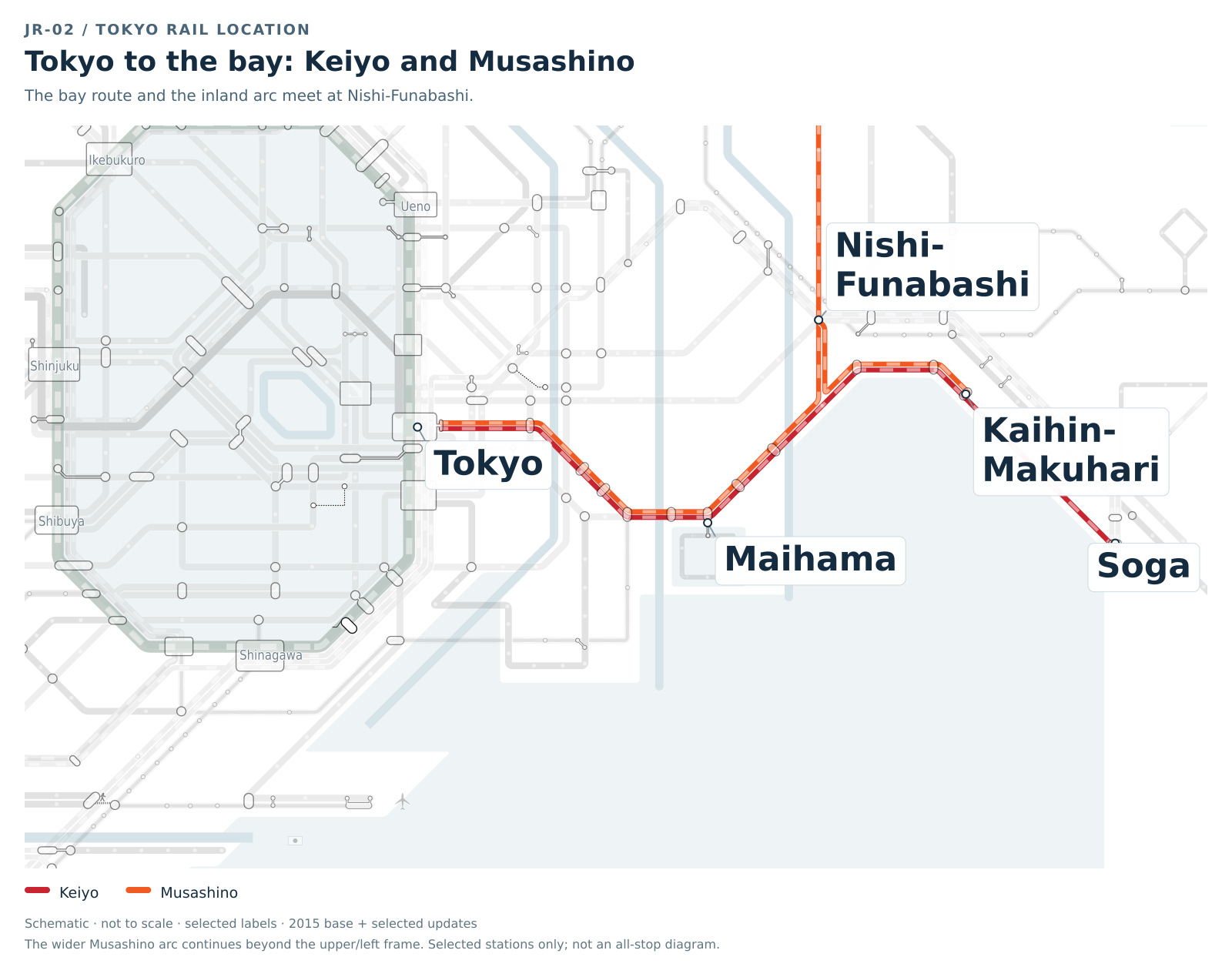
- Maihama: the JR station for Tokyo Disney Resort. Check for a stop there on a Keiyo or Musashino through service.
- Kaihin-Makuhari: the Keiyo Line station used for Makuhari Messe access. Choose a train that reaches and stops there.
- Makuhari or Makuhari-hongo: different stations on the inland Sobu corridor. They are not alternative spellings of Kaihin-Makuhari.
- Nishi-Funabashi: a major inland interchange. A useful destination for some journeys, but not a coastal continuation toward Kaihin-Makuhari.
The spelling also matters. JR Keiyo serves Tokyo Bay. Keio is a different railway associated with western Tokyo. A search result for “Keio Shinjuku” will not help you find Tokyo Station’s Keiyo platforms.
Tokyo Station: plan the whole interchange
If arriving on the Shinkansen or another JR line, follow the signs for Keiyo Line rather than heading for an exit by habit. Keep looking for that line name at each junction. Only choose the platform after you reach the departure boards and have checked the destination and train type.
The official Tokyo station map distinguishes the Keiyo underground area from the Sobu underground area and the above-ground platforms. The interchange can involve a long walk. A rail planner’s ride time does not cover your arrival platform, finding the corridor, a lift wait and reaching the train.
With luggage, a stroller or a wheelchair, identify the lifts on the current map before you travel. The shortest signed route and a step-free route are not necessarily identical. Construction and lift outages can change the practical journey; ask station staff for the usable route rather than treating a diagram as an accessibility guarantee.
A hotel advertised as near Tokyo Station may be close to a different side of the station. When comparing Tokyo Station hotel bases, include the entrance-to-platform route in your Disney or exhibition-day plan. Do not choose a tight timed connection based solely on the words “Tokyo Station.”
Why a Musashino train can be right for Maihama
Tokyo-bound and Tokyo-originating Musashino through trains share the Keiyo approach through Maihama. There is one Maihama station here, not separate “Keiyo Maihama” and “Musashino Maihama” stations. Tokyo Disney Resort’s access answer explicitly names both lines from Tokyo.
Suppose the board at Tokyo shows a train for Fuchuhommachi and another for Soga. The unfamiliar inland destination does not rule out the first train for Maihama. Open the stopping list: if it includes Maihama, it can serve that part of your journey. The difference becomes important after the shared section. JR East example train and stops
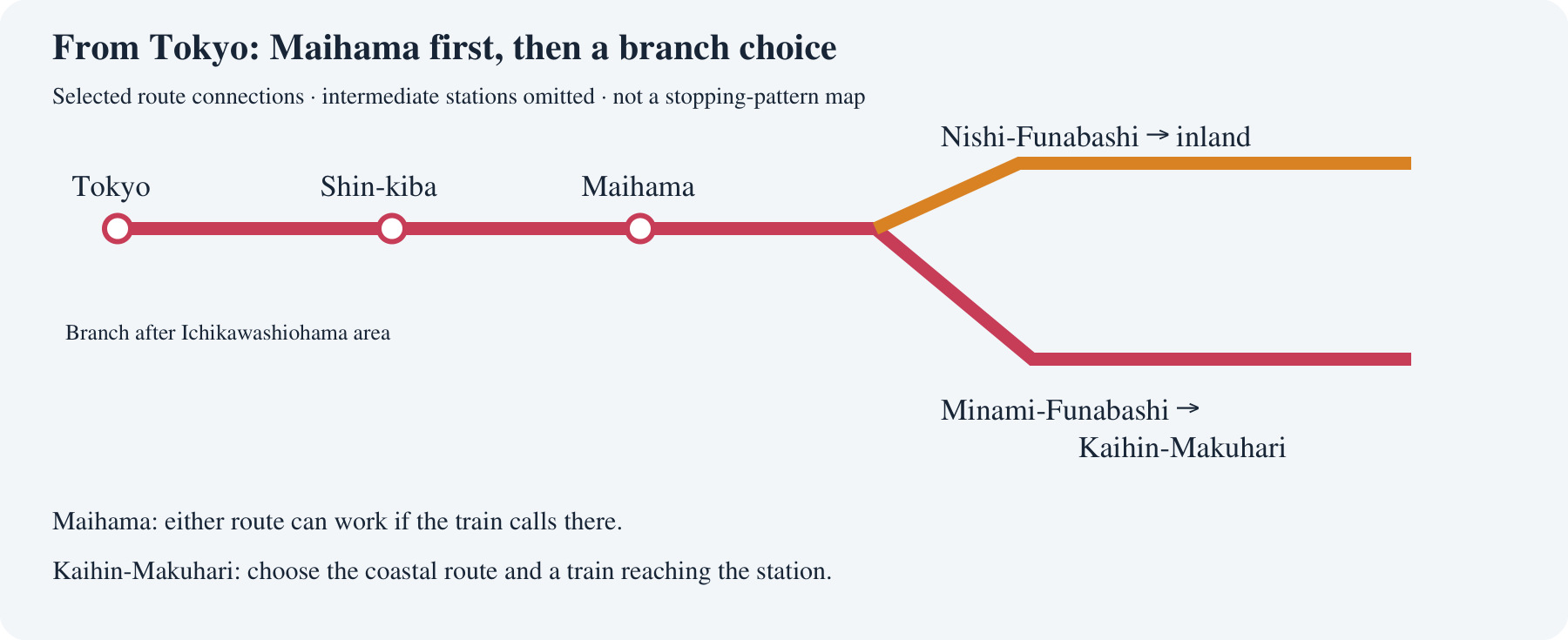
Selected connections only; intermediate stations omitted. The diagram shows the Tokyo-originating choice. Musashino services also connect with the coastal side from Nishi-Funabashi, so it is not a complete service map.
From Tokyo, Musashino through trains turn toward Nishi-Funabashi after the Ichikawashiohama area; the coastal Keiyo route continues toward Minami-Funabashi and Kaihin-Makuhari. For a Maihama trip you get off before that decision matters. For Makuhari, it matters before you board.
Local, Rapid and limited express are separate checks
Do not apply a remembered list of old commuter-rapid stops to today’s timetable. Use the current Tokyo departure index, which groups Keiyo and Musashino departures, and inspect the individual train.
A Keiyo Rapid can be suitable for Maihama and Kaihin-Makuhari, but it does not call at every intermediate station. A Local ending at Shin-Narashino does not reach Kaihin-Makuhari. Conversely, a Soga-bound train can go beyond Kaihin-Makuhari without needing that station to be printed as its terminus.
Wakashio and Sazanami are limited expresses, with different stops and ticket requirements. Their presence in the same platform area is not permission to use them as ordinary commuter trains. If your plan is a regular local or rapid journey, match the service type before boarding.
Worked trip: Tokyo arrival to a Disney park
Start with the destination park and the arrival date. Tokyo Disneyland and Tokyo DisneySea share Maihama as their JR gateway, but the onward route is not identical.
At Tokyo Station, follow Keiyo signs from your actual arrival point. Reach the correct underground departure area, then choose a train whose stopping list contains Maihama. Board an ordinary car on the selected regular service and get off at Maihama, even if its final destination is far beyond the resort.
After leaving the JR station, follow the resort’s current access directions for your park. Do not treat Maihama arrival as arrival at the park entrance, security check or reservation location. Use the official Tokyo Disney Resort access pages to finish that part of the route.
For the return, save an itinerary all the way to your hotel, including any final transfer after Tokyo. A train that gets you back to Tokyo too late for your next line is not a complete return plan. Start with the last-train planning guide and check the travel-date departures.
Worked trip: an event at Makuhari Messe
Search for Kaihin-Makuhari, then compare the departure’s stopping list. A suitable Kaihin-Makuhari-bound train or a coastal train continuing beyond it can work. A Tokyo-originating Fuchuhommachi-bound Musashino train is not a direct Makuhari option.
At Kaihin-Makuhari, use the event’s hall or entrance name, not just “Messe.” The complex is large, and the route to one hall is not necessarily the route to another. Makuhari Messe’s official access page identifies Kaihin-Makuhari as a rail approach and also describes buses from Makuhari-hongo. Those are different journeys, each with its own walking and waiting components.
If your hotel is already on the Sobu side, a Makuhari-hongo-and-bus itinerary may be worth comparing. If you are starting at Tokyo’s Keiyo platforms, do not change your destination to Makuhari-hongo simply because it shares the area name. Match the entire route to the venue entrance and your mobility needs.
Alternatives to starting at Tokyo Station
Hatchobori and Shin-kiba can be useful boarding or transfer points when they fit your starting location. They are not universal shortcuts. Compare the walk from your hotel, the connecting line, the transfer and the train’s actual stops.
For a stay around Nihonbashi and Hatchobori, check whether walking to a suitable Hatchobori entrance is more practical than first travelling to Tokyo. From the Odaiba area, a Rinkai connection at Shin-kiba may fit your route, but the non-JR leg has its own fare or pass conditions. Neither suggestion promises the shortest or step-free journey for every hotel.
Nishi-Funabashi has trains toward both the Maihama/Tokyo side and the coastal Makuhari side. Starting there, “take Musashino” is incomplete. JR East’s Nishi-Funabashi to Maihama explanation illustrates why you must check the direction, not just the platform family’s name.
Quick answers
Are Keiyo and Musashino platforms at Tokyo in different parts of the station?
They use the same Keiyo underground platform area. Different departures can use different platforms within it, so check the board rather than fixing on a platform number.
Does every train from that area stop at Maihama?
Do not assume so. Limited expresses have different stopping patterns. Choose a regular service that explicitly lists Maihama.
Can I use this route as a Narita Airport train?
Maihama is not an airport stop. Plan any airport journey separately with the Narita access comparison; a train heading east is not automatically airport-bound.
What if direct services are disrupted?
Read JR East’s current service information before choosing a replacement. Another line’s name does not guarantee independence from the disrupted section. Avoid leaving the station to try a speculative alternative until you have checked where it goes and whether it is running.
More help for the journey
Use the station-navigation guide for reading transfer signs and the Suica and Pasmo guide for ordinary ticketing. For hotel selection, compare the route from the actual property rather than the nearest station name alone.
Service and venue sources checked 11 October 2026. No fixed transfer time or travel-date service guarantee is implied.
All stations within this guide route scope
Evidence checked: 11 October 2026. All 18 Keiyo main-line stations Tokyo–Soga and all 26 Musashino passenger-line stations Nishi-Funabashi–Fuchuhommachi; both connecting branches to the Keiyo side are shown.
Original editorial diagrams; station order is factual, not to scale. No source artwork or departure-time table reproduced. Circles indicate inventory, not a universal stopping pattern. Read the service notes and station tables together with the panels.
Service and scope notes
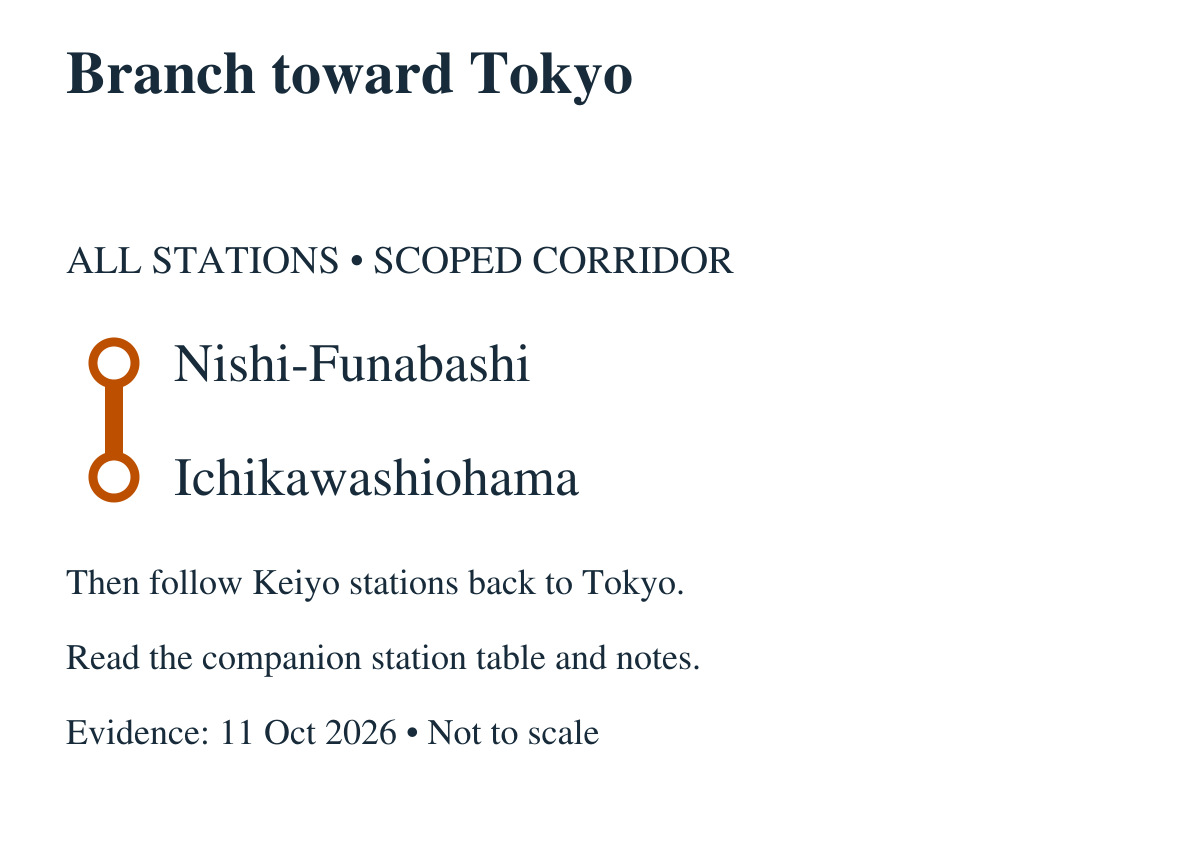
- Tokyo-direction Musashino services connect Nishi-Funabashi with Ichikawashiohama, then follow the shared Keiyo stations to Tokyo. Coastal-direction services connect Nishi-Funabashi with Minami-Funabashi, then may continue toward Shin-Narashino/Kaihin-Makuhari. Check the train destination.
- Neither connecting curve stops at Futamatashimmachi. That station belongs to the Keiyo main line between Ichikawashiohama and Minami-Funabashi. The branch panel is essential; do not imply that Nishi-Funabashi sits on Tokyo–Soga trains.
- Keiyo Rapid skips stations. All circles mark the complete physical inventory, not the stops for any one train. Check the current departure’s stopping list before boarding.
- Through routes beyond Soga and special Musashino services toward Omiya are outside this map. No timing, fare or one-seat guarantee is implied.
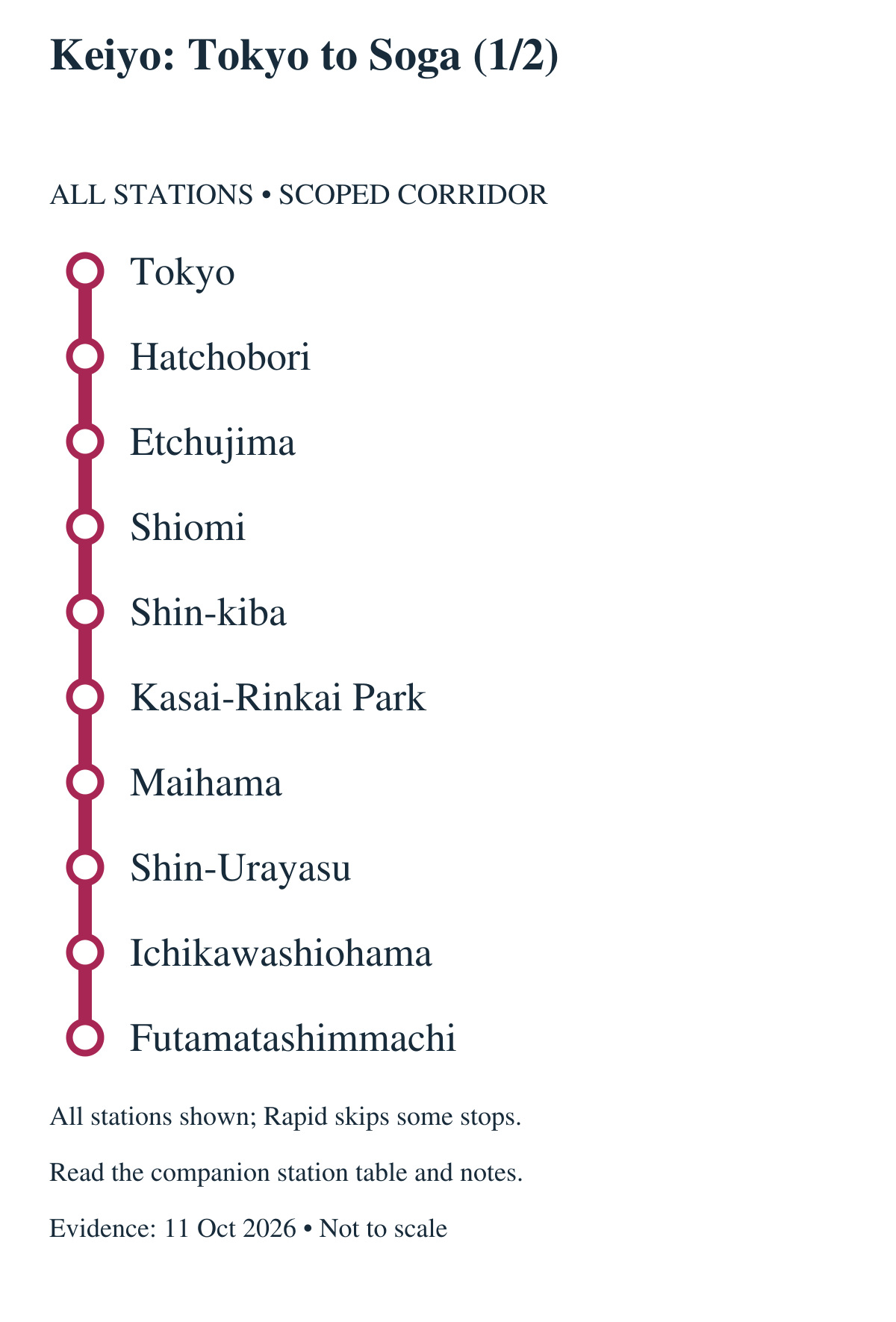
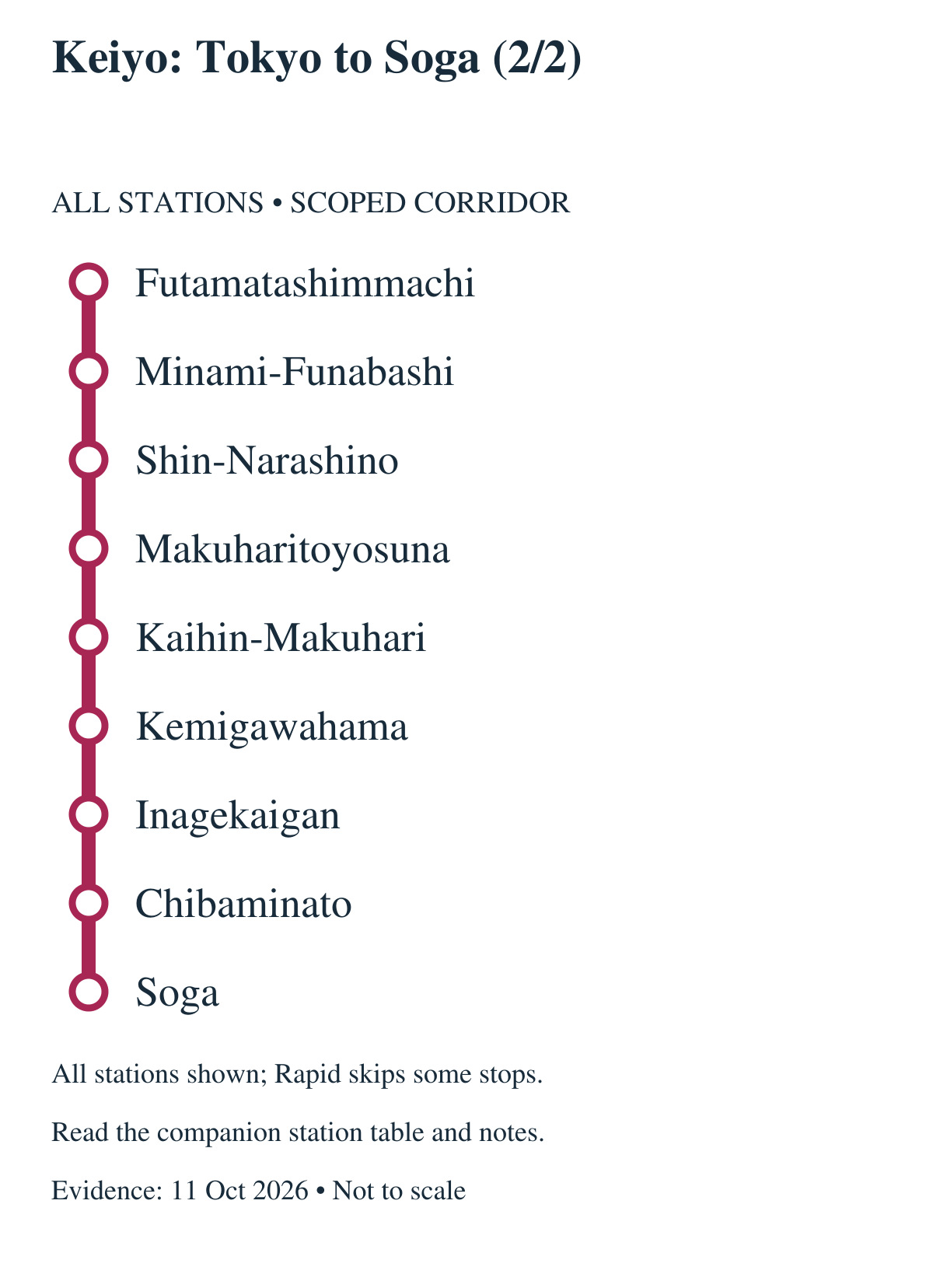
Keiyo: Tokyo to Soga
18 stations, in order. All stations shown; Rapid skips some stops.
| Order | Station | Japanese | Note |
|---|---|---|---|
| 1 | Tokyo | 東京 | Station in scoped inventory |
| 2 | Hatchobori | 八丁堀 | Station in scoped inventory |
| 3 | Etchujima | 越中島 | Station in scoped inventory |
| 4 | Shiomi | 潮見 | Station in scoped inventory |
| 5 | Shin-kiba | 新木場 | Station in scoped inventory |
| 6 | Kasai-Rinkai Park | 葛西臨海公園 | Station in scoped inventory |
| 7 | Maihama | 舞浜 | Station in scoped inventory |
| 8 | Shin-Urayasu | 新浦安 | Station in scoped inventory |
| 9 | Ichikawashiohama | 市川塩浜 | Station in scoped inventory |
| 10 | Futamatashimmachi | 二俣新町 | Station in scoped inventory |
| 11 | Minami-Funabashi | 南船橋 | Station in scoped inventory |
| 12 | Shin-Narashino | 新習志野 | Station in scoped inventory |
| 13 | Makuharitoyosuna | 幕張豊砂 | Station in scoped inventory |
| 14 | Kaihin-Makuhari | 海浜幕張 | Station in scoped inventory |
| 15 | Kemigawahama | 検見川浜 | Station in scoped inventory |
| 16 | Inagekaigan | 稲毛海岸 | Station in scoped inventory |
| 17 | Chibaminato | 千葉みなと | Station in scoped inventory |
| 18 | Soga | 蘇我 | Station in scoped inventory |
Source: JR East October 2026 Tokyo Station Keiyo timetable. Check the current stopping list for your train.
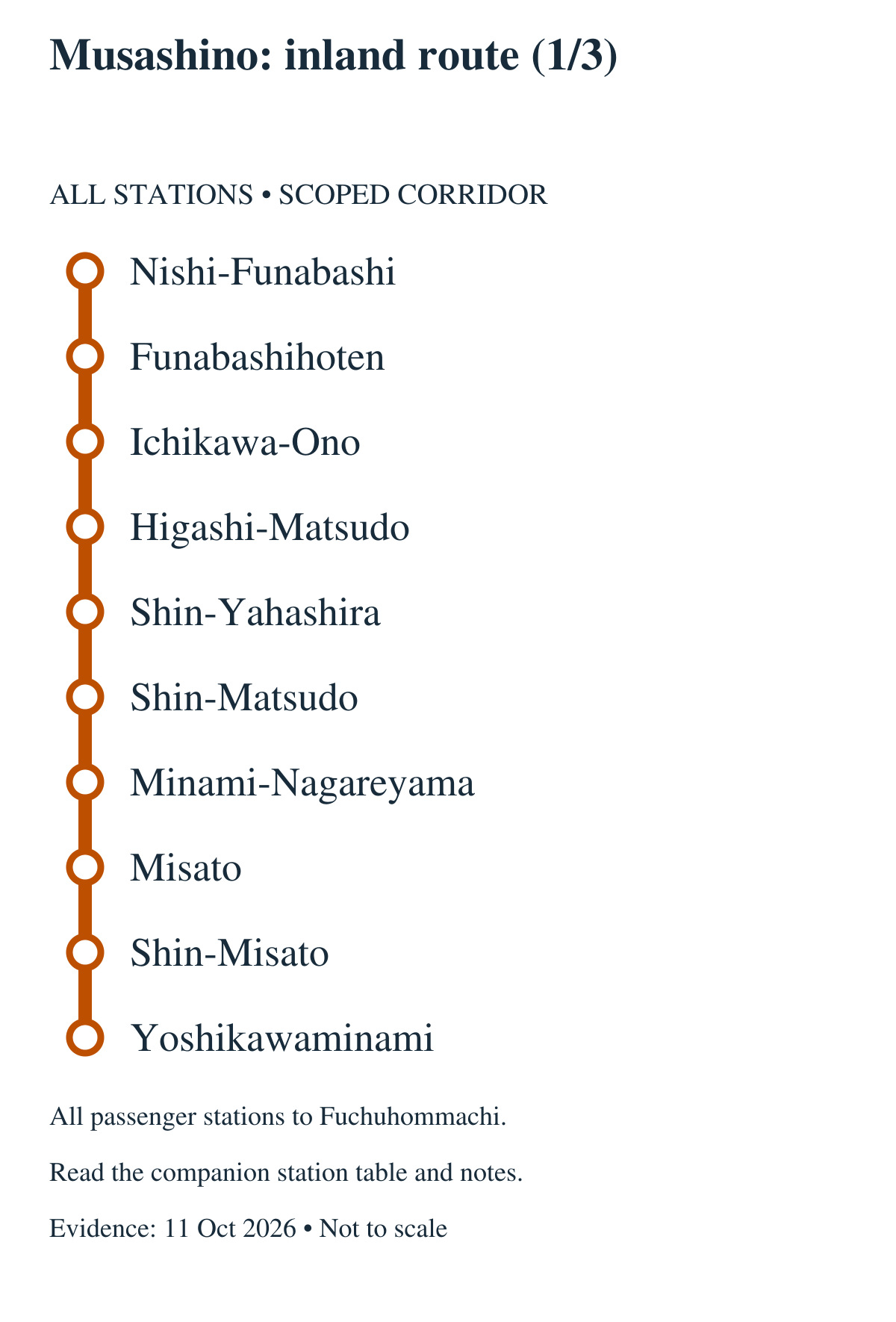
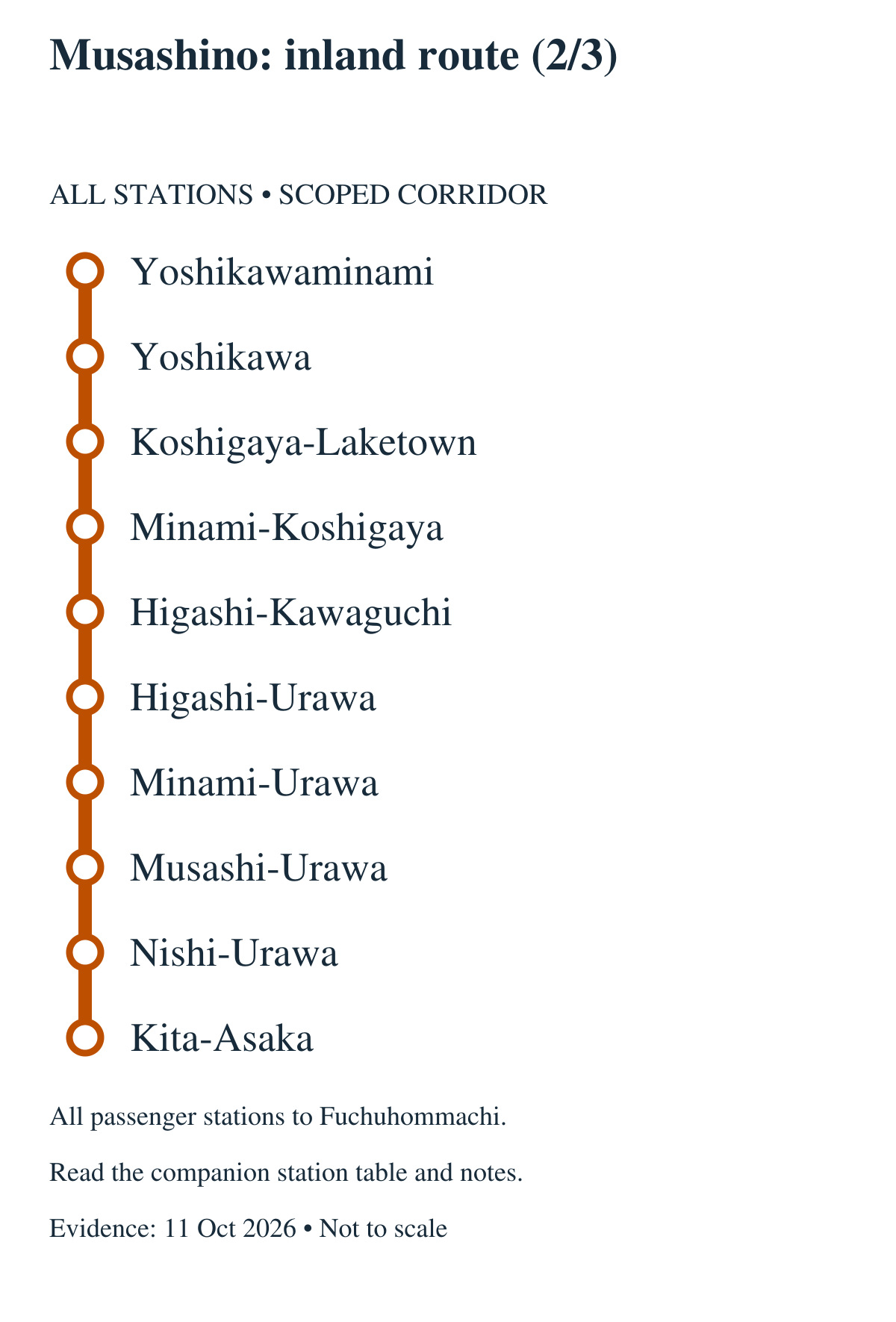
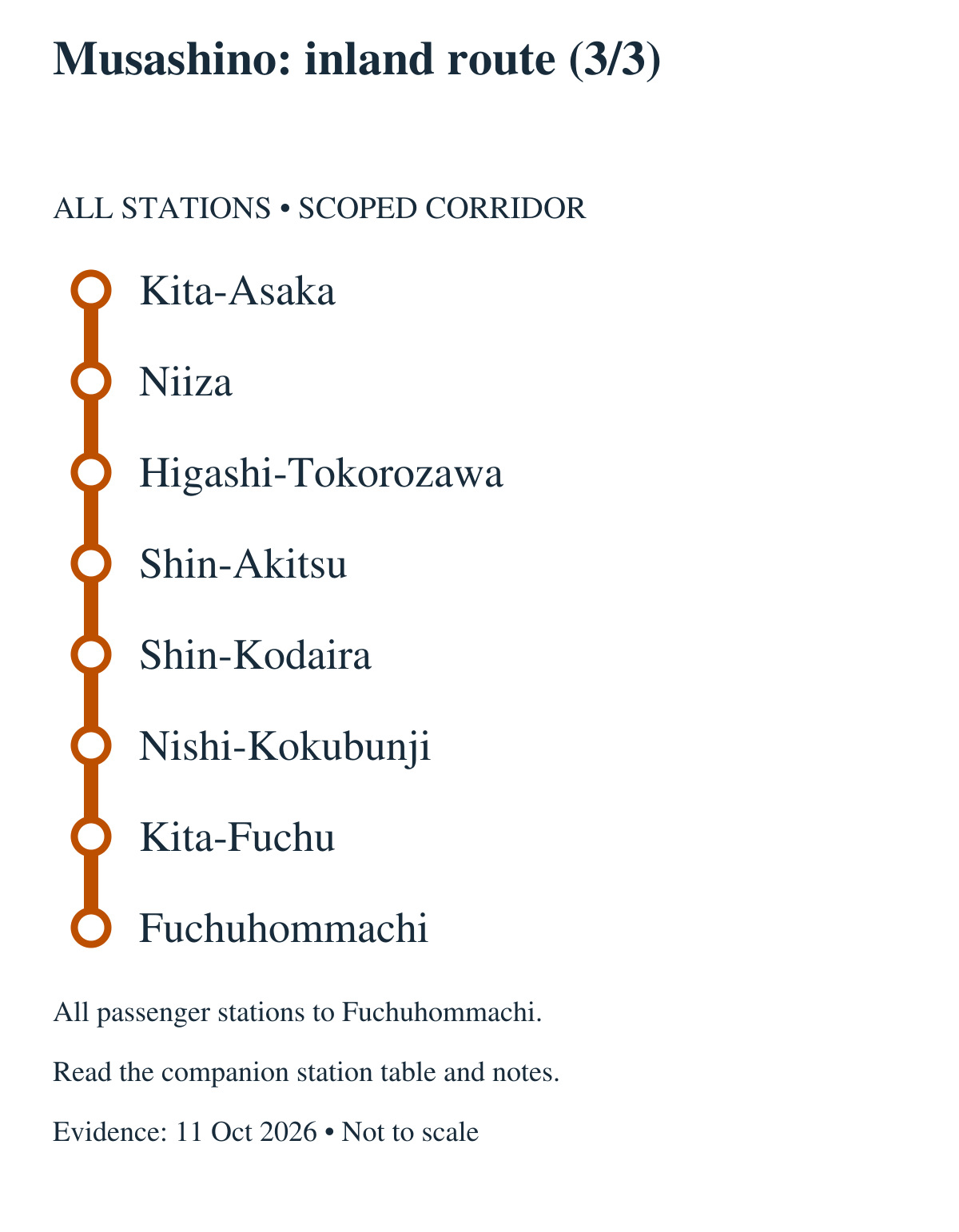
Musashino: inland route
26 stations, in order. All passenger stations to Fuchuhommachi.
| Order | Station | Japanese | Note |
|---|---|---|---|
| 1 | Nishi-Funabashi | 西船橋 | Station in scoped inventory |
| 2 | Funabashihoten | 船橋法典 | Station in scoped inventory |
| 3 | Ichikawa-Ono | 市川大野 | Station in scoped inventory |
| 4 | Higashi-Matsudo | 東松戸 | Station in scoped inventory |
| 5 | Shin-Yahashira | 新八柱 | Station in scoped inventory |
| 6 | Shin-Matsudo | 新松戸 | Station in scoped inventory |
| 7 | Minami-Nagareyama | 南流山 | Station in scoped inventory |
| 8 | Misato | 三郷 | Station in scoped inventory |
| 9 | Shin-Misato | 新三郷 | Station in scoped inventory |
| 10 | Yoshikawaminami | 吉川美南 | Station in scoped inventory |
| 11 | Yoshikawa | 吉川 | Station in scoped inventory |
| 12 | Koshigaya-Laketown | 越谷レイクタウン | Station in scoped inventory |
| 13 | Minami-Koshigaya | 南越谷 | Station in scoped inventory |
| 14 | Higashi-Kawaguchi | 東川口 | Station in scoped inventory |
| 15 | Higashi-Urawa | 東浦和 | Station in scoped inventory |
| 16 | Minami-Urawa | 南浦和 | Station in scoped inventory |
| 17 | Musashi-Urawa | 武蔵浦和 | Station in scoped inventory |
| 18 | Nishi-Urawa | 西浦和 | Station in scoped inventory |
| 19 | Kita-Asaka | 北朝霞 | Station in scoped inventory |
| 20 | Niiza | 新座 | Station in scoped inventory |
| 21 | Higashi-Tokorozawa | 東所沢 | Station in scoped inventory |
| 22 | Shin-Akitsu | 新秋津 | Station in scoped inventory |
| 23 | Shin-Kodaira | 新小平 | Station in scoped inventory |
| 24 | Nishi-Kokubunji | 西国分寺 | Station in scoped inventory |
| 25 | Kita-Fuchu | 北府中 | Station in scoped inventory |
| 26 | Fuchuhommachi | 府中本町 | Station in scoped inventory |
Sources: JR East Musashino train timetable.
Branch toward Tokyo
2 stations, in order. Then follow Keiyo stations back to Tokyo.
| Order | Station | Japanese | Note |
|---|---|---|---|
| 1 | Nishi-Funabashi | 西船橋 | Station in scoped inventory |
| 2 | Ichikawashiohama | 市川塩浜 | Station in scoped inventory |
Sources: JR East Musashino train timetable; JR East Tokyo rail map.
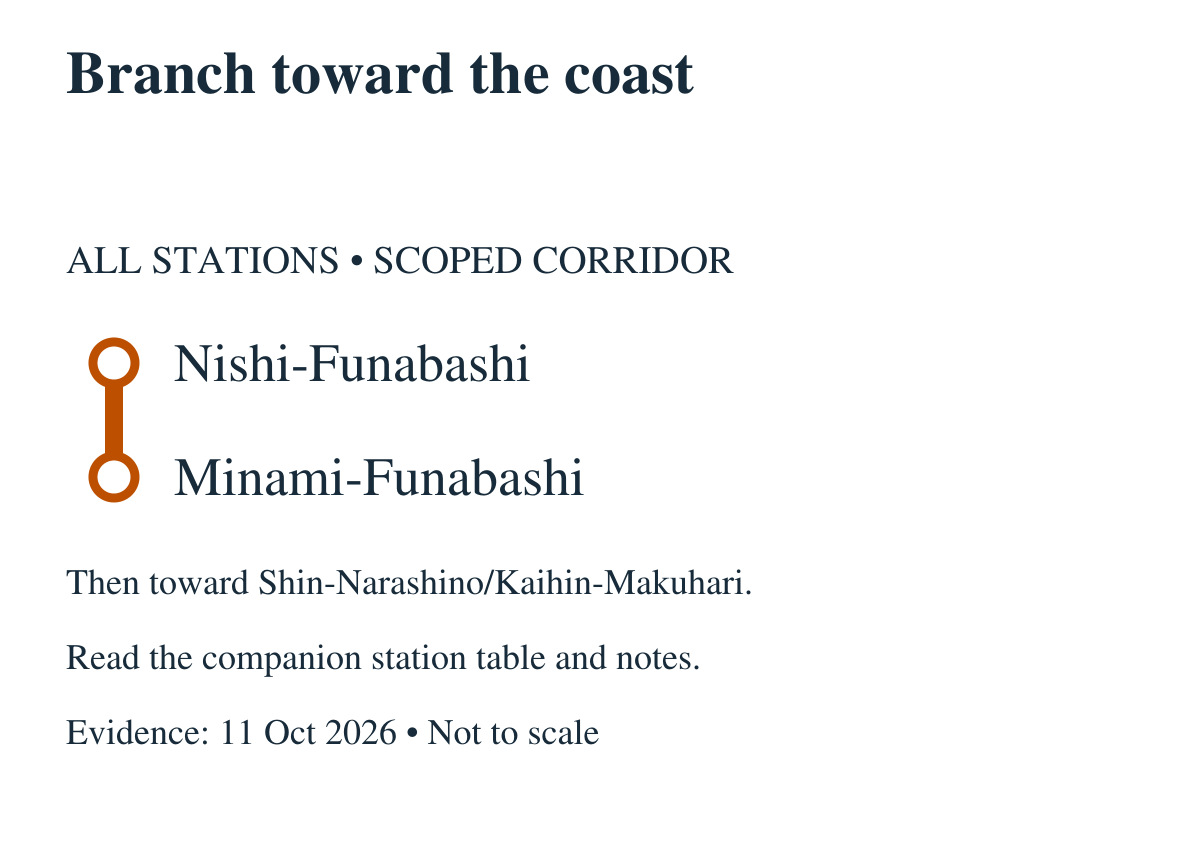
Branch toward the coast
2 stations, in order. Then toward Shin-Narashino/Kaihin-Makuhari.
| Order | Station | Japanese | Note |
|---|---|---|---|
| 1 | Nishi-Funabashi | 西船橋 | Station in scoped inventory |
| 2 | Minami-Funabashi | 南船橋 | Station in scoped inventory |
Sources: JR East coastal-branch train timetable; JR East Tokyo rail map.