Tokyo subway guide
Namboku or Mita? Choose the Right Train at Meguro and Shirokane-takanawa
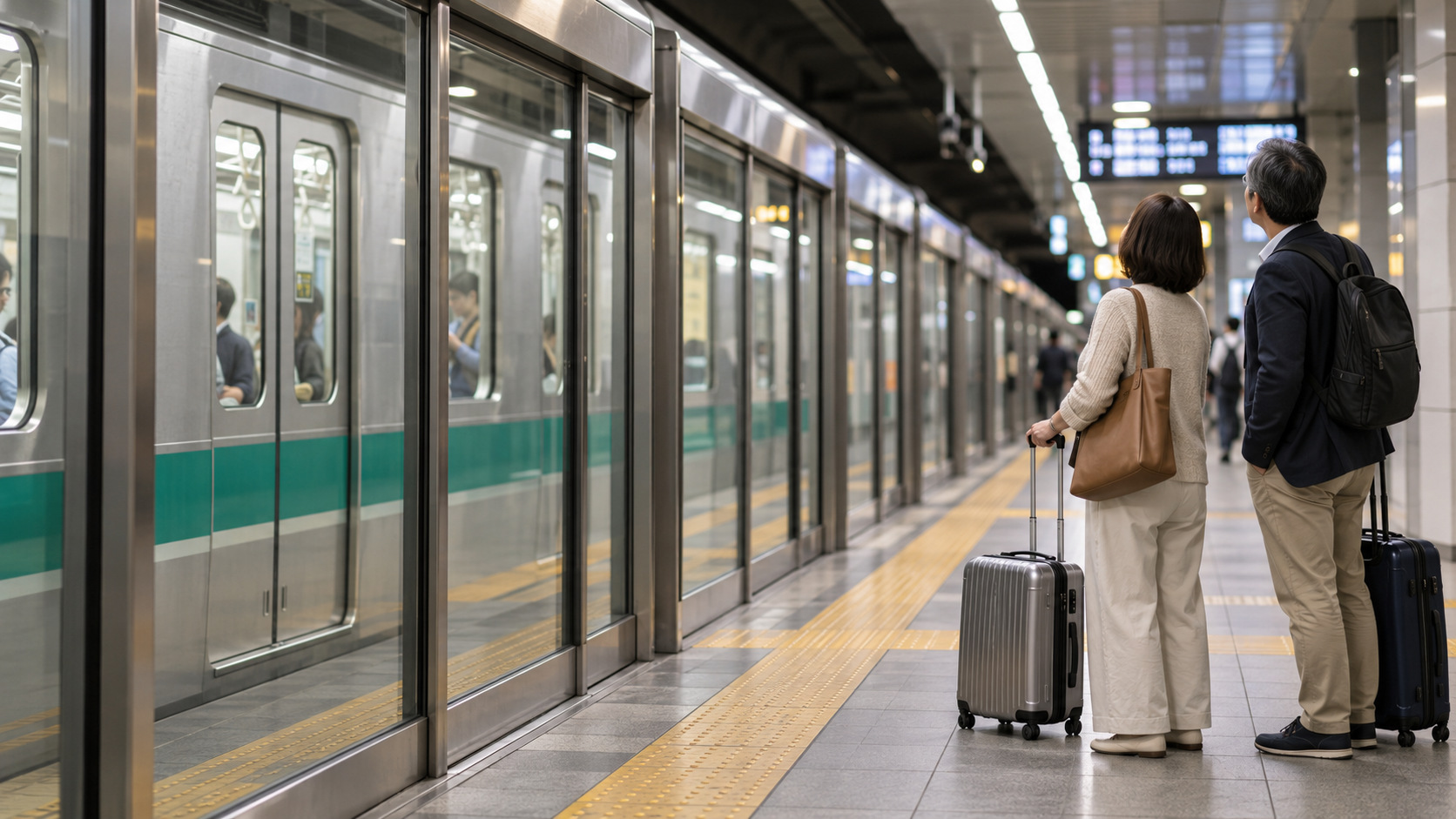
The Namboku and Mita lines share the railway between Meguro and Shirokane-takanawa. That makes a train from either line useful for a short journey within the shared section. It does not make the two lines interchangeable for Roppongi-itchome, Azabu-juban, Hibiya or Otemachi.
For those trips, the decision is the branch the train takes after Shirokane-takanawa. Check the line and destination together before boarding at Meguro. If you need to change at Shirokane-takanawa, check whether you are continuing north or reversing direction: the platform arrangements are different.
This guide is for choosing a train and planning a hotel arrival. Departure times and platforms can change during disruption; use the station display for the train in front of you.
The shared section, then the split
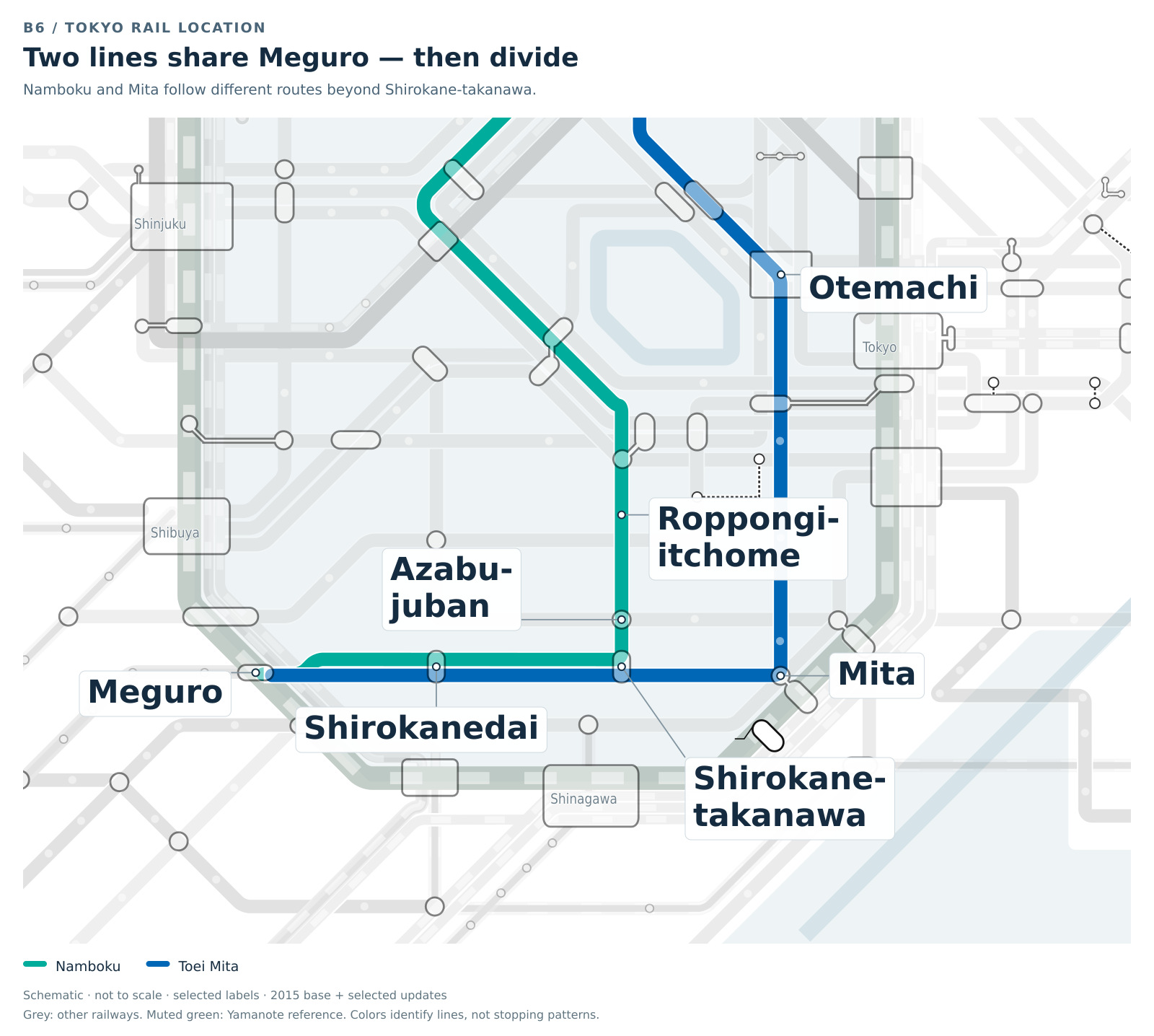
Read the route from south to north:
- Shared by both lines: Meguro → Shirokanedai → Shirokane-takanawa.
- Namboku branch: Azabu-juban → Roppongi-itchome → Tameike-sanno and onward.
- Mita branch: Mita → Shibakoen → Onarimon → Uchisaiwaicho → Hibiya → Otemachi and onward.
Toei confirms that the two operators share facilities between Meguro and Shirokane-takanawa. The Namboku station list and Toei and Tokyo Metro subway map show why “the next train toward central Tokyo” is not a sufficient instruction once your destination is beyond that section.
The word “Mita” creates an extra trap: it is both a line name and a station name. A Namboku train through the shared section does not call at Mita station.
From Meguro: choose your destination branch first
Your hotel is near Roppongi-itchome
Choose a northbound Namboku service. The relevant sequence is Shirokane-takanawa, Azabu-juban, then Roppongi-itchome. A northbound Mita service takes the other branch after Shirokane-takanawa.
If you have already boarded a Mita service at Meguro, you can change to a Namboku service at Shirokane-takanawa. That is a usable recovery plan, but waiting for the correct service at Meguro can save a transfer when you have luggage. Compare the live departures rather than assuming the first train produces the simplest trip.
Also check the hotel address: Roppongi-itchome and Roppongi are separate stations. The Namboku line does not serve Roppongi station. Our Roppongi, Akasaka and Azabu hotel-base guide helps distinguish the wider neighborhoods; the property’s own access page should settle the final station and entrance.
Your appointment is at Otemachi
Choose a northbound Mita service that continues to Otemachi. A train continuing on the Namboku branch may look equally plausible at Meguro because both lines serve the next two stations. The destination display and line name distinguish them before the tracks separate.
Otemachi is a large station complex. “Direct to Otemachi” describes the train journey, not a promise that your building entrance is beside the arrival platform. Save the building’s recommended exit before leaving.
You only need Shirokanedai
Both lines serve Shirokanedai in the shared section. For this particular trip, the branch farther north is not the deciding factor. Confirm that the departure is northbound and calls at your stop, then use its arrival platform’s exit signs.
This is the useful distinction for a Meguro-area hotel base: a convenient shared section can offer more usable departures for local trips without offering the same one-seat journey to every central-Tokyo destination.
Shirokane-takanawa: two different kinds of transfer
The official station plan shows four platform faces on two islands at basement level three. Platforms 1 and 2 share one island; platforms 3 and 4 share the other.
- Platform 1: Mita line toward Nishi-takashimadaira.
- Platform 2: Namboku line toward Akabane-iwabuchi.
- Platforms 3 and 4: services toward Meguro.
These are the normal arrangements shown on the map. Follow current signs and staff instructions if operations differ.
Continuing north after arriving from Meguro
If you arrive on the Mita line and need the Namboku branch, the normal transfer is between platforms 1 and 2 on the same island. Check the next train’s line and destination before boarding across the platform.
This is the easy case behind advice that the transfer is “just across the platform.” It applies to the direction of travel, not to every possible journey involving the two lines.
Coming south from Mita and heading north to Azabu-juban
This trip reverses direction at Shirokane-takanawa. You arrive on the Meguro-bound island, then need the northbound Namboku island. Follow the station’s signed stairs, escalators or lifts through the concourse to platform 2; you cannot make this journey by simply boarding the train across the same island.
Allow for the vertical movement, the wait for the correct train and any luggage or mobility needs. There is no universal transfer time that works for both this journey and the same-island case above. If a journey planner offers a very tight connection, check which of these two movements it expects.
Going toward Meguro: check both platforms and the endpoint
For a journey from Shirokane-takanawa to Meguro, departures can use either southbound platform. Do not assume that all useful trains leave from just the Namboku-labelled side or just the Mita-labelled side.
A concrete example appears in Toei’s weekday timetable toward Meguro, revised March 16, 2026: the 12:00 local for Hiyoshi uses platform 4, while the 12:09 express for Shin-yokohama uses platform 3. Both serve Meguro. These times illustrate the arrangement; they are not a recommended connection or a substitute for today’s board.
The express label in that example matters farther along the Tokyu route. It does not mean that the train skips Meguro in the shared subway section. If you are continuing beyond Meguro, check the stopping pattern and destination again rather than treating the subway portion as a guarantee for the rest of the trip.
A through train can cross your ticket boundary
Services can continue beyond Meguro onto Tokyu tracks, and Namboku services can continue beyond Akabane-iwabuchi onto Saitama Railway. Remaining in the same carriage does not make those sections part of the Tokyo subway fare product you bought.
The Tokyo Subway Ticket covers Tokyo Metro and Toei subway services. It does not cover Tokyu or Saitama Railway sections. Check the ticket’s conditions and ask staff about the additional fare when your destination is outside the covered network. Our Metro versus Toei guide explains the operator distinction without requiring you to memorize the entire through-service network.
Before leaving the platform
- Confirm the exact station, especially Roppongi versus Roppongi-itchome.
- From Meguro, choose Namboku or Mita for destinations beyond Shirokane-takanawa.
- For a transfer, identify whether you are continuing north or reversing direction.
- For a hotel arrival, check the exit and entrance, including the lift route if needed.
Our station-navigation guide covers the signs and exit decisions that come after choosing the correct train.
Quick questions
Can I take either line from Meguro to Shirokanedai? Yes, both serve the shared section. Confirm the direction and the current departure display.
Is changing between Mita and Namboku always cross-platform? No. Continuing north can use the same island; switching from a southbound arrival to a northbound departure requires changing islands.
Does a train for Shin-yokohama skip Meguro? The southbound services in the official example call at Meguro. Check any onward Tokyu stops separately, especially when the train is an express.
Is Roppongi-itchome the same station as Roppongi? No. Choose the station based on the actual hotel address and recommended access route.