Where to Stay in Kagurazaka & Iidabashi: Quiet Streets and Central Access
Iidabashi supplies the transport; Kagurazaka supplies the reason to come home early. Together they form a rare central Tokyo base that feels calm without being isolated.
Quick links
Is Kagurazaka and Iidabashi a good base?
Yes—especially for travelers who want central access without living above Tokyo’s loudest nightlife. Iidabashi is served by JR Chuo-Sobu Local, Tokyo Metro Tozai, Yurakucho and Namboku lines, and the Toei Oedo Line. Kagurazaka rises northwest from the station into a restaurant neighborhood of slopes, temples, small shops, and narrow side lanes.
The pairing works because each half solves the other’s weakness. Iidabashi is practical but visually ordinary around several exits. Kagurazaka is atmospheric but has fewer hotels and less convenient luggage access. Stay close to Iidabashi for transport; stay near Kagurazaka or Edogawabashi for neighborhood immersion.
This is not the best base for visitors who need department stores, airport express trains, or dinner at 01:00. It is excellent for couples, repeat visitors, Tokyo Dome trips, restaurant-focused stays, and travelers who value sleep over neon.
Best for:
- Travelers dividing time between east and west Tokyo.
- Couples who reserve small restaurants and prefer calm evenings.
- Tokyo Dome visitors who do not want to stay inside the event district.
- Families choosing Hotel Metropolitan Edmont or a large Hotel Vintage room.
- Repeat visitors seeking a residential central neighborhood.
Choose elsewhere if:
- Shibuya or Shinjuku nightlife will end most days.
- A direct airport train is mandatory.
- Large shopping facilities must be outside the hotel.
- The group cannot manage slopes, stone lanes, or a ten-minute walk.
Must-see Kagurazaka & Iidabashi landmarks and attractions
Kagurazaka & Iidabashi’s core attractions form a compact route. Use this visual shortlist to choose what to see first and where a hotel should sit.
 01
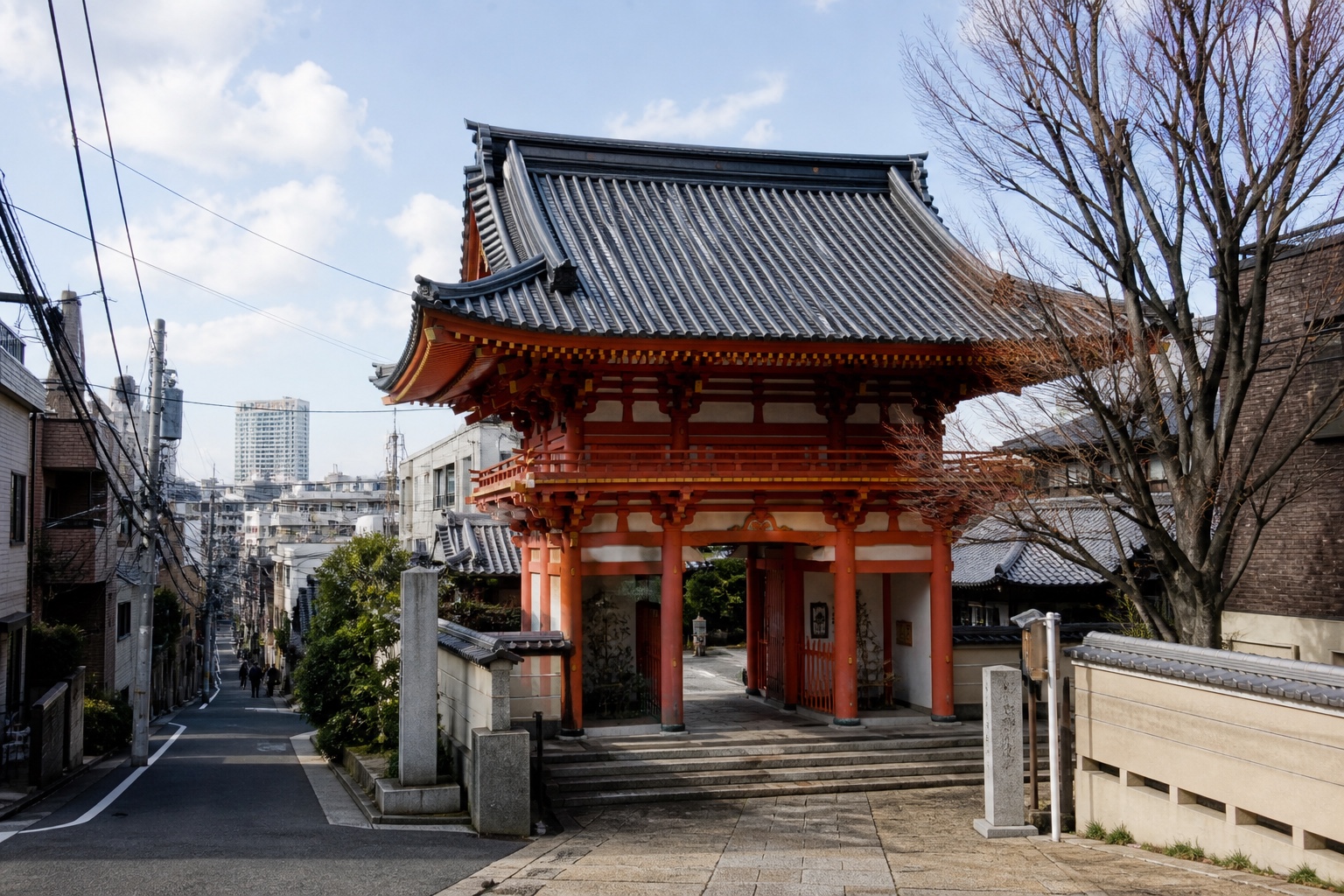
01Zenkokuji Temple
Temple walkWalk through Kagurazaka’s lanes to this named temple, one of the places structuring the neighborhood walk.
 02
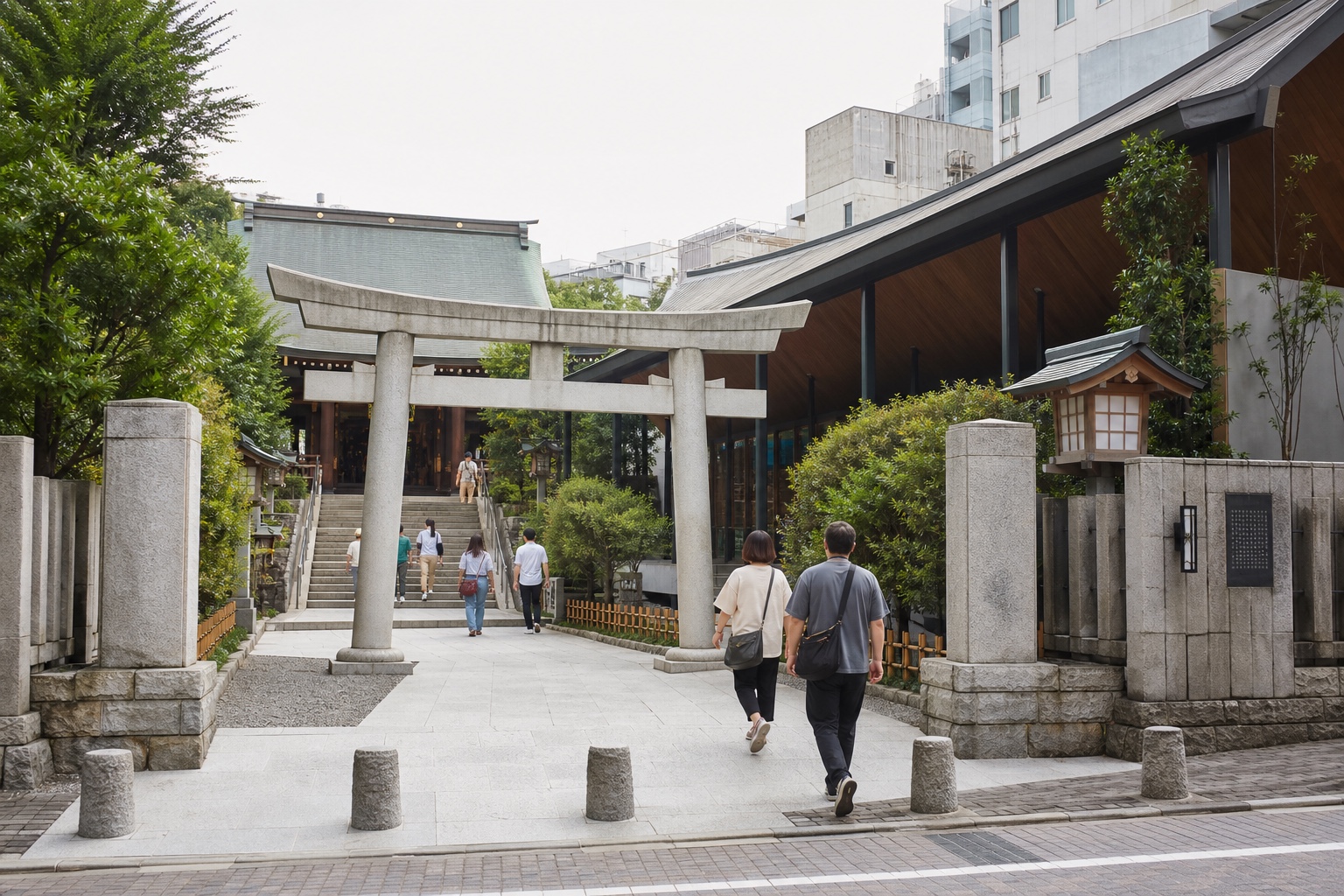
02Akagi Shrine
Shrine stopAkagi Shrine gives the upper Kagurazaka walk a clear destination among temples, restaurants, stone-paved lanes, and small shops.
 03
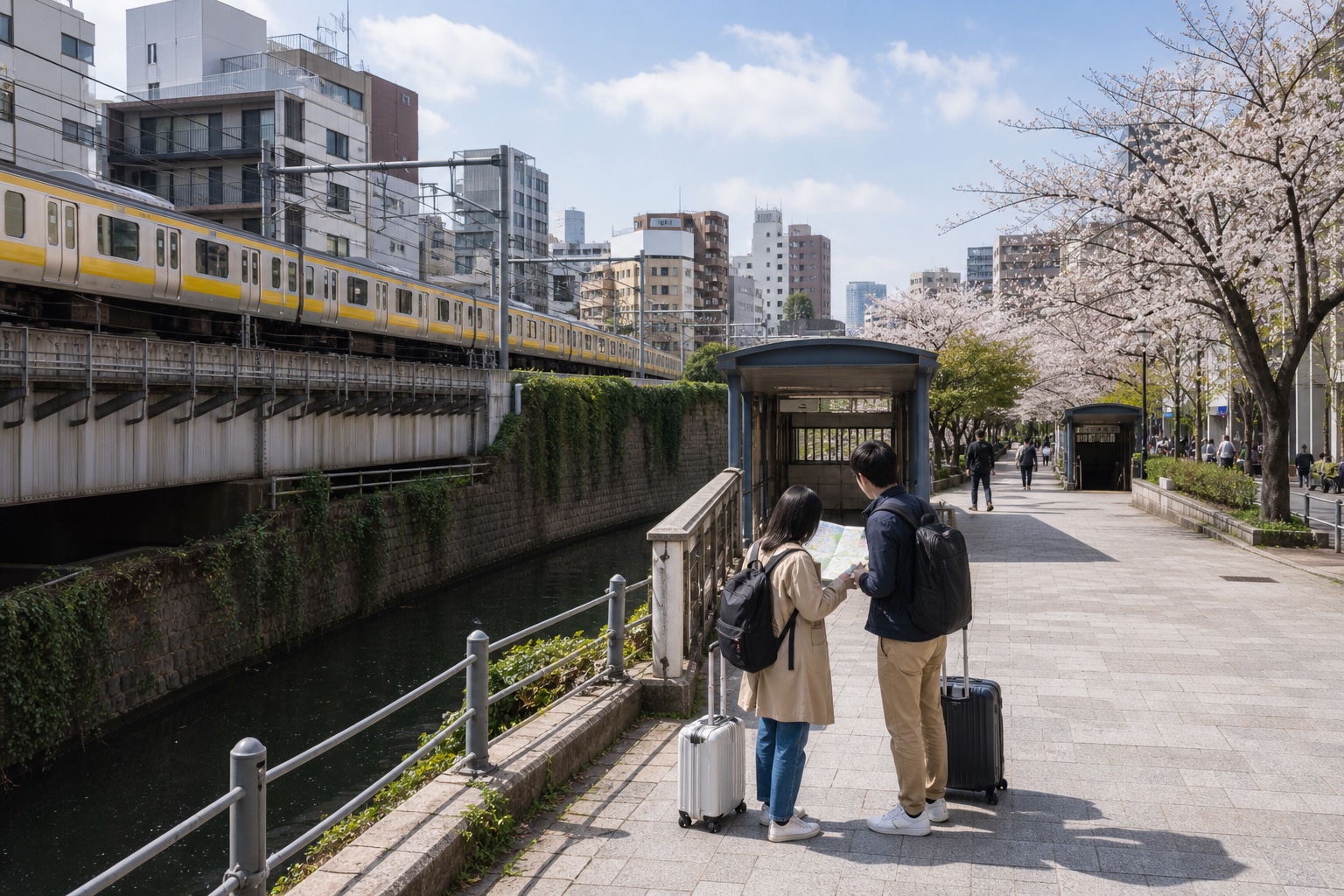
03Koishikawa Korakuen
Garden and canalThe Iidabashi side pairs canal walks with Koishikawa Korakuen’s gardens and historic grounds.
 04
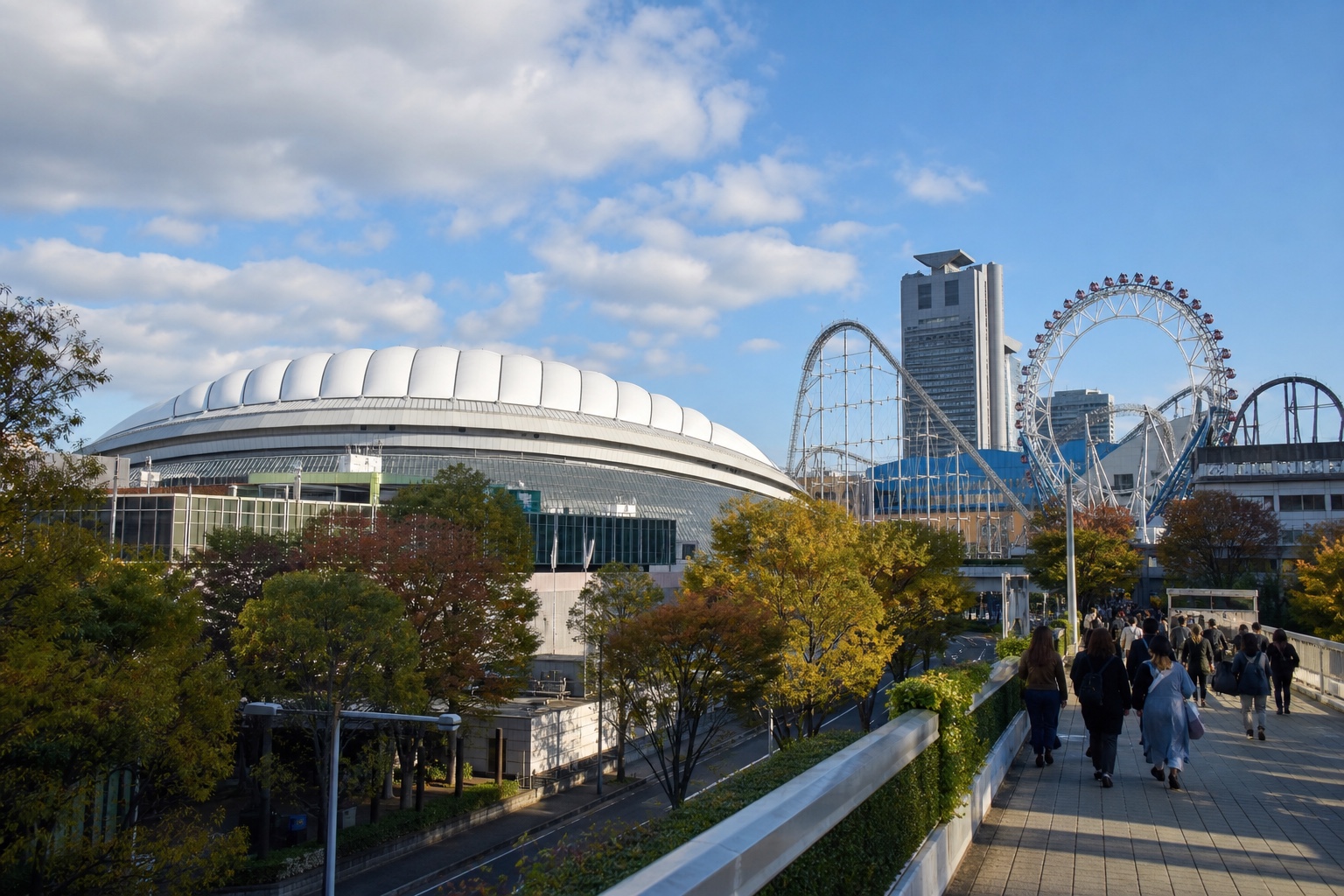
04Tokyo Dome City
Family attractionA family-oriented branch from the canal, gardens, and calm Iidabashi base.
Iidabashi or Kagurazaka: choose the right side
Iidabashi Station spans a large area. The JR tracks and canal form the visible center, while different Metro and Toei concourses extend beneath surrounding blocks. “Five minutes from Iidabashi” is incomplete without an exit and operator.
The east and south side favors Hotel Metropolitan Edmont, APA, offices, Tokyo Daijingu, Kudanshita, and Tokyo Dome access. It is flatter and easier with luggage. The west/northwest side opens toward Kagurazaka’s main slope and side lanes. It gives better evening atmosphere but more foot traffic and gradients.
Upper Kagurazaka, near Kagurazaka Station and Edogawabashi, feels quieter and more local. Hotel Vintage and UNPLAN sit here. The Tozai Line is useful, but guests lose Iidabashi’s one-station interchange convenience unless they walk or ride back.
A simple booking rule
Choose Iidabashi when the itinerary is spread across Tokyo. Choose Kagurazaka when two or three dinners and slow neighborhood mornings are central to the trip. Do not book an upper-Kagurazaka property and then complain that JR is not outside the door; the distance is the price of the atmosphere.
Getting around
JR Chuo-Sobu Local runs directly to Shinjuku westbound and Akihabara eastbound. The Tozai Line reaches Otemachi and Nihombashi while continuing toward Takadanobaba and Nakano. The Yurakucho Line is direct to Ikebukuro and Ginza-itchome; the Namboku Line serves central north-south destinations; the Oedo Line reaches Roppongi and Shinjuku-nishiguchi.
| Destination | Practical line | Trade-off |
|---|---|---|
| Shinjuku | JR Chuo-Sobu Local | Direct, but local rather than express |
| Akihabara | JR Chuo-Sobu Local | Direct and simple |
| Tokyo Station | Tozai to Otemachi, then walk/transfer | Underground navigation takes time |
| Ikebukuro | Yurakucho Line | Direct |
| Roppongi | Toei Oedo Line | Direct but deep subway |
| Ginza | Yurakucho to Ginza-itchome | Final walk depends on destination |
| Tokyo Dome | Walk or short local trip | Event crowds affect paths |
Changing among five lines is not always fast. Entrances, gates, and platforms are separated. Families and mobility-limited travelers should use the official station map to select a lift-equipped exit rather than following the closest stair symbol.
Station side matters: Iidabashi combines JR, Tokyo Metro, and Toei routes, while Kagurazaka is more walk-and-slope oriented. For a suitcase, compare the Tokyo Metro Iidabashi accessibility guide and Toei Iidabashi station guide with the hotel’s exact street route. A hotel described as “Kagurazaka” may still be a long walk from the lift-equipped Iidabashi side.
Airport access requires a transfer. From Haneda, routes commonly use the Asakusa/Tozai network through Nihombashi or other city connections. From Narita, Keisei plus Metro is common. Check the live route; neither Kagurazaka nor Iidabashi is an airport-express base.
What Kagurazaka feels like
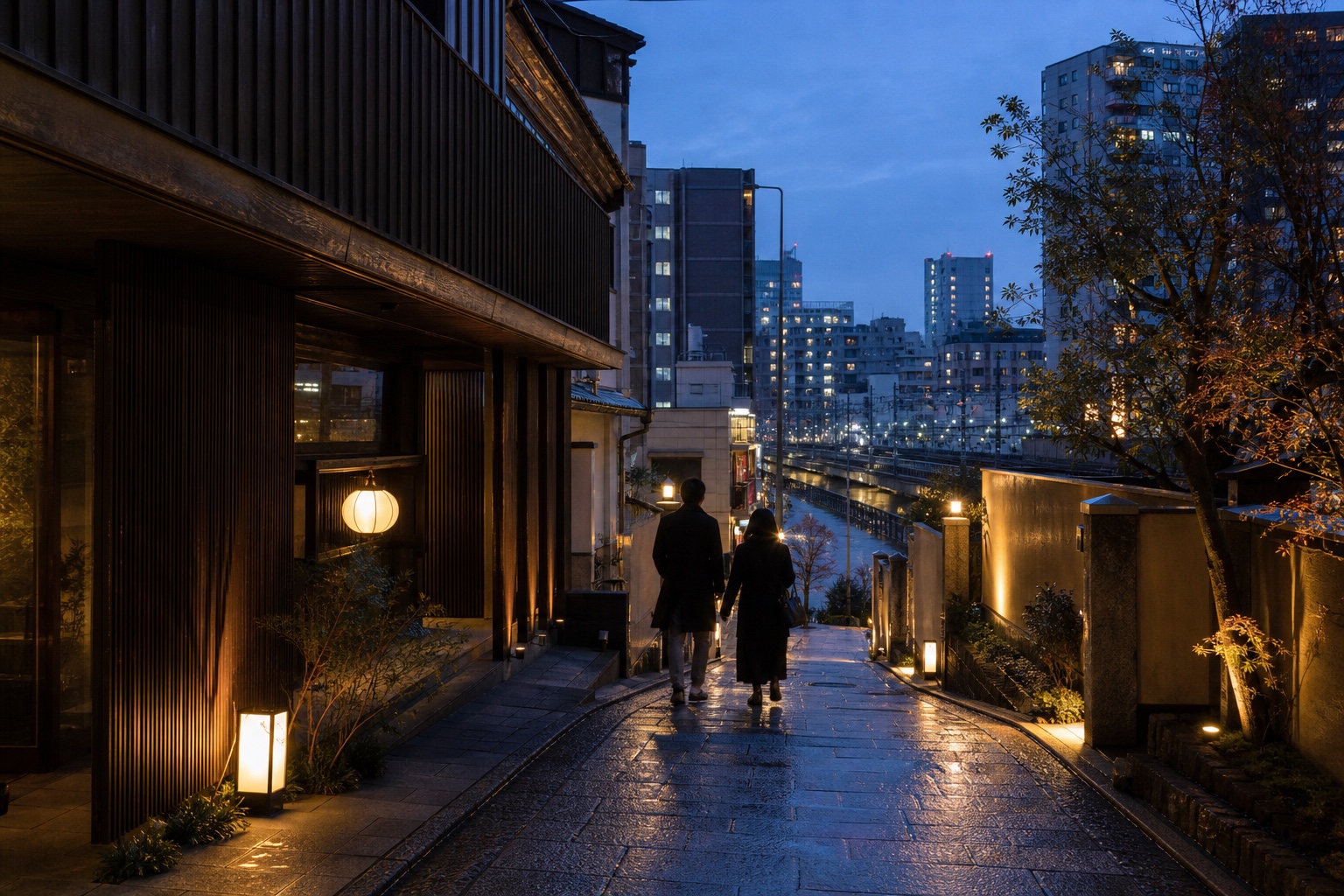
Kagurazaka’s main street is active with bakeries, cafes, supermarkets, shops, temples, and restaurants. Its identity becomes clearest in side lanes where stone paving, restrained entrances, and small dining rooms survive beside modern apartments.
The neighborhood’s former geisha-district history is real, but visitors should avoid turning it into costume scenery. Some lanes lead to operating restaurants and private residences. Speak quietly, ask before photographing people or entrances, and never block a doorway for a portrait.
Akagi Shrine and Zenkokuji Temple give structure to a walk. French restaurants, Japanese dining, sweets, and independent cafes reflect the neighborhood’s long cultural mix. Prices range widely. “Hidden alley” does not mean cheap, casual, or walk-in.
The main slope can be busy in the evening, then quiet quickly after restaurants close. This is a dining neighborhood, not a club district. A reserved 19:00 dinner and a short walk home is the ideal rhythm.
Eating and reservations
Kagurazaka rewards planning. Many desirable restaurants occupy small rooms and may serve set courses. Reserve when a particular dinner matters, disclose allergies in advance, and arrive on time. A late cancellation can be more disruptive than at a large restaurant.
The area also supports flexible meals: soba, ramen, curry, bakeries, cafes, supermarkets, and convenience stores. Iidabashi station-side buildings broaden weekday lunch and practical dinner choices. Tokyo Dome event nights can increase demand east of the station.
Do not depend on one viral restaurant. Save a reserved special meal, one casual backup, and one station-side late option. English menus vary. Translation tools help with text but do not explain fish stock, shared grills, or allergy cross-contact.
Breakfast is quieter than dinner. A cafe, bakery, or hotel breakfast works better than searching residential lanes at 07:00. UNPLAN has a cafe, while larger Iidabashi hotels offer more conventional breakfast operations. Confirm current hours.
Best hotels in Kagurazaka and Iidabashi
These six stays were checked against official sites. The set includes three Iidabashi hotels, two true Kagurazaka-side properties, and one clearly labeled Ichigaya alternative. Fixed rates and guest scores are omitted because they change.
Hotel Metropolitan Edmont is the full-service family choice. VIA INN is the balanced practical choice. APA is the closest compact station-oriented option. Hotel Vintage solves a rare problem—large group rooms in central Tokyo. UNPLAN is the hostel/social option. Grand Hill Ichigaya is useful only when another multi-line station is acceptable.
- ★★★★★Not ratedOur pick
Hotel Metropolitan Edmont
Families, restaurants, and full serviceA substantial city hotel with multiple restaurants and broader family inventory than most neighborhood properties. Its east-side location favors JR, Tokyo Dome, and business travel.
Pros:Reliable full-service facilities, useful family rooms, and strong multi-line access.
Price: 🏷️ Full-service city hotelTrade-off: It is east of Iidabashi rather than among Kagurazaka’s atmospheric lanes.
📍 5 minutes from JR Iidabashi east exit🗺️ Map - ★★★★★Not rated
VIA INN Iidabashi Korakuen
Couples, solo travelers, and simple valueA modern practical base with rooms from compact singles to a 22-square-meter deluxe twin. The accessible room can take three with an extra bed under the official configuration.
Pros:Balanced price/location choice, individual air conditioning, and useful room variety.
Price: 🏷️ Practical mid-range hotelTrade-off: Entry rooms are 13–16 square meters and the location is functional rather than romantic.
📍 5 minutes from Metro B1; 6 minutes from JR🗺️ Map - ★★★★★Not rated
APA Hotel Iidabashi Eki-Minami
Solo travelers and short station-focused staysThe closest straightforward business-hotel choice in this set. It works when a bed, desk, and quick station walk matter more than shared space or neighborhood character.
Pros:Short Tozai access and a simple predictable stay.
Price: 🏷️ Compact business hotelTrade-off: Rooms are compact and the south/east position is not the Kagurazaka experience.
📍 About 2 minutes from Tozai Line Exit A5🗺️ Map - ★★★★★Not rated
Hotel Vintage Kagurazaka
Families and groups of four to eightAn unusually strong group option with 30–76-square-meter rooms and multiple fixed beds plus day-bed configurations. One-room-per-floor categories add privacy.
Pros:Rare central Tokyo space, group capacity, and genuine Kagurazaka-side location.
Price: 🏷️ Large-room boutique hotelTrade-off: Very small inventory, higher group-oriented pricing, and a longer journey to Iidabashi’s lines.
📍 4 minutes from Kagurazaka Exit 2 and Edogawabashi Exit 2🗺️ Map - ★★★★★Not rated
UNPLAN Kagurazaka
Solo social travel and budget private roomsA cafe-hostel with dormitories, private doubles, and family rooms. It places guests in the upper Kagurazaka/Edogawabashi side rather than beside Iidabashi.
Pros:Neighborhood immersion, social common space, and flexible room types.
Price: 🏷️ Hostel and private roomsTrade-off: Shared facilities vary by booking and the official FAQ states the building is not fully barrier-free.
📍 3 minutes from Kagurazaka Station Exit 2🗺️ Map - ★★★★★Not rated
Hotel Grand Hill Ichigaya — nearby alternative
Japanese rooms and travelers prioritizing another four-line stationThis is an Ichigaya alternative, not a Kagurazaka hotel. It offers 17–24-square-meter conventional rooms and a 36-square-meter Japanese room for four.
Pros:Excellent station access, real Japanese-style family room, and conventional hotel services.
Price: 🏷️ Nearby full-service alternativeTrade-off: Guests trade nightly Kagurazaka walks for a separate station and neighborhood.
📍 3 minutes from JR, Toei, and Metro Ichigaya🗺️ Map
How to choose the right hotel
Families and groups
Hotel Vintage has the most unusual inventory: official layouts from 30 to 76 square meters, with capacities of four to eight using fixed beds and day beds. Confirm the exact sleeping arrangement; “capacity six” does not mean six identical beds.
Hotel Metropolitan Edmont offers conventional full-service support and family inventory near Iidabashi. Hotel Grand Hill Ichigaya’s 36-square-meter Japanese room sleeps four, but it changes the base to Ichigaya.
Couples
Hotel Vintage suits couples wanting space and design, though it may be excessive for two. VIA INN’s deluxe twin gives a conventional 22-square-meter alternative. A smaller Hotel Metropolitan room makes sense when restaurants and service matter more than boutique character.
Solo travelers
UNPLAN offers dormitories and private rooms near Kagurazaka Station. It is best for travelers comfortable with hostel conditions and shared spaces. APA and VIA INN provide private business-hotel rooms closer to Iidabashi. Compare room size, not only price.
Accessibility
VIA INN lists a 29.5-square-meter accessible room that can accommodate three with an extra bed. Hotel Vintage lists accessible categories. Those labels are a starting point, not proof that every required dimension or bathroom feature fits. Contact the property.
UNPLAN explicitly states that it is not fully barrier-free. Travelers who need step-free circulation should not book it on the assumption that a modern website implies a fully accessible building.
A two-day plan
Day one: lanes and dinner
Start at Iidabashi and walk uphill, noting the return route before exploring side lanes. Visit Zenkokuji, browse shops, continue toward Akagi Shrine, and pause at a cafe. Do not fill every hour; the district’s value is the walk between places.
Return to the hotel before a reserved dinner. This avoids carrying shopping bags into a small dining room and gives the group time to arrive punctually. Walk home rather than adding another attraction.
Day two: gardens, canal and books
Walk the canal and visit Koishikawa Korakuen after checking current hours. Continue to Tokyo Dome City for a family itinerary, or take the train to nearby Jimbocho for books and cafes. Tokyo Daijingu and Kudanshita form another quieter route.
The area works as a base precisely because the second day can move east or west without abandoning a calm evening.
Safety and practical details
The main risks are ordinary urban ones: slippery stone after rain, bicycles, station crowds, poorly lit residential turns, and missed last trains. Keep voices down in lanes and avoid photographing private premises.
Suitcases are easiest on the Iidabashi side. Upper Kagurazaka involves slopes and textured paving. Confirm luggage storage before arrival, particularly at hostels or small hotels with limited reception hours.
Late-night convenience stores remain available, but restaurant choice narrows. Save the hotel pin and exact entrance because several lanes look similar after dark. If mobility, allergies, or a child’s bed setup is essential, obtain written confirmation from the hotel.
Booking decision notes
Kagurazaka and Iidabashi should be treated as two connected but different hotel bases. Iidabashi is the practical side: JR Chuo-Sobu, the Tozai Line, Yurakucho Line, Namboku Line, and Oedo Line give the area unusually broad coverage. The station is not effortless with luggage, however. Long corridors and several exits can turn a short rail journey into a tiring arrival, so confirm the hotel’s nearest exit instead of relying on the station name alone. Kagurazaka is the atmospheric side, with restaurant lanes, Zenkokuji, Akagi Shrine, and a quieter walk home, but its slopes and textured paving are real trade-offs.
Hotel Metropolitan Edmont is the safest all-round choice for families who want full service, multiple restaurants, and a larger room selection. VIA INN Iidabashi Korakuen is the balanced mid-range option when a compact but modern room and a short Metro walk matter more than atmosphere. APA Hotel Iidabashi Eki-Minami is a predictable short-stay choice for solo travelers. Hotel Vintage Kagurazaka is the unusual group option: its 30–76-square-meter rooms can solve a space problem that ordinary Tokyo business hotels cannot, but inventory is small. UNPLAN Kagurazaka works for travelers who value a social hostel and private-room flexibility, provided shared facilities and accessibility limits fit the trip.
The neighborhood is strongest for a trip that mixes central sightseeing with slower evenings. Tokyo Dome City, Koishikawa Korakuen, Tokyo Daijingu, Jimbocho, and the canal are close enough to build a second day without crossing Tokyo. Airport convenience is less direct than Ueno or Shinagawa, and the uphill walk is not a good default for a heavy suitcase in rain. Book Kagurazaka for the evening experience; book Iidabashi for the transport network; choose Ichigaya or Suidobashi when the exact hotel requirement matters more than the neighborhood label.
FAQ
Is Iidabashi central?
Yes. Five rail/subway services create strong coverage even though it is not on the Yamanote Line. Transfer distances inside the station are the main caveat.
Is Kagurazaka quiet?
Side lanes and upper residential blocks are calm, but the main slope and restaurants can be busy at dinner. Hotel-room noise still depends on the exact street and room orientation.
Can I walk from Iidabashi to Kagurazaka Station?
Yes, but it is an uphill neighborhood walk rather than an in-station transfer. With luggage, rain, or limited mobility, use the closest station to the hotel.
Is the area good for families?
Yes when the room is chosen carefully. Hotel Metropolitan and Hotel Vintage offer the strongest family options; many entry-level business rooms are too small for multiple large bags.
Is it good for first-time Tokyo visitors?
It suits a first trip that values calm and does not require an airport express outside the hotel. Visitors wanting maximum visual intensity may prefer Shinjuku or Shibuya.
Final verdict
Iidabashi and Kagurazaka offer a rare bargain in location rather than price: central connections without central-Tokyo sensory overload. Book near Iidabashi for movement, or deeper in Kagurazaka for atmosphere. The wrong choice is expecting one side to behave exactly like the other.
Explore more Tokyo areas
Compare Suidobashi and Korakuen for Tokyo Dome and family attractions, Shinjuku for shopping and late nights, and Kanda and Jimbocho for books, business-hotel value, and Tokyo Station access.

Suidobashi & Korakuen
Choose it for Tokyo Dome events, family attractions, and a larger hotel supply.
Open guide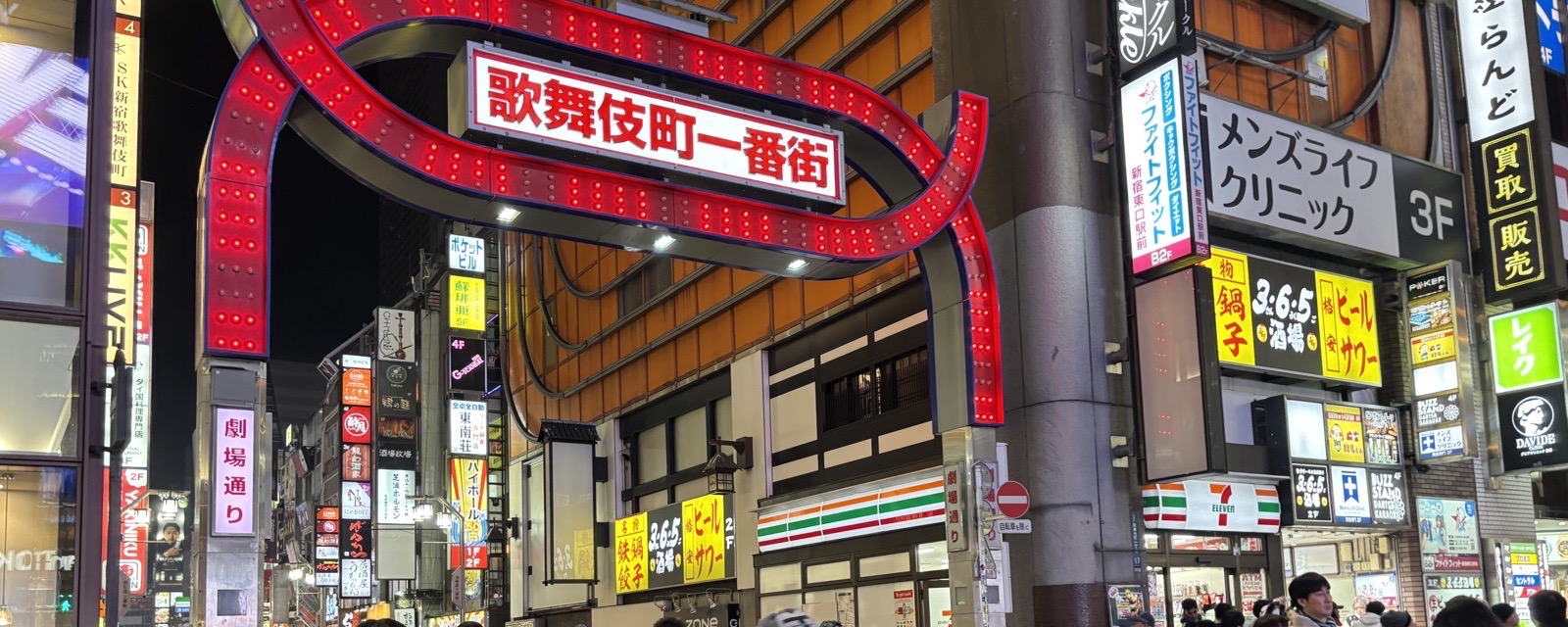
Shinjuku
Choose it for late-night dining, shopping, and maximum west-Tokyo transport.
Open guide
Kanda & Jimbocho
Choose it for books, business-hotel value, and easier Tokyo Station access.
Open guideSome links below are affiliate links. If you book through them we may earn a small commission at no extra cost to you.