JR rail guide
Joban Rapid vs Local: Why Your Train May Not Go to Ueno
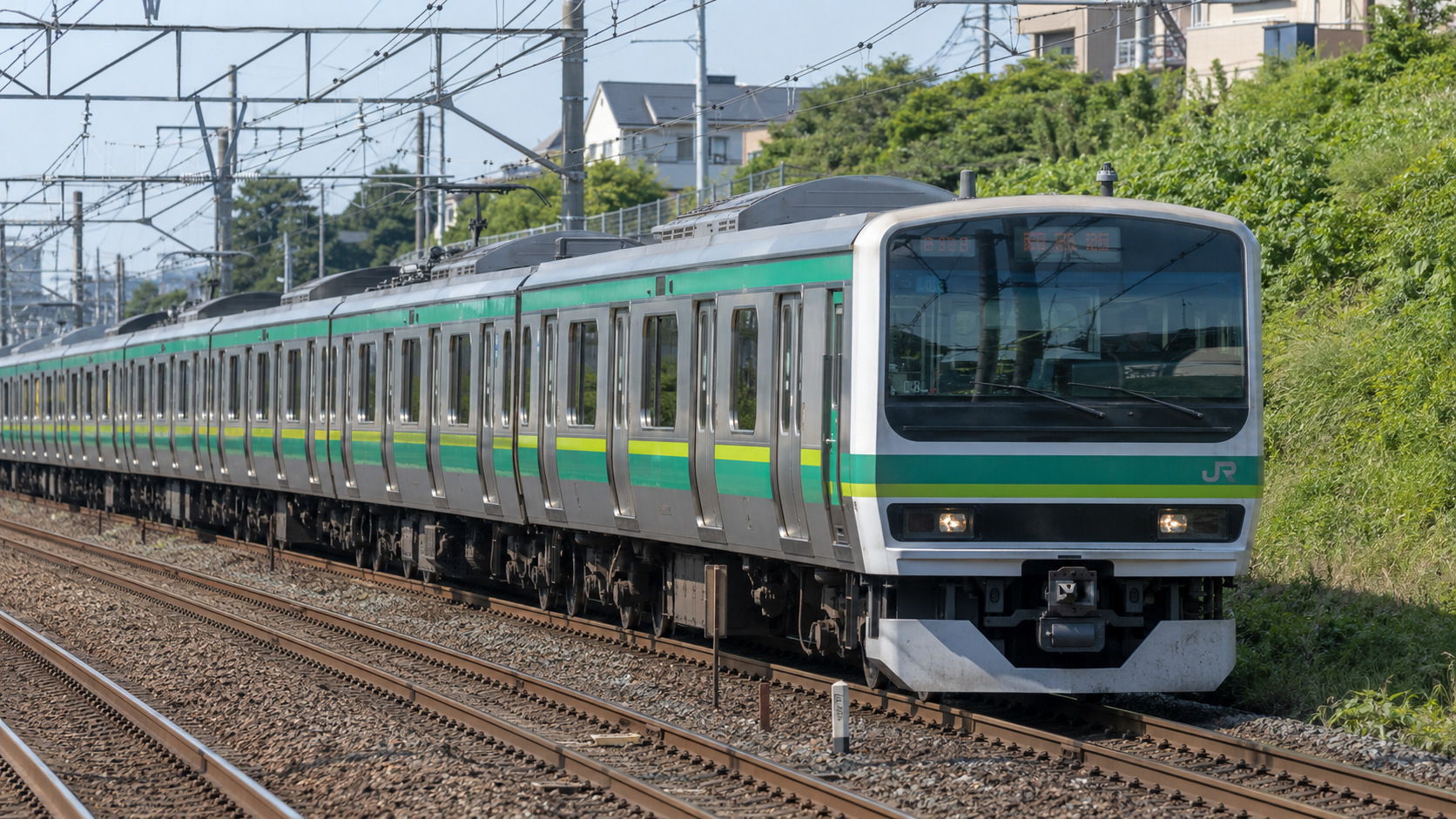
For Nippori or Ueno, choose a suitable train on the Joban Rapid corridor. For Kameari or Kanamachi, use Joban Local. The difference is more than speed: southbound Local trains run through the Chiyoda subway, so they do not follow the Rapid route to Nippori and Ueno.
This matters most on the return journey. You can arrive at Kashiwa from Nippori and later board a train at the same station that heads into a completely different part of Tokyo. The shared “Joban” name does not mean the two departures retrace the same route.
Two service families, two central-Tokyo paths
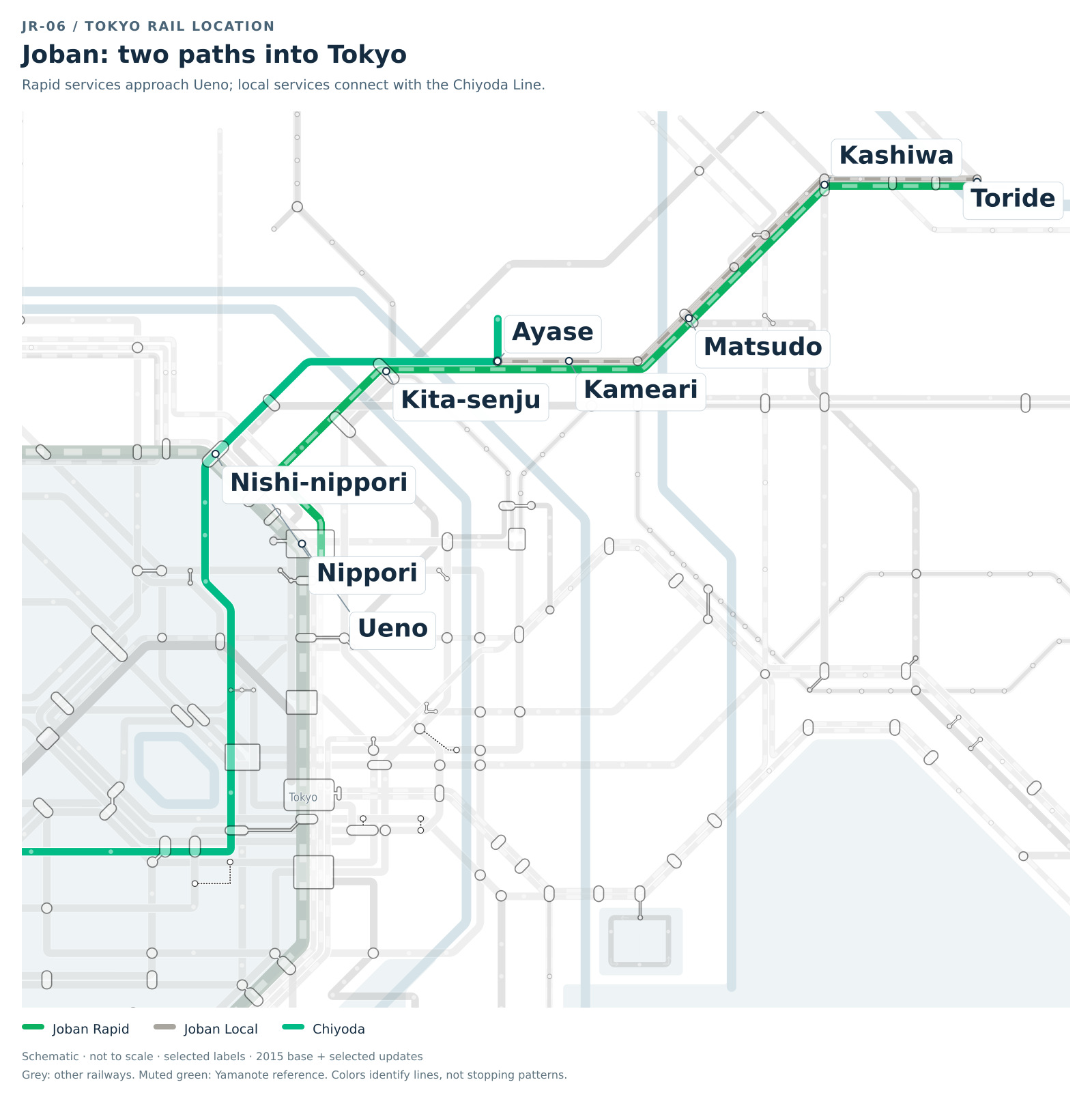
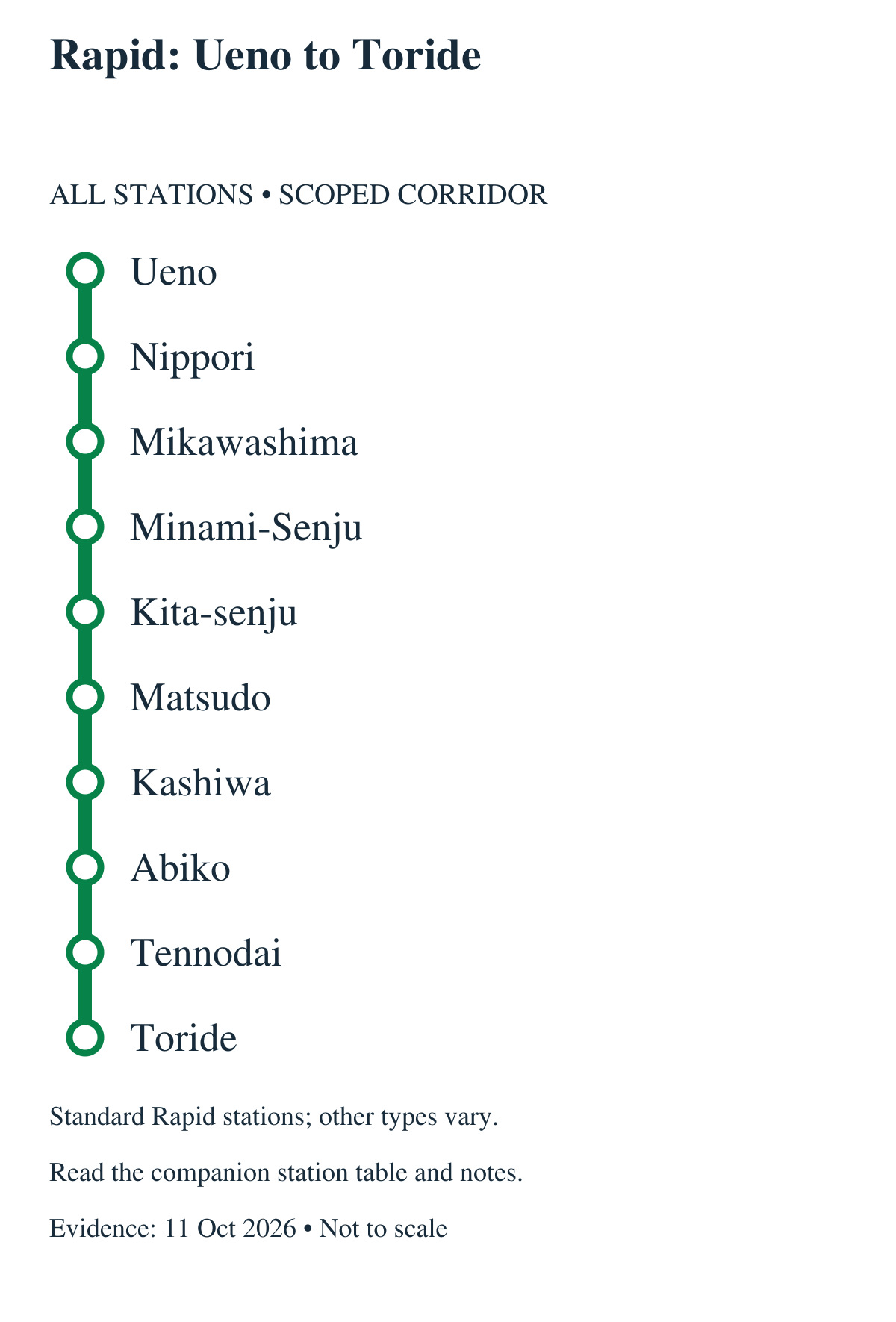
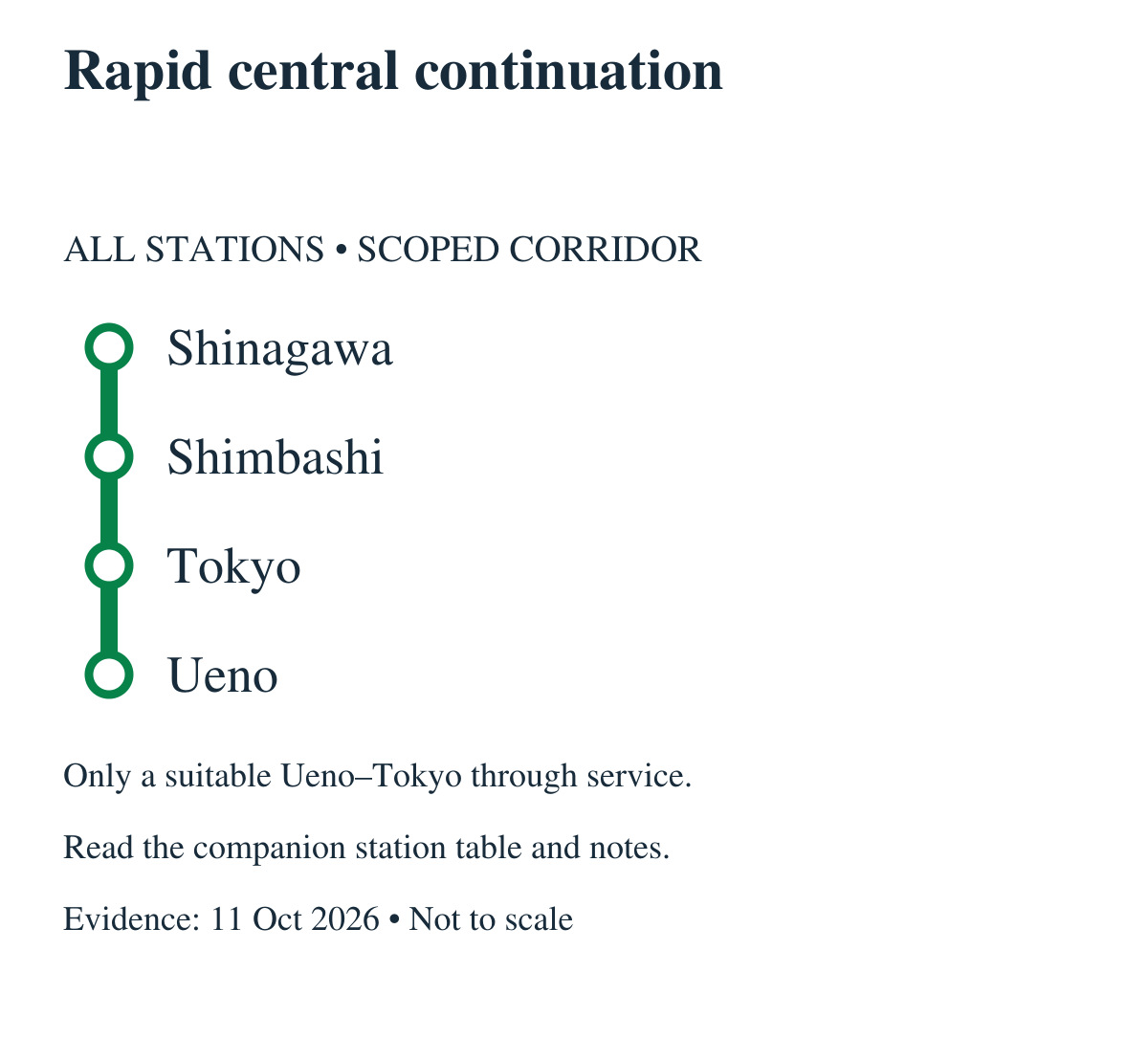
The Rapid corridor connects stations such as Kashiwa and Matsudo with Kita-senju, Nippori and Ueno. Some trains continue via the Ueno–Tokyo Line to Tokyo, Shimbashi and Shinagawa; others end at Ueno or sooner. Check the destination if you need the through section.
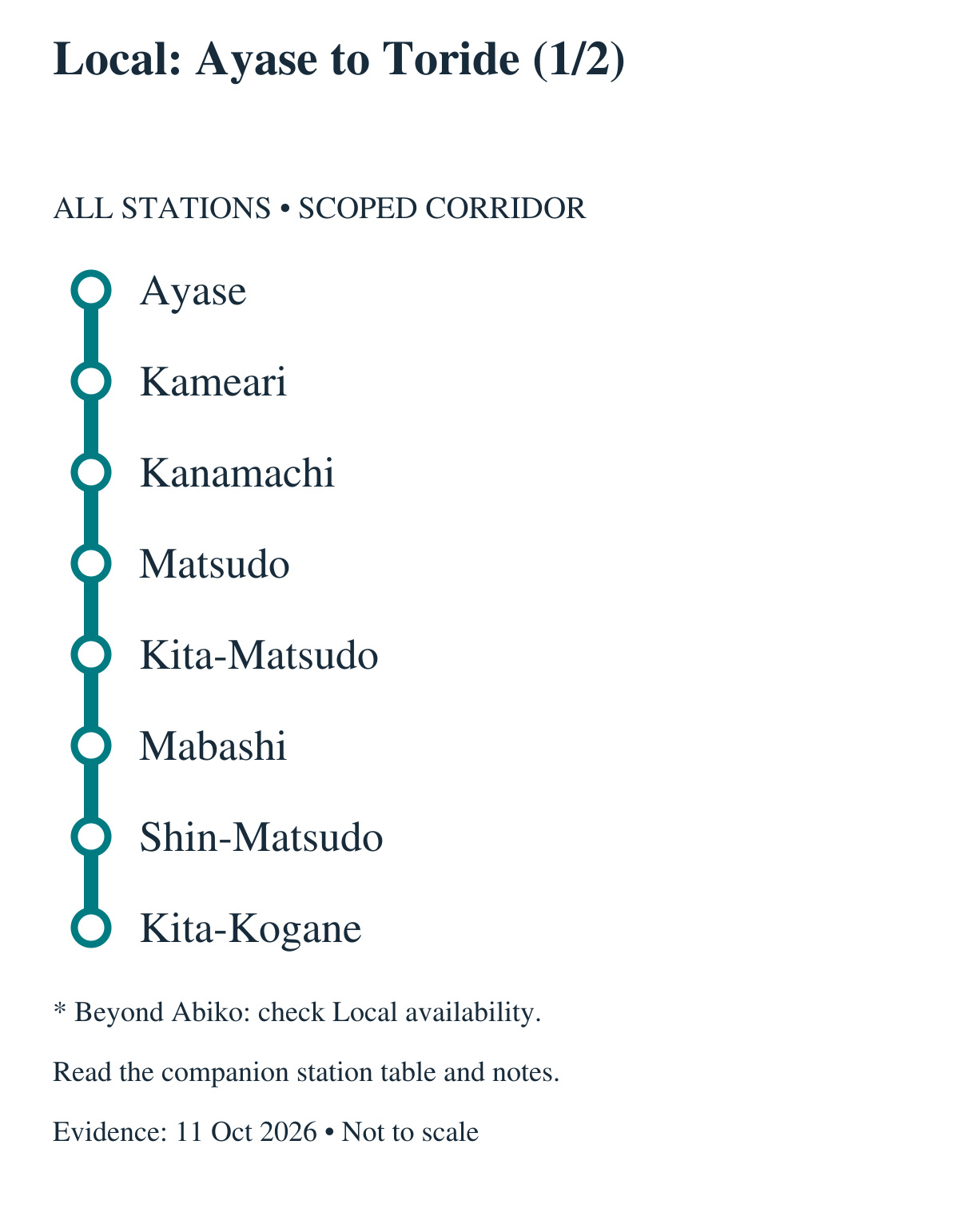
Joban Local serves additional stations between the larger stops and connects through Ayase with Tokyo Metro’s Chiyoda Line. Suitable through trains serve Chiyoda destinations such as Nishi-nippori, Otemachi and Omotesando rather than Nippori and Ueno.
JR East’s Kashiwa timetable lists Rapid toward Ueno/Tokyo/Shinagawa and Local toward Ayase separately. Nippori’s timetable lists the Rapid corridor, not Joban Local. These are useful checks when a route planner’s shorthand makes both journeys look like the same train.
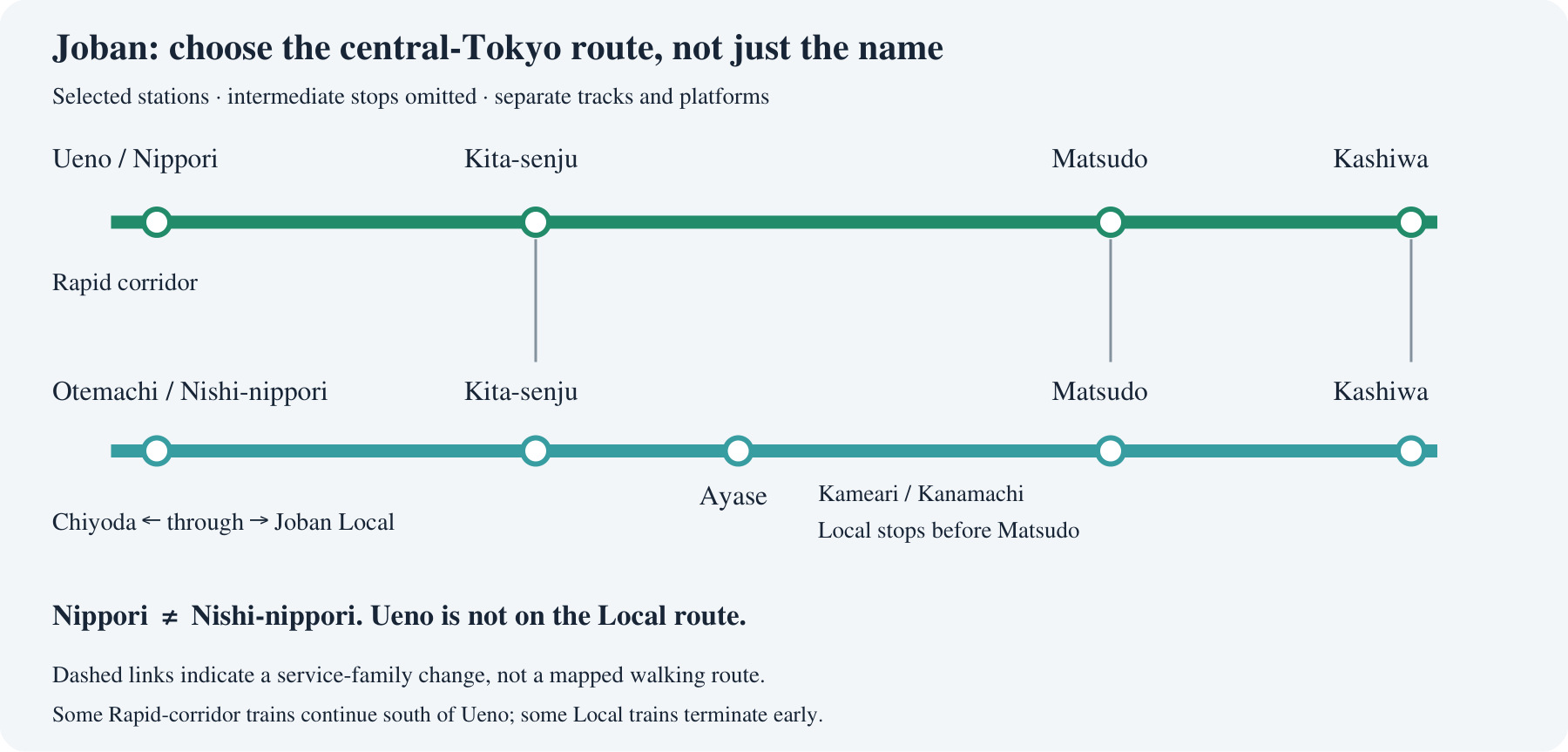
Selected stations only; intermediate stations omitted. Rapid and Local use different tracks/platforms at shared stations. The diagram shows route choices, not the station’s physical platform arrangement.
Train colour is not enough. Read the line, direction, service type and stopping list. A JR-branded train can continue onto the subway, while a train labeled “Local” or “Ordinary” elsewhere in the timetable may belong to the Rapid corridor’s longer-distance service family.
The easily missed distinction: “Ordinary” is not always Joban Local
JR East’s Rapid-corridor timetable includes trains described as Ordinary as well as Rapid. In that context, an Ordinary train serving stations north of Toride still uses the Rapid stopping corridor through the Tokyo metropolitan section. It does not suddenly call at every Joban Local station.
For Kameari, Kanamachi, Kita-Matsudo or Shin-Matsudo, look specifically for Joban Local and inspect its stops. Do not assume “Ordinary” on a longer-distance Joban train means it will call at Kameari. The current Kashiwa Rapid-corridor timetable explains the Ordinary/Rapid distinction and links each departure’s details.
Special Rapid and Hitachi/Tokiwa limited expresses introduce other stopping patterns. A shortcut label is not a substitute for finding your station on the list.
Worked return: Kashiwa to Nippori
At Kashiwa, first choose the Rapid corridor toward Ueno rather than Local toward Ayase/Chiyoda. Then select a regular departure whose stopping list includes Nippori. An Ueno-bound train can work; a suitable Shinagawa-bound through train can also work because Nippori is before Ueno on that journey.
A Local for Yoyogi-Uehara is not the same return route. It can take you through Chiyoda’s Nishi-nippori, but that is a different station from Nippori. If you are transferring to a booked airport train at Nippori, this distinction affects both your transfer plan and the time you need.
If you notice the mistake while still at a shared station such as Matsudo, check an interchange to a suitable Rapid-corridor train. If you are already farther along, use your actual next station in a fresh route search. Do not ride on hoping that “Nishi” will disappear from the station name.
For airport planning, use the Narita access guide. A connection at Nippori does not make the Joban train itself an airport service, and Keisei’s ticket requirements are separate.
Worked outward trip: Ueno to Kameari
Kameari is served by Joban Local, so an ordinary Rapid-corridor train from Ueno will pass the area without stopping there. A practical route is a suitable regular Joban train from Ueno to Kita-senju, followed by a Chiyoda/Joban Local train toward Ayase and onward to Kameari.
At Kita-senju, check that the second train continues beyond Ayase onto Joban Local and calls at Kameari. A train ending at Ayase stops short; a Kita-ayase destination follows a different branch. A suitable Matsudo- or Abiko-bound through train is the kind of onward service to look for, subject to its actual stopping list and the day’s operation.
The journey requires a real platform-area change at Kita-senju. It is not a matter of waiting beside the Rapid train for a slower one to appear. Save the transfer instruction as well as the final station name.
If your starting point is already on the Chiyoda Line, a suitable through train may avoid this Rapid-to-Local change. Compare that with the entire walk from your hotel rather than routing every trip through Ueno.
Kita-senju: follow Chiyoda/Joban Local or JR Rapid signs deliberately
Kita-senju brings together several railways and more than one subway line. For this transfer, look specifically for the Chiyoda Line/Joban Local connection. Hibiya Line signs lead to a different service even though both are Tokyo Metro lines.
Use Tokyo Metro’s Kita-senju station map alongside JR East’s station information. The Local/Chiyoda platforms are underground and separate from the JR Rapid platform area. Check the current departure board once you reach the correct line.
If you need step-free access, identify your arrival platform and ask staff for the current lift route before following the nearest staircase signs. Lift availability and construction can affect the path. This guide does not certify a platform-to-platform accessible route or a fixed transfer duration.
A Kita-senju hotel base can give you several route choices, but the station name alone does not tell you which entrance or platform family serves today’s trip. For a Ueno hotel base, the initial Joban choice is on the Rapid corridor; local-only destinations still need a connection.
Fares: do not draw a simple price boundary at Ayase
Through-running crosses the JR/Metro network, but the Kita-senju–Ayase section has special fare treatment. Tokyo Metro’s rules distinguish journeys wholly within that section from journeys continuing toward the JR Joban side or farther into the subway. Depending on the itinerary, JR or Metro fare rules apply differently.
The safe approach is to price the complete origin-to-destination journey. Use the official Kita-senju–Ayase fare explanation or ask staff when combining tickets or passes. “Change operator, add a second full fare” is not a reliable shortcut for this section.
For a normal supported IC-card journey, use the same card consistently at the required gates. If combining a rail pass with paid travel, show staff the pass and the full route before trying to settle the uncovered part. The Suica and Pasmo guide covers ordinary IC use; it does not replace the special-section rules.
Hitachi and Tokiwa are a third decision
Hitachi and Tokiwa are limited expresses. They are not simply faster versions of an ordinary commute that you can board with base fare alone. Check their stopping stations and the applicable limited-express ticket before using one.
JR East’s limited-express usage guide explains reserved and seat-unspecified products. An apparently empty seat is not evidence that your ordinary ticket covers it. If your trip is to a local-only station, a limited express cannot solve the missing-stop problem.
Green Cars on ordinary trains are another separate paid product when provided. They should not be confused with limited-express accommodation. Check your selected train and ticket rather than assuming all Joban services have the same carriage arrangement.
A short station-choice checklist
- Nippori: choose the Rapid corridor and a train that calls there. Nishi-nippori on Chiyoda is different.
- Ueno: choose a suitable Rapid-corridor train. Joban Local through Chiyoda does not run there.
- Kameari or Kanamachi: choose Joban Local, with a Rapid-to-Local change if your origin needs one.
- Matsudo or Kashiwa: both service families can be relevant; the next destination determines which you need.
- Otemachi or Omotesando: a suitable Joban Local/Chiyoda through train can be useful. Confirm it continues far enough.
- Tokyo or Shinagawa: use a suitable Rapid-corridor Ueno–Tokyo through service, or plan a change if it ends earlier.
This is a decision list, not a complete catalogue of Joban stations.
Quick answers
Do I have to change at Ayase when a Local train becomes Chiyoda?
Not if your selected train runs through to the Chiyoda station you need. Stay aboard that service unless an announcement changes the operating plan. A train ending at Ayase is different and needs an onward connection.
Does every Joban Rapid-corridor train continue to Shinagawa?
No. Ueno and other shorter destinations also appear. Check for a service that reaches Shinagawa, or include the change in your itinerary.
Is changing at Kita-senju the same as changing at Matsudo?
Both can be relevant to a Rapid/Local journey, but their station layouts and the resulting route differ. Choose the interchange in a complete route plan; don’t assume that one station’s platform instructions work at the other.
Before the last leg home
Check the train’s terminus again on the return trip, especially late at night. Local and Rapid services can finish at intermediate stations. Also recheck JR East’s service information and Tokyo Metro’s station information if through-running is disrupted.
If you make a mistake, ask staff about the fare treatment before exiting and starting over. There is no blanket promise of a free reverse journey. Our station-navigation guide helps turn a route result into the correct line and direction at the station.
Service and ticket sources checked 11 October 2026. Travel-date stopping lists and operating notices take priority.
All stations within this guide route scope
Evidence checked: 11 October 2026. Complete Ueno–Toride standard Rapid station inventory (10) and Ayase–Toride Local station inventory (14), plus the connecting central approaches at Ueno and Ayase.
Original editorial diagrams; station order is factual, not to scale. No source artwork or departure-time table reproduced. Circles indicate inventory, not a universal stopping pattern. Read the service notes and station tables together with the panels.
Service and scope notes
- Rapid and Local are distinct stopping corridors. Stations shown only on Local are not served by the standard Rapid. Shared station names do not imply a shared platform or step-free transfer.
- The Rapid corridor reaches Ueno via Nippori. Suitable Ueno–Tokyo Line through trains additionally call Tokyo, Shimbashi and Shinagawa south of Ueno; not every Rapid continues. Ordinary trains from north of Toride may use the Rapid corridor. Special Rapid and limited express have different stop lists.
- Local continues from Ayase via Kita-senju onto the Chiyoda Line, not via Nippori and Ueno. Kita-senju is a connection between corridors, with separate platform areas. Kita-ayase is a different Chiyoda branch, not the next Joban Local station after Ayase.
- Tennodai and Toride are part of the Local infrastructure inventory, but Local service beyond Abiko is limited by day/time; do not infer an all-day Local from these circles. Verify the travel-date timetable. No unverified time window is stated.
- The rest of the Chiyoda/Odakyu network, Joban north of Toride, and Narita Line through services from Abiko are outside this map.
Rapid: Ueno to Toride
10 stations, in order. Standard Rapid stations; other types vary.
| Order | Station | Japanese | Note |
|---|---|---|---|
| 1 | Ueno | 上野 | Station in scoped inventory |
| 2 | Nippori | 日暮里 | Station in scoped inventory |
| 3 | Mikawashima | 三河島 | Station in scoped inventory |
| 4 | Minami-Senju | 南千住 | Station in scoped inventory |
| 5 | Kita-senju | 北千住 | Station in scoped inventory |
| 6 | Matsudo | 松戸 | Station in scoped inventory |
| 7 | Kashiwa | 柏 | Station in scoped inventory |
| 8 | Abiko | 我孫子 | Station in scoped inventory |
| 9 | Tennodai | 天王台 | Station in scoped inventory |
| 10 | Toride | 取手 | Station in scoped inventory |
Sources: JR East Joban Rapid train timetable.
Local: Ayase to Toride
14 stations, in order. * Beyond Abiko: check Local availability.
| Order | Station | Japanese | Note |
|---|---|---|---|
| 1 | Ayase | 綾瀬 | Station in scoped inventory |
| 2 | Kameari | 亀有 | Station in scoped inventory |
| 3 | Kanamachi | 金町 | Station in scoped inventory |
| 4 | Matsudo | 松戸 | Station in scoped inventory |
| 5 | Kita-Matsudo | 北松戸 | Station in scoped inventory |
| 6 | Mabashi | 馬橋 | Station in scoped inventory |
| 7 | Shin-Matsudo | 新松戸 | Station in scoped inventory |
| 8 | Kita-Kogane | 北小金 | Station in scoped inventory |
| 9 | Minami-Kashiwa | 南柏 | Station in scoped inventory |
| 10 | Kashiwa | 柏 | Station in scoped inventory |
| 11 | Kita-Kashiwa | 北柏 | Station in scoped inventory |
| 12 | Abiko | 我孫子 | Station in scoped inventory |
| 13 | Tennodai | 天王台 | See service-exception note (*) |
| 14 | Toride | 取手 | See service-exception note (*) |
Source: JR East October 2026 local-service timetable. Check the current train before travel.
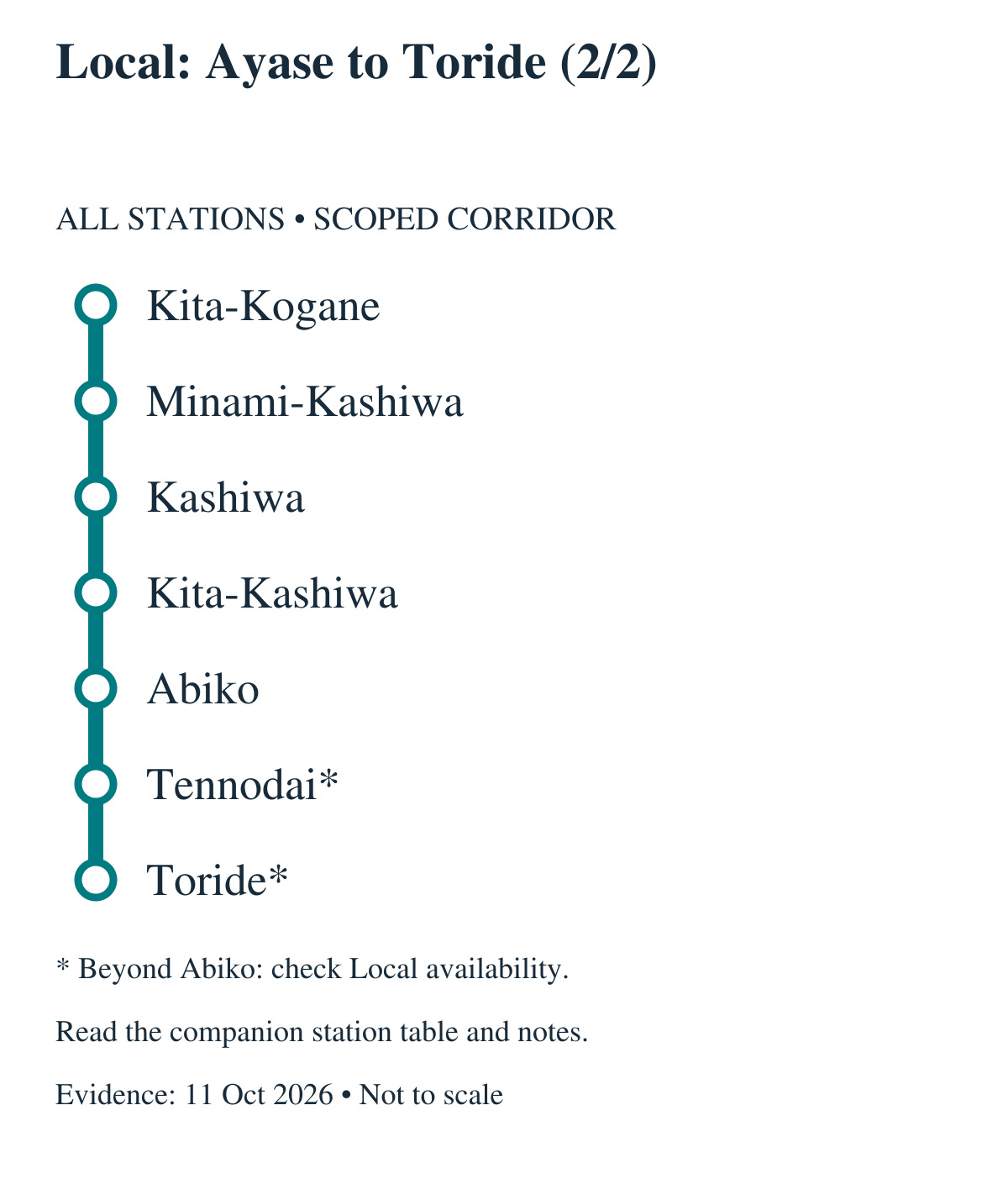
Rapid central continuation
4 stations, in order. Only a suitable Ueno–Tokyo through service.
| Order | Station | Japanese | Note |
|---|---|---|---|
| 1 | Shinagawa | 品川 | Station in scoped inventory |
| 2 | Shimbashi | 新橋 | Station in scoped inventory |
| 3 | Tokyo | 東京 | Station in scoped inventory |
| 4 | Ueno | 上野 | Station in scoped inventory |
Sources: JR East October 2026 Joban Rapid timetable.
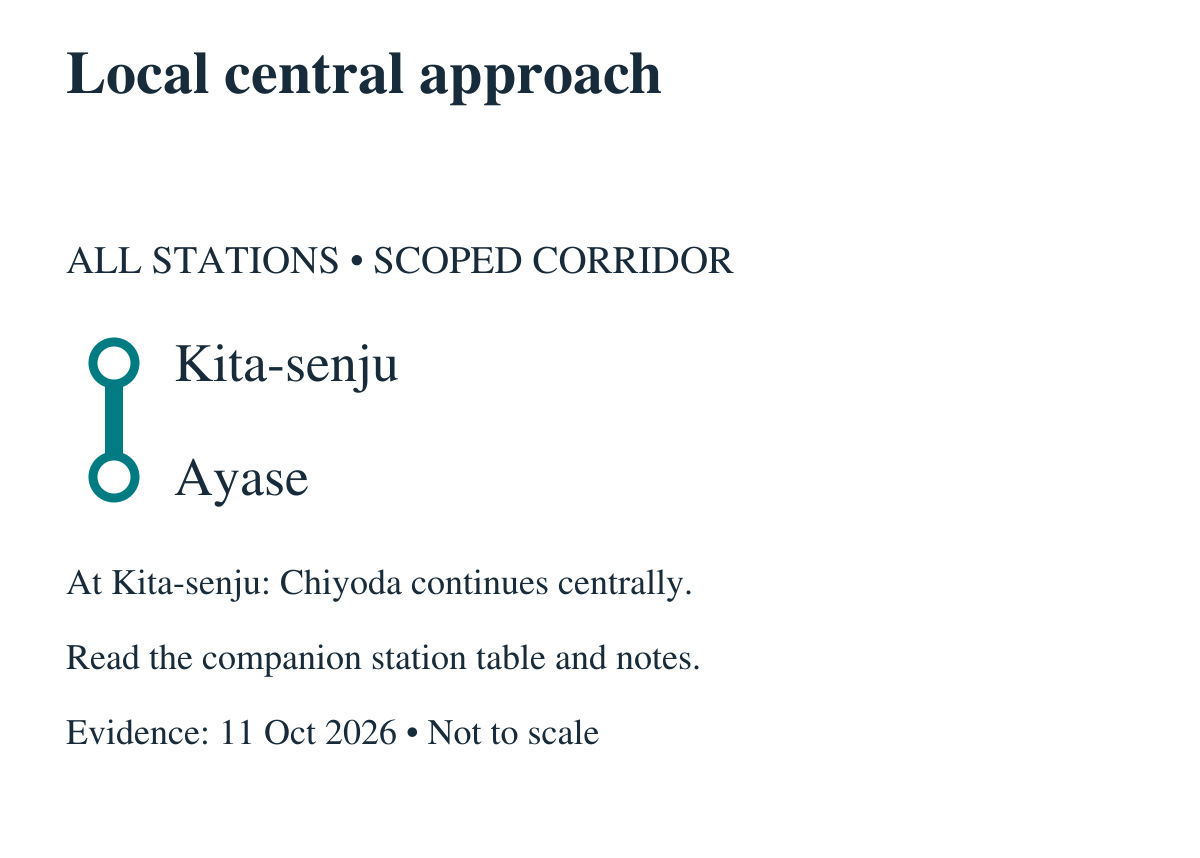
Local central approach
2 stations, in order. At Kita-senju: Chiyoda continues centrally.
| Order | Station | Japanese | Note |
|---|---|---|---|
| 1 | Kita-senju | 北千住 | Station in scoped inventory |
| 2 | Ayase | 綾瀬 | Station in scoped inventory |
Source: JR East October 2026 local-service timetable. Check the current train before travel.