Private rail guide
Tokyo Sakura Tram: How to Ride and Choose a Useful Short Trip
By Coverstories Editorial
Official sources checked 11 October 2026 UTC / 12 October 2026 JST.
Board the Tokyo Sakura Tram at the front, pay as you get on, and leave through the rear door after signaling your stop. Check the destination before boarding: some trams finish partway along the line, and an ordinary fare does not buy a free onward ride on the next tram.
The service is also called the Toden Arakawa Line. It runs between Waseda and Minowabashi, but you do not need to ride end to end to include it in a Tokyo day. A short section between useful railway connections can be a better fit than spending the whole outing on transport.
Boarding without a conventional station gate
At the stop, first read the tram’s front or side destination display. Then join the queue for the front entrance. Have your fare or supported IC card ready before stepping aboard, and pay at the fare box beside the driver.
Toei’s Japanese riding instructions confirm the front-entry, rear-exit system. Move away from the entrance after paying. When your stop is approaching, press a stop button in good time and make your way to the rear exit. This is not an entry-and-exit IC-gate journey like an ordinary subway ride.
If you need help boarding, or want to pay for more than one person with one card, speak to the driver before using the reader. Follow the crew’s directions rather than trying to solve payment while blocking the doorway.
Use the tram stop’s full name
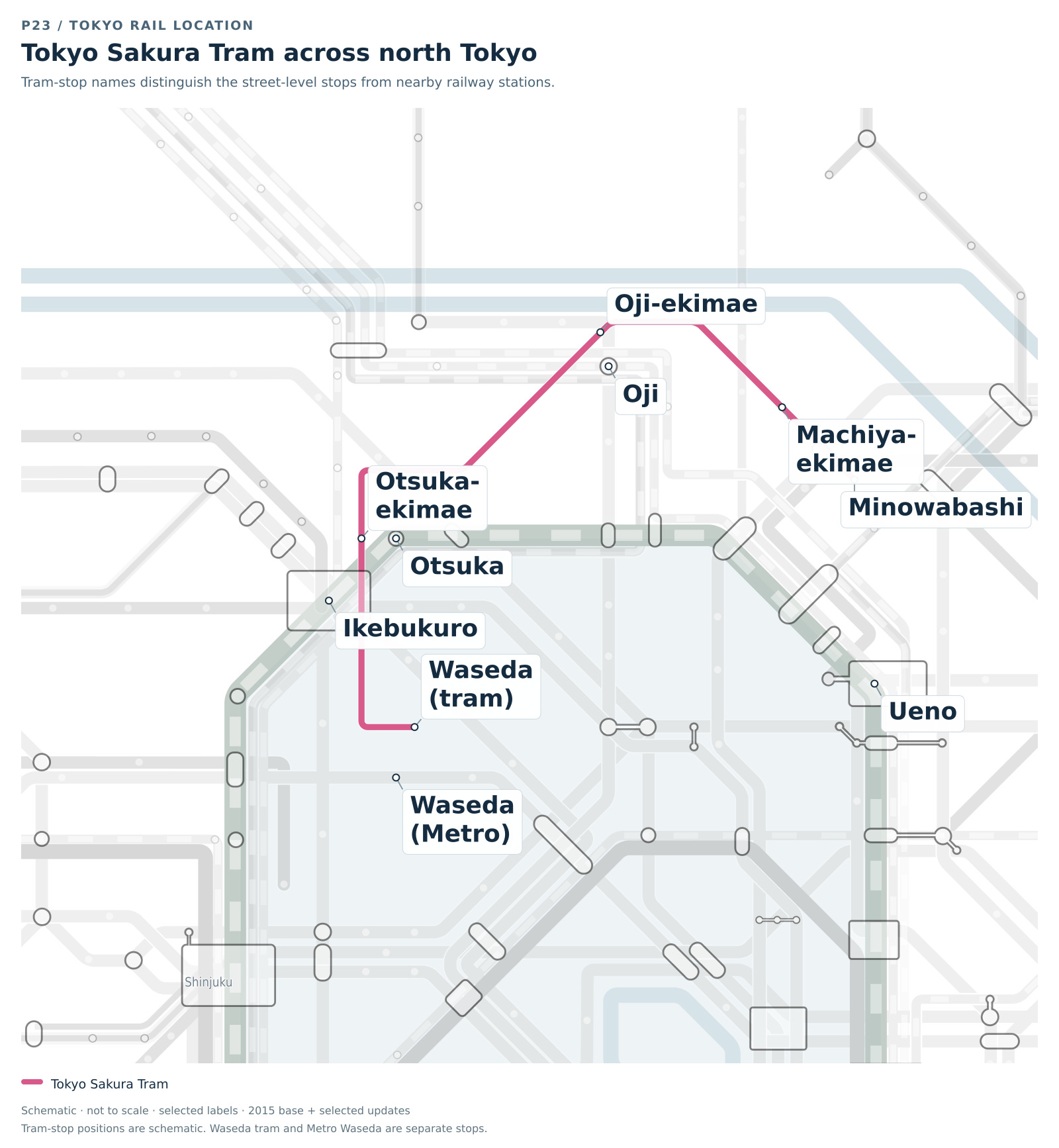
The official stop directory lists the route in order. Several names tell you which larger railway connection you are approaching: Otsuka-ekimae, Oji-ekimae and Machiya-ekimae are useful examples. “Ekimae” means in front of the station, but it does not promise a same-platform or step-free transfer.
Keep the tram and mainline station names distinct in your route search. At Otsuka, for example, the tram stop is Otsuka-ekimae, while the JR station is Otsuka. Search the whole journey so that the walk between them is included. Do not remove the walking segment merely because both names look familiar.
The same care matters at Waseda and Minowabashi. Select the tram stop when planning the tram journey, then check the map separately for any subway connection. Similar names do not establish a shared ticket hall.
Worked trip: Otsuka-ekimae to Oji-ekimae
This is a useful route to compare if you want a tram section between rail connections rather than an end-to-end excursion. From the JR side at Otsuka, leave for the tram stop, then choose the direction toward Minowabashi.
Check that the particular tram reaches Oji-ekimae. A destination beyond Oji-ekimae can be fine; one that terminates before your stop is not the same journey. Use the stop list to place the displayed destination rather than assuming only an end-to-end tram is usable.
Pay once when boarding. Signal Oji-ekimae before arrival and leave by the rear door. If you are continuing on another railway, follow that operator’s signs and arrange its fare separately unless your exact pass covers both.
The Yamanote Line guide provides the larger JR context for reaching Otsuka. For a stay around Ikebukuro, compare the approach to Otsuka with your actual hotel location; the tram does not depart from Ikebukuro’s main station simply because part of its route passes through nearby neighborhoods.
Short-turn trams: read the destination before paying
Toei warns that some services terminate between Waseda and Minowabashi. Its instructions also state that someone who mistakenly boards a short-turn tram must pay another ordinary fare to continue on the next one.
For example, if you want to travel beyond Otsuka-ekimae, a tram displaying Otsuka-ekimae is not an end-to-end substitute. Either wait for a service that reaches your stop or deliberately plan a change and account for the fare or pass conditions. Ask the driver if you cannot identify the displayed destination.
Do not use this as a reason to avoid every tram that lacks your exact stop name. The displayed name is normally the final destination; your intermediate stop may still be on its route. The check is whether your stop lies before that terminus.
Which day ticket covers the tram?
Read the product name and its coverage list. Toei’s ticket guide includes the Tokyo Sakura Tram and Nippori-Toneri Liner in the Toei 1Day Pass, alongside Toei Subway and Toei Bus. That does not add Tokyo Metro to the same product.
The Tokyo Subway Ticket is a different product for Tokyo Metro and Toei subway lines. Do not assume “Toei” in a subway ticket description adds every Toei vehicle, including the tram. A tram-specific day ticket is another option to compare if your day consists mainly of repeated tram boardings.
Count the trips you actually intend to make. One tram ride between other railway journeys may not justify a day pass. Several separate tram boardings could change that comparison. Check current prices and conditions rather than using an old fare quoted in a travel blog.
For paper day tickets, follow the date-validation and presentation instructions for the product. For an IC-stored product, use its specified reader procedure. Avoid paying a new ordinary fare by tapping a different card when your valid pass already covers the ride.
Small-vehicle practicalities
Keep your bag close and clear of the front entrance and rear exit. Plan a sightseeing ride with the luggage you can comfortably manage; the vehicle’s permission to carry an item is not a promise of available space. Ask the crew about assistance rather than assuming the stop-to-vehicle gap suits your needs.
If the route takes you to a different railway afterward, leave time for the walk and the next platform. Our station navigation guide explains how to check that connection. A useful tram trip ends at a stop that works for your next destination, not necessarily at the line’s terminus.