Train Delays Guide
Complete guide to train delays in Japan — common causes, how to check status, delay certificates, and backup plans.
Quick links
Train disruptions can change your entire route. Typhoons, earthquakes, signal failures, and the occasional “passenger injury” can halt entire networks. Check the affected line and any connections before changing your route; recovery time and available alternatives depend on the incident. Here’s how to handle it.
Best for: Anyone in Japan during typhoon season (June–October), or anyone who wants to be prepared for the unexpected.
Common Causes of Disruption
| Cause | Frequency | Duration | What happens |
|---|---|---|---|
| 人身事故 (jinshin jiko) — “Personal injury” | Unscheduled | Until emergency response and safety checks allow service | The affected line may stop; check connecting and through-service lines too |
| Signal failure / equipment | Unscheduled | Depends on the fault and repairs | Delays on one line, minor ripple effects |
| Typhoon | June–October | Depends on the weather, inspections and announced restart | Planned suspension announced in advance; Shinkansen may stop |
| Earthquake | Unpredictable | Until required inspections and safety clearance | Safety checks may require speed restrictions or suspension; follow staff instructions |
| Heavy rain / snow | Seasonal | Depends on conditions and safety clearance | Speed restrictions or suspension; Shinkansen very cautious |
| 計画運休 (keikaku unkyū) — Planned suspension | Before major storms | Announced in advance | Operators announce affected lines and suspension times; notice and scope vary |
What to Do: Step by Step
Step 1: Check What’s Happening
| Source | Best for | English? |
|---|---|---|
| Station announcements | Immediate info at your location | ✅ Major stations |
| Platform displays | Real-time delay info | ✅ Most |
| JR East Train Info | JR East Kanto status; select other areas for onward travel | ✅ |
| Tokyo Metro | Metro line status | ✅ |
| Toei Transportation | Toei subway + bus | ✅ |
| Google Maps | Route ideas; confirm each leg is operating | ✅ |
| Jorudan | Delay/suspension alerts + rerouting | ✅ |
| Twitter/X: @JREast_official | Additional alerts; confirm on the official service page | ❌ (use translate) |
Step 2: Understand 振替輸送 (Furikae Yusō) — Alternative Transport
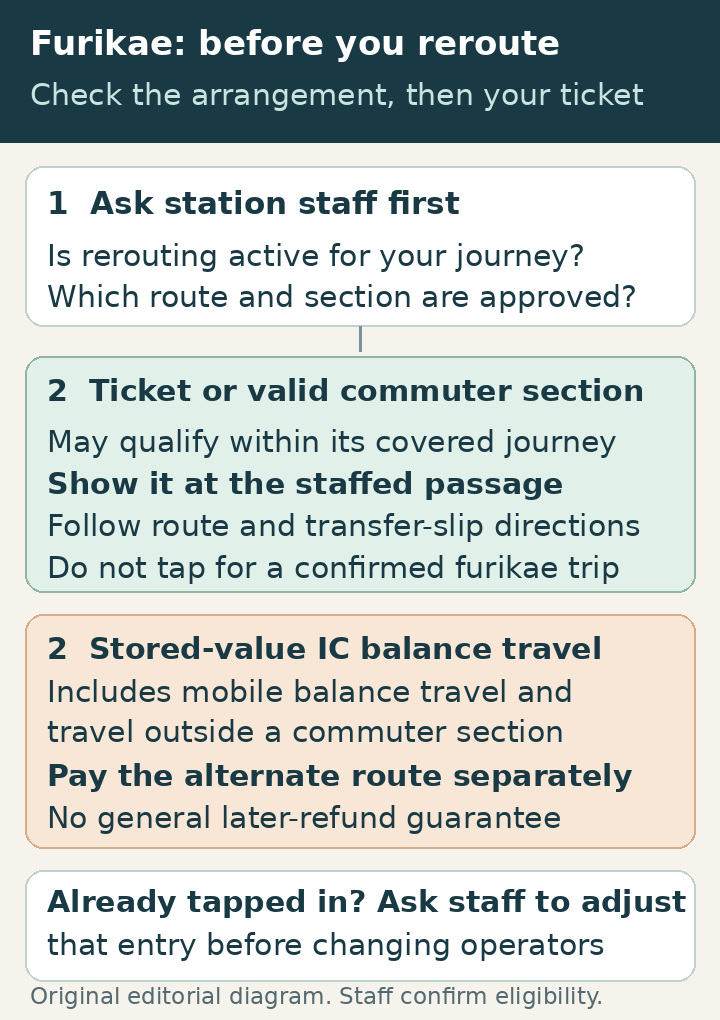
Furikae is a designated rerouting arrangement, not automatic free travel whenever a train stops. Confirm that it is being offered for the affected line and your journey before using another operator.
How it works:
- Ask the station staff booth whether furikae is active and which route you may use.
- Show the ticket or valid commuter pass you already hold for the affected section. Staff must confirm its covered section and eligibility.
- Use the staffed passage, without tapping or inserting the ticket into a gate machine. Follow any instructions about a transfer slip.
- Use only the designated route within your ticket’s covered journey. A rail reroute may allow the eligible ticket alone; a slip is not always required.
- Show the ticket and any required slip to staff when exiting. Do not treat it as permission for extra travel or a stopover.
Stored-value Suica/PASMO, including mobile balance travel: These rides do not qualify for furikae. The same applies outside a commuter pass’s valid section. Pay the alternate route’s fare; there is no general promise that it will later be refunded.
Valid IC commuter pass: The affected journey within its valid section can qualify. Show it to staff rather than tapping. Eligible paper tickets and day passes also depend on their covered section and the announced arrangement.
Before changing operators: If you have already tapped in, ask staff how to close or adjust that entry. This is separate from furikae eligibility. A card adjustment does not make a stored-value reroute free.
Eligibility and staffed-gate handling: JR East, Tokyo Metro and Toei subway FAQ. Suica travel conditions.
Step 3: Decide — Wait or Reroute?
| Situation | Best action |
|---|---|
| “5–10 min delay” | Check the next update and your connection deadline before waiting |
| “30+ min delay” | Compare a confirmed operating route, extra fare and transfer time |
| “Operation suspended” | Ask whether your ticket and route qualify for furikae. Check paid alternatives; taxis and unapproved buses are at your expense |
| “Planned suspension” (typhoon) | Check the announced suspension area and local safety instructions. Confirm an indoor place to stay rather than assuming shops are open |
Hotel return: Check the complete route to the hotel’s actual entrance and any last onward connection. If you cannot safely reach it, contact the accommodation before assuming a room or late check-in is available.
Airport or reserved-train connection: Check every operator, the correct airport terminal and the airline’s check-in deadline. A through train may be curtailed even when the subway section is running. If the connection is at risk, contact the airline or ticket issuer before its deadline; a delay certificate does not guarantee a refund. Toei’s status page links through-service operators.
Step 4: Get a Delay Certificate (遅延証明書)
Use the affected operator’s certificate page and select the actual line, date and time band. Conditions and available formats differ:
| Operator | Where to check | Conditions |
|---|---|---|
| JR East | Covered-line delay certificates | Approximately 5+ minutes; covered conventional local trains, not Shinkansen or limited express. Past 45 days online. |
| Tokyo Metro | Select the line and date | 5+ minutes; past 35 days online. Paper distribution ended in principle on April 1, 2026. |
| Toei | Certificates and conditions | 5+ minutes; 35 days from posting. Station-issued certificates are also available. |
What it proves: A line/time-band delay, not that you rode a particular train or missed your flight. Publication may follow later than the disruption. Ask the employer, tour operator or reservation provider whether it accepts the certificate; compensation and refunds follow the relevant ticket or booking rules.
Metro’s paper-distribution change notice and Toei’s certificate limits. Save the relevant record promptly.
Typhoon Playbook 🌀
Typhoons can bring planned suspensions across several operators. Check the announced lines and times; an unaffected service is not a guarantee that every connection will run.
Before the Typhoon
- Check 計画運休 (planned suspension) announcements — confirm the affected lines, dates and latest planned stopping times
- Prepare essentials: Buy food and water before conditions worsen; confirm your accommodation and follow local safety guidance.
- Reschedule: Ask the ticket issuer about the specific disruption policy before departure. Ordinary changes, disruption refunds and pass rules are different.
- Check your flight and ground route: Confirm airline updates, the terminal and check-in deadline before deciding whether to leave.
During the Typhoon
- Follow local safety instructions. Avoid unnecessary travel in dangerous conditions and check which services are actually suspended.
- Follow accommodation and evacuation instructions; do not assume every building or route is safe.
- Check restoration timelines on JR and Metro websites
After the Typhoon
- Check the affected operator’s reopening notice; the end of the storm is not itself a restart time.
- Expect possible crowding: Recheck onward connections and your deadline before waiting longer or changing routes.
- Shinkansen: Check the operator’s actual service and reservation notices before boarding.
Earthquake Protocol 🔔
- Trains may slow or stop in response to detected shaking and the operator’s safety procedures
- Stay calm and follow crew instructions while required safety checks are carried out
- Follow crew instructions — they will make announcements in Japanese (and sometimes English)
- Wait for staff confirmation — required inspections and clearance determine when service can restart.
- Major earthquake: Trains may be suspended for hours. Staff will guide evacuation if needed.
- Check official alerts: Follow crew instructions and official alerts when safe; do not wait for a phone warning before taking protective action
Practical Tips
Pro Tips
- Follow official evacuation guidance and contact your accommodation : Return only if the full route is operating and safe. If stranded, ask staff about the next safe option.
- Buy supplies before severe weather : Convenience stores may close, reduce hours, or run out of supplies during severe weather. Stock up on food and water.
- Keep your phone charged : A portable battery is essential during disruptions. Use official operator, weather-agency, and local-government updates.
- Limited-express arrival delays : If a limited-express train arrives two hours or more late, the limited-express charge is normally refundable. The basic fare is not automatically refunded when the journey was completed.
- Learn the kanji : 遅延 (delay), 運休 (suspended), 運転見合わせ (service suspended), 運転再開 (service resumed)
- Typhoon season : If visiting June–October, build buffer days into your itinerary.
Keep tickets and receipts: Ask the issuer before surrendering a ticket or buying a replacement. On ordinary JR tickets, abandoning a cancelled journey, stopping partway and completing a delayed limited-express journey have different refund treatment. Discounted products and passes may have separate rules. JR East does not cover additional transport or hotel costs caused by an itinerary change; a used JAPAN RAIL PASS is not extended or refunded for disruption.
JR East disruption refunds and JAPAN RAIL PASS conditions.
Refund handling depends on the disruption and ticket use. JR Central: cancellations and delays
For broader disruption planning, pair this guide with our Tokyo rush-hour survival guide and last-train survival guide.
FAQ
Will my JR Pass cover alternate routes during disruptions?
Do not assume blanket coverage. Show the exact pass and affected journey to JR staff and ask whether a designated reroute accepts it. Metro and Toei are not part of the pass’s ordinary coverage. The pass’s own conditions do not promise reimbursement of extra transport or accommodation, or an extension/refund after use begins. Check ordinary pass coverage and disruption conditions.
Can I get a refund for a cancelled Shinkansen?
If a Shinkansen is cancelled, or if you decide not to travel because service is disrupted, refund handling depends on the ticket and whether any segment was used. For an arrival delay of two hours or more, the limited-express charge is normally refundable; this is not automatically a refund of the full basic fare.
What does 人身事故 mean?
“Personal injury accident” — this describes a reported personal-injury incident; the announcement alone does not establish the circumstances. Restart depends on emergency response and safety clearance. Check the affected and connecting lines rather than assuming a fixed recovery time or that all other services continue.
How reliable are trains in Japan, really?
Use the operator’s current service information for your journey. A general reputation for punctuality does not tell you whether your train or connection is running today. Build time into important connections and confirm any changed route before paying for it.
Explore More Tokyo Guides
For neighborhood-specific tips on where to stay and what else to explore nearby:


