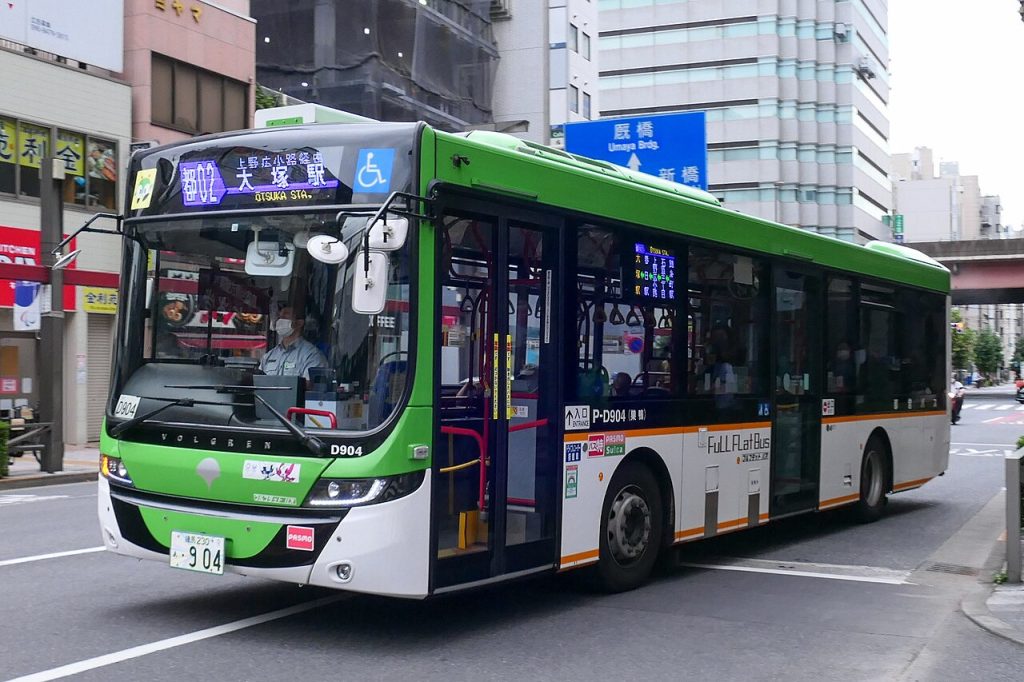
Riding a Bus in Japan
Complete guide to riding buses in Japan — front door vs back door, flat fare vs distance fare, IC cards, and route planning apps.
Quick links
Boarding and payment rules change between operators and routes. Front door or back door? Pay when you get on or off? Flat fare or distance-based? This guide removes the guesswork.
Best for: Travelers visiting areas not covered by trains (Kyoto bus routes, rural towns, airport limousine buses) or wanting a cheaper alternative.
Two Bus Systems You’ll Encounter
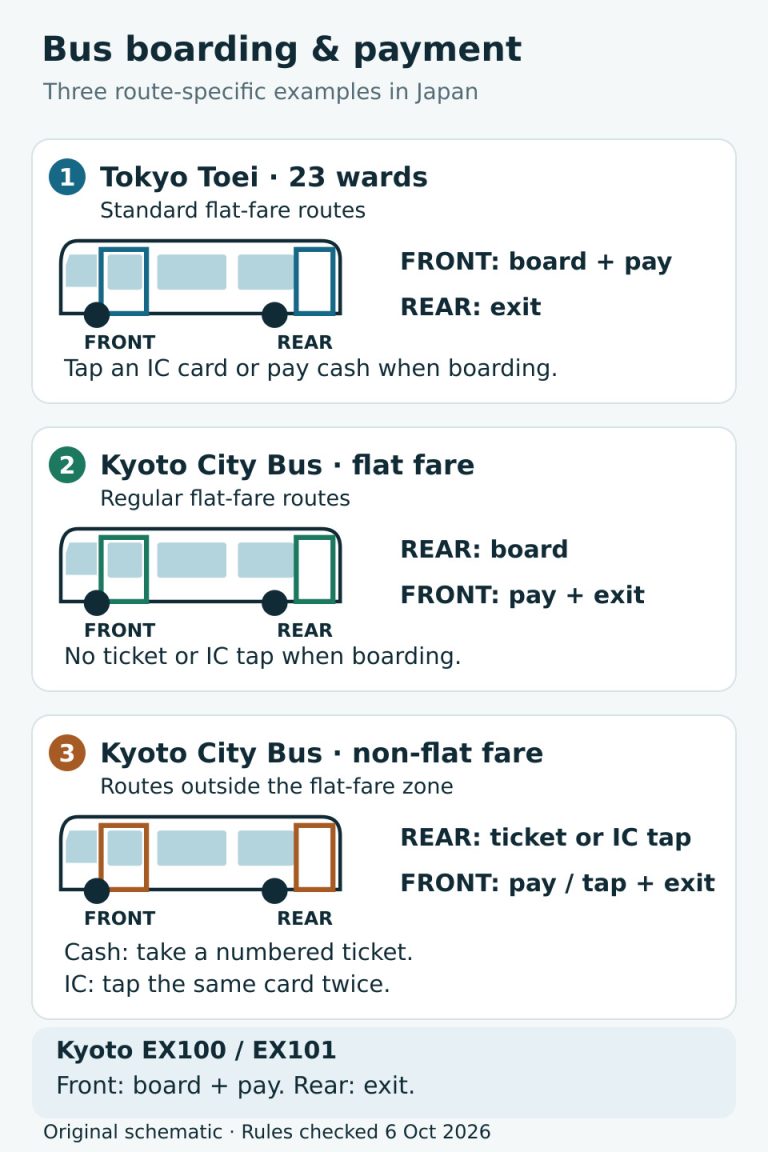
These examples show two common payment patterns. A flat fare does not always mean front-door boarding: Kyoto’s regular flat-fare buses use rear-door boarding and payment on exit.
| Tokyo Toei (23 wards) | Kyoto non-flat routes | |
|---|---|---|
| Board from | Front door | Back/middle door |
| Pay when | Boarding (tap IC or drop coins) | Alighting (tap IC or pay the displayed fare; check change options with the operator) |
| Fare | ¥210 on standard adult routes | Depends on the boarding and alighting stops |
| IC card? | Yes: Suica, PASMO and other supported IC cards | Yes: tap when boarding and again on exit |
| Where | Standard Toei routes within Tokyo’s 23 wards | Kyoto City Bus routes outside the flat-fare zone |
Step-by-Step: Riding a City Bus (Flat Fare)
Tokyo Toei Bus Example: 23 Wards
- Find your stop — Bus stops show route numbers and destinations in English (usually)
- Board from the front door
- Tap your IC card on the reader next to the driver, OR pay the adult fare of ¥210 on a standard route. Cash payment accepts coins or a ¥1,000 note; the farebox gives change.
- Sit or stand — Hold the handrails. Priority seats near the front are for elderly, pregnant, and disabled passengers
- Press the button when the next stop announcement says your stop (buttons are on poles and walls throughout the bus)
- Exit from the rear door after the bus stops
Toei Bus boarding and payment guide; Toei fares. Checked October 7, 2026.
Step-by-Step: Riding a Suburban Bus (Distance Fare)
Kyoto City Bus: Non-Flat Fare Routes
This example applies to routes outside the flat-fare zone. On regular flat-fare routes, no numbered ticket or boarding tap is needed.
- Board from the back/middle door
- Paying cash? Take a numbered ticket (整理券 / seiriken) from the machine at the door. Using an IC card? Tap it on the boarding reader instead; you do not need a paper ticket.
- Watch the fare display at the front of the bus — it shows the current fare for each ticket number
- Press the button when your stop is announced
- Wait until the bus stops, then move to the front to pay and exit
- Pay the displayed fare: Insert your numbered ticket first, then pay with coins or a ¥1,000 note and collect your change. If using an IC card, tap the same card again at the front reader.
Cash payment depends on the operator. Kyoto City Bus and Tokyo Toei buses in the 23 wards give change from coins or a ¥1,000 note. Larger notes are not accepted. On other buses, follow the farebox instructions and ask the driver if you need to change money.
Kyoto Buses — A Special Case
Kyoto City Bus rules differ by route. Regular routes use the rear door for boarding and the front door for exiting and payment. On flat-fare routes, take no numbered ticket and tap your IC card only when getting off. On non-flat routes, take a ticket if paying cash, or tap your IC card when boarding and again on exit. Sightseeing Limited Express EX100/EX101 use front-door boarding and payment, then rear-door exit.
- Regular flat-zone fare: adult ¥230, child ¥120.
- Sightseeing Limited Express EX100/EX101: adult ¥500, child ¥250.
- The former Bus One-Day Pass is no longer sold or valid.
- The current Subway & Bus 1-Day Pass is ¥1,100 for adults and covers Kyoto City Subway plus specified bus networks and routes.
- Suica and PASMO are accepted on Kyoto City Bus, but a JAPAN RAIL PASS is not.
Kyoto fares and boarding rules checked October 7, 2026. Kyoto City Bus & Subway guide; detailed payment guide
Airport Limousine Buses
These are express coaches connecting airports to city centers. Ticket and reservation rules depend on the route and direction.
| Route | Fare | Time | Book |
|---|---|---|---|
| Narita → Shinjuku | ¥3,600 | About 2 hours | Limousine Bus route guide |
| Haneda → Shibuya | ¥1,300 | About 35–70 min | Limousine Bus route guide |
| Kansai Airport → Namba (OCAT) | ¥1,400 | ~50 min from Terminal 1 | Kansai Airport bus guide |
Adult one-way fares checked October 7, 2026. Journey times are estimates; check your terminal and departure, and allow for traffic.
Pro tip: Airport coaches have luggage storage underneath — much easier than dragging suitcases through train stations. Check your operator’s baggage allowance before traveling.
Highway Buses (Long-Distance)
The budget alternative to Shinkansen.
| Route | Bus fare | Shinkansen fare | Bus time |
|---|---|---|---|
| Tokyo → Osaka | Varies by operator, date and seat | Check train and seat type | ~8h (night bus) |
| Tokyo → Kyoto | Check your date and seat type | Check train and seat type | ~7h (night bus) |
| Shinjuku (Tokyo) → Kawaguchiko | ¥2,200 | N/A | ~2h |
Night buses run overnight; departure and arrival times depend on your service. Seats recline, and some have curtain partitions. Search your travel date through Willer Express or Japan Bus Lines, and compare the full price with our Shinkansen guide.
Shinjuku–Kawaguchiko fare and timetable; overnight bus examples.
Bus Etiquette
The unwritten rules
- Queue at the stop. Board in the order people arrived.
- Avoid eating and drinking. City buses are short shared journeys.
- Keep your phone silent. Do not make calls.
- Fold a stroller when needed. Follow the driver’s instructions on a crowded bus.
- Thank the driver briefly. A nod or “thank you” is enough.
- Move toward the back. Leave space near the front door for boarding and payment.
Practical Tips
Pro Tips
- Carry a topped-up IC card, plus coins or ¥1,000 notes for routes that do not accept it
- Use Google Maps for route planning, and the operator’s timetable or live service page for current departures
- Kyoto: avoid buses during peak season (March–April cherry blossom, November foliage) — buses get stuck in traffic. Use the subway instead where possible.
- Bus stops can be tiny — Just a pole with a sign. Don’t expect a shelter.
- An overnight bus can replace one hotel night, but compare the full fare and arrival time
If bus transfers are not the best fit, compare our Japan taxi guide with the route choices in our Haneda Airport access guide.
FAQ
Can I use Suica/Pasmo on buses?
Yes on Tokyo Toei and Kyoto City Bus. Acceptance varies on other bus networks; check the operator’s payment guide, especially for rural and airport routes.
What if I don’t know when to get off?
Buses announce each stop in Japanese and often English. You can also follow along on Google Maps — it shows your real-time position on bus routes.
Are buses wheelchair accessible?
Many urban routes use low-floor buses with ramps. Check the operator’s accessible services and tell the driver if you need boarding assistance. Airport and highway coaches may have steps and different wheelchair arrangements; confirm the specific service before booking.
How do I buy highway bus tickets?
Online is easiest. Willer Express and Japan Bus Lines have English booking. You can also buy at highway bus terminals (Shinjuku Expressway Bus Terminal is the largest).
Explore More Tokyo Guides
For neighborhood-specific tips on where to stay and what else to explore nearby:


