JR rail guide
Shonan Shinjuku vs Ueno Tokyo Line
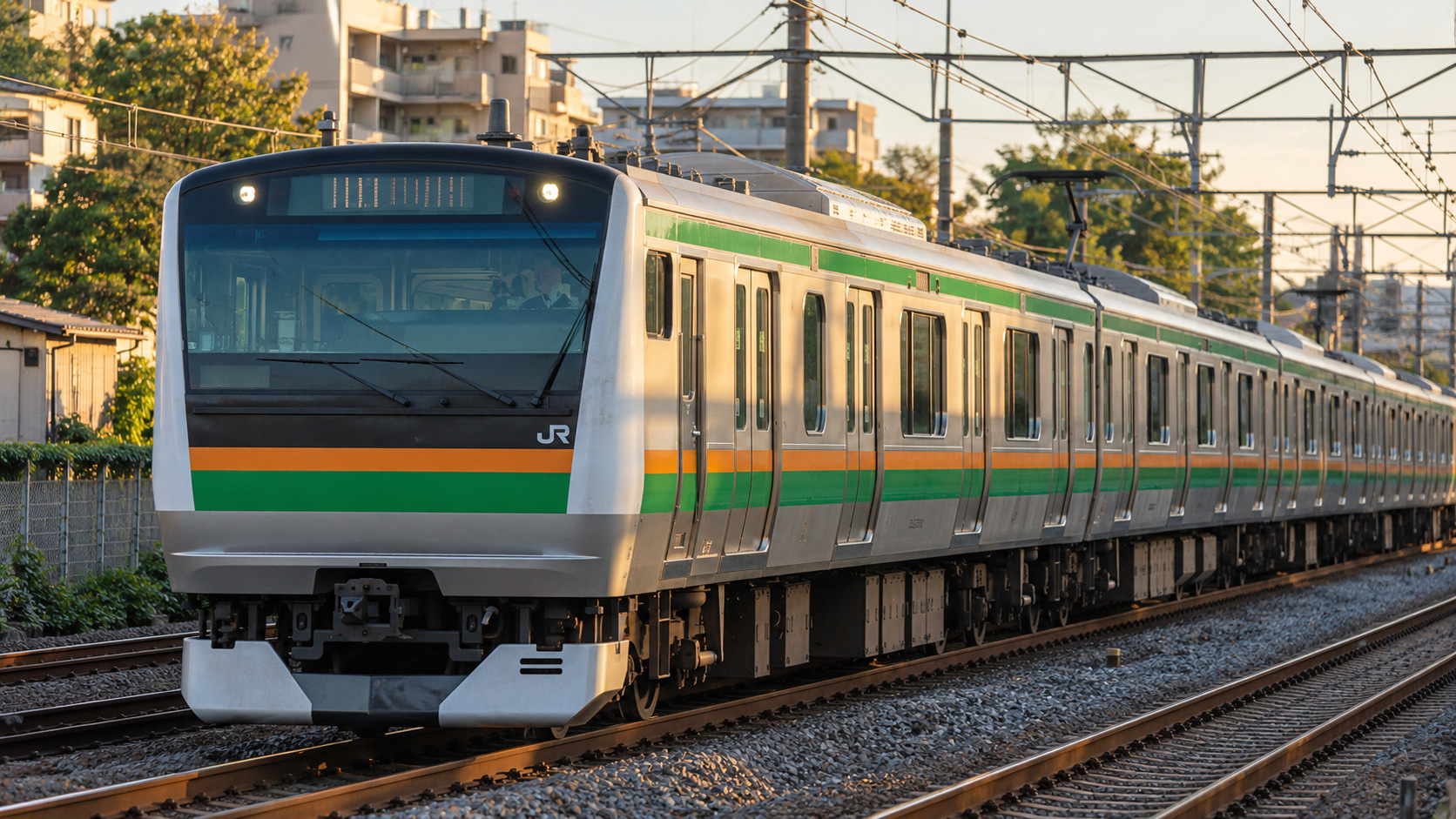
Choose the Right Tokyo Route
By Coverstories Editorial
For Shinjuku, Shibuya or Ikebukuro, look for the Shonan-Shinjuku Line. For Tokyo Station, Ueno or Shinagawa, look for the Ueno-Tokyo Line. Then check the train’s destination and stops: choosing the correct side of Tokyo does not guarantee that the train follows the branch you need.
That distinction matters when you return from Yokohama, leave Tokyo for Kamakura, or board a northbound train marked Takasaki or Utsunomiya. These are long through services linking suburban lines across Tokyo. Neither is a loop, and neither is a single train running to every destination shown on a network map.
The choice in thirty seconds
| Your journey | Start by looking for | Check before boarding |
|---|---|---|
| Yokohama to Shinjuku, Shibuya or Ikebukuro | Shonan-Shinjuku Line | The stop list and a route via Shinjuku |
| Yokohama to Tokyo, Ueno or Shinagawa | Tokaido Line / Ueno-Tokyo Line | A northbound service that reaches your station |
| Shinjuku or Shibuya to Kamakura | Shonan-Shinjuku Line toward Zushi | Kamakura on the stop list; an Ofuna terminus means a transfer |
| Tokyo Station to Kamakura | Yokosuka Line | A train continuing beyond Ofuna to Kamakura |
| Central Tokyo to Omiya | Either axis, depending on your departure station | Avoid a Joban service and trains terminating before Omiya |
| Tokyo or Shinagawa to Kashiwa | Ueno-Tokyo Line through to the Joban Line | Kashiwa on the stop list; Takasaki and Utsunomiya trains go elsewhere |
The table is a route-selection guide, not a live departure board. Compare actual departure and arrival times before walking to a platform. A faster train that leaves much later may not get you there sooner. JR East Tokyo Station services
Read the map as two routes through Tokyo
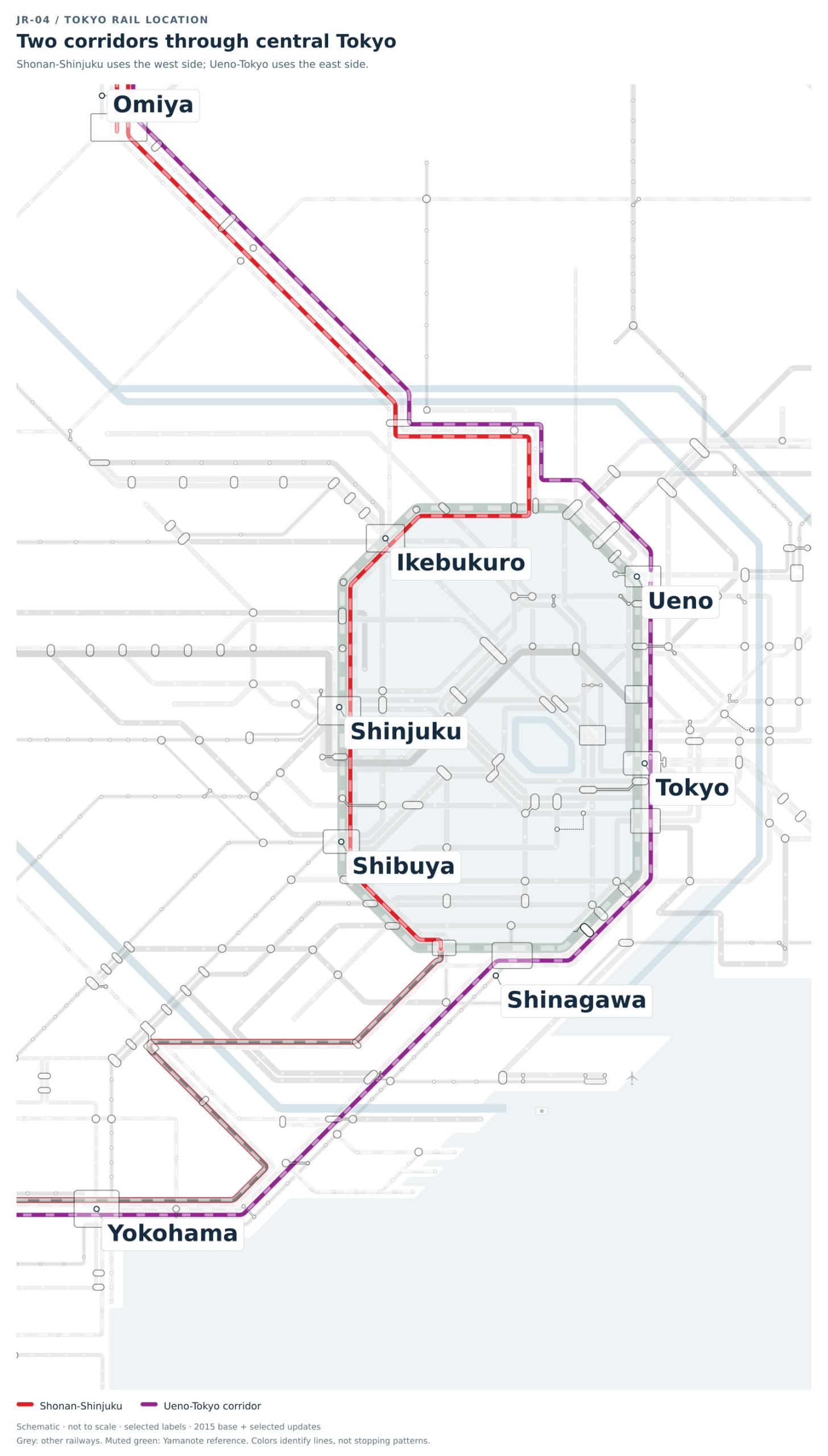
The Shonan-Shinjuku route passes through Tokyo’s western hubs. The Ueno-Tokyo route passes through the eastern rail corridor. Both can serve Omiya and Yokohama, but their central Tokyo stations differ.
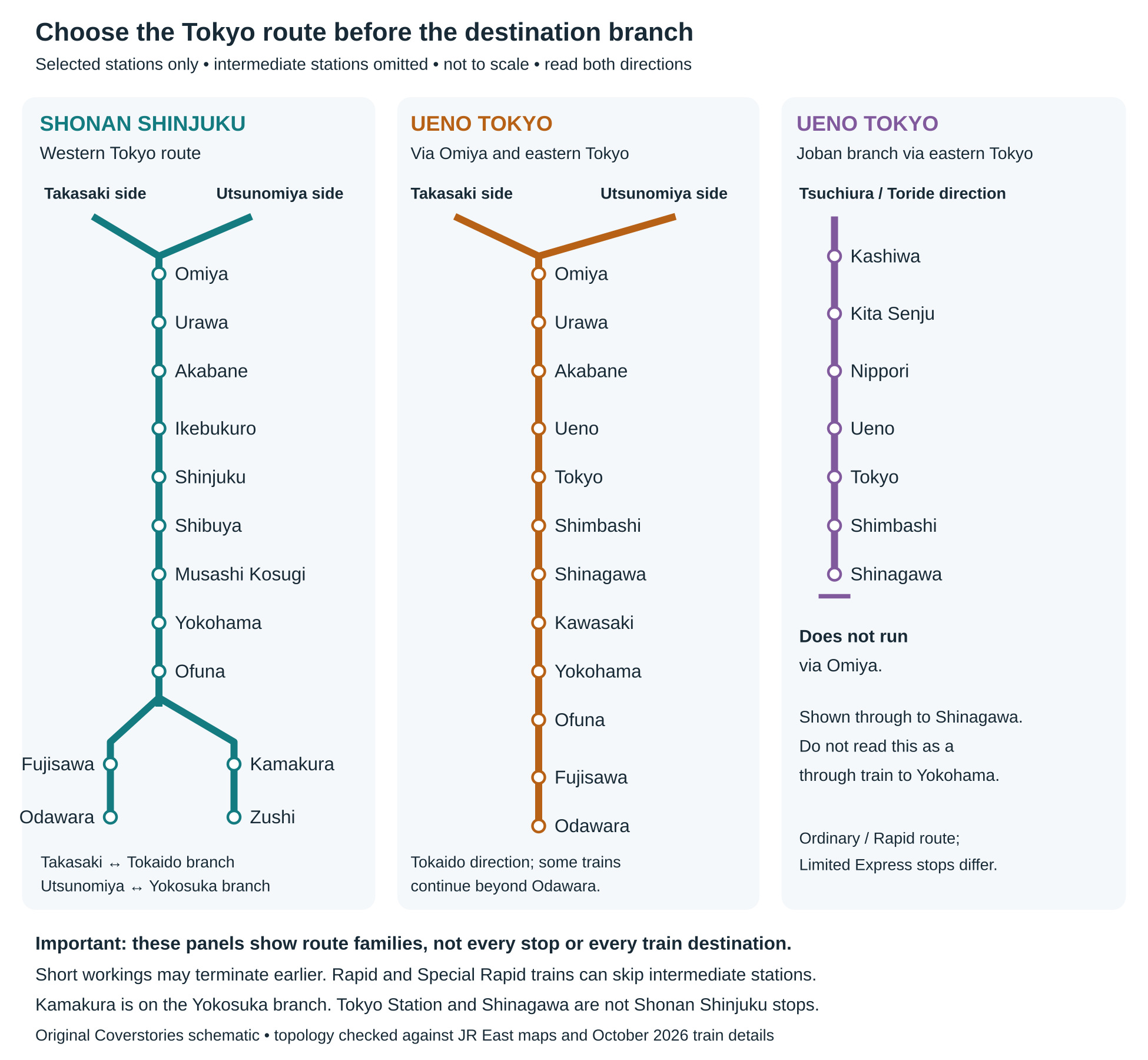
Original schematic by Coverstories Editorial. Selected stations only; not to scale and not a platform diagram. Colored connections show route families, not a promise that every train runs end to end. The Joban branch is separate from the Omiya branches. For the wider network, use the official JR East map.
This is a useful way to understand the names: a through service lets the same train continue from one named line onto another. Your journey planner may therefore show a line-name change without asking you to get off. Follow its transfer instruction and the train’s destination, rather than assuming every change of name means a change of train.
The destination board tells you more than the train’s appearance
At a shared station, the final destination alone can be misleading. An Odawara-bound train may take the western or eastern route through Tokyo. JR East’s route explainer specifically tells passengers to look for the via station in the display. Its old fare panel should not be used for current prices. JR East route and display explainer
Use this order when reading a departure board:
- Find the route through Tokyo. Look for Shonan-Shinjuku / 湘南新宿ライン or a display referring to Shinjuku / 新宿. For the eastern route, look for Ueno-Tokyo / 上野東京ライン and the Tokyo / 東京 or Ueno / 上野 route information.
- Check the destination. Zushi, Odawara, Takasaki and Utsunomiya describe different branches or endpoints. They are not interchangeable labels for “south” or “north.”
- Check your station in the stopping pattern. Rapid and Special Rapid services can skip stations. The train must both reach your part of the route and stop where you need to get off.
Consider these examples as reading exercises, not exact screen replicas:
- “Shonan-Shinjuku Line, via Shinjuku, for Takasaki”: useful for returning from Yokohama to Shinjuku. Beyond Omiya it takes the Takasaki direction.
- “Ueno-Tokyo Line, for Utsunomiya”: useful for Tokyo, Ueno and the Utsunomiya branch if those stations are ahead of your boarding point. It does not take you to Shinjuku.
- “Shonan-Shinjuku Line, for Zushi”: the destination to investigate for a direct Kamakura trip from Shinjuku or Shibuya.
- “Ueno-Tokyo Line, Joban Line, for Tsuchiura”: a northeast-bound service, not an Omiya-bound one. Check the particular train’s stops, especially if it is marked Limited Express.
If the board rotates between Japanese and English, give it a moment. Matching the departure time, destination and stop list is more reliable than following everyone else onto a similar-looking train.
Going south from Shinjuku or Shibuya
Yokohama is the straightforward case
For Yokohama Station, the Shonan-Shinjuku Line is a direct JR option from Shinjuku, Shibuya and Ikebukuro. You do not need a train whose final destination is Yokohama; longer-distance trains can stop there along the way.
Yokohama Station is not Sakuragicho, Kannai or Chinatown. Put your actual attraction or onward station into the journey planner before deciding where to leave the train. The advantage of reaching Yokohama directly can disappear if you have chosen the wrong station for the day’s first stop.
Kamakura requires the Yokosuka branch
For a direct journey to Kamakura, look for a Shonan-Shinjuku service continuing toward Zushi and confirm Kamakura in its stop list. An Odawara-bound service follows the Tokaido direction beyond Ofuna instead. An Ofuna-bound train ends before Kamakura, so plan a transfer.
A real October 2026 weekend/holiday example makes the distinction concrete. JR East lists a Zushi-bound service leaving Shinjuku at 11:45, Shibuya at 11:50 and Yokohama at 12:19, then calling at Kita-Kamakura and Kamakura before Zushi. It is an example of the route, not a standing recommendation to catch that departure. Zushi-bound train details
The 12:00 departure from Shinjuku in another weekend/holiday example is a Special Rapid for Odawara. After Ofuna it calls at Fujisawa and continues along the Tokaido route. Boarding it because “Shonan-Shinjuku goes to Kamakura” would leave you needing a transfer. Odawara-bound train details
The train type matters at intermediate stops too. The checked Odawara Special Rapid skips Ebisu, while the checked Zushi ordinary service stops there. An October Rapid to Hiratsuka also stops at Ebisu but skips Nishi-Oi and Shin-Kawasaki. Read the stop list for your own train rather than turning “Rapid” into one universal pattern. Hiratsuka Rapid example
For a Kamakura day, save both your outward and return route. The train you take back may show a distant northern destination rather than Shinjuku. Check that it is the Shonan-Shinjuku route and that your Tokyo station appears among the stops.
Tokyo Station has a different direct Kamakura option
From Tokyo Station, check the Yokosuka Line for Kamakura. It is listed separately from the Tokaido / Ueno-Tokyo service in JR East’s station timetable. Do not head for Ueno-Tokyo simply because it also serves Yokohama. The destination and stopping pattern still matter on the Yokosuka Line. Tokyo’s station map puts Yokosuka services in the separate Sobu underground platform area, so choosing the line also changes where you walk inside the station. Official Tokyo station layout, Tokyo’s Yokosuka timetable
For a wider choice of outings, use our day trips from Tokyo guide, then check the railway route for the specific place you choose.
Going north beyond Omiya
Omiya is a shared major station, not proof that all northbound trains continue along the same route. Beyond it, the Takasaki and Utsunomiya directions separate.
For the Takasaki direction, destination names include Takasaki and Kagohara. For the Utsunomiya direction, they include Utsunomiya, Koganei and Koga. A train terminating earlier on the correct branch may still require another train. Choose for the station you actually need rather than the most familiar city on the board. Tokyo northbound destinations
The difference is visible in current train details. One Ueno-Tokyo service from Tokyo continues beyond Omiya through Ageo and Kumagaya to Takasaki. Another follows the Utsunomiya direction through Kuki and Oyama. They share a useful central section but cannot both take you to the same northern stations. Takasaki example, Utsunomiya example
If your destination is Omiya itself, choose the axis nearest your starting point and compare departures. From Shinjuku, a Shonan-Shinjuku service may suit you; from Tokyo Station, inspect the Utsunomiya/Takasaki Ueno-Tokyo services. Check for short-running trains before boarding.
For Saitama-Shintoshin, do not assume a Shonan-Shinjuku train stops because the station lies between Omiya and Urawa. The two checked Shonan-Shinjuku examples run between Omiya and Urawa without that stop. Use a service whose stop list includes Saitama-Shintoshin.
The Joban exception at Tokyo and Shinagawa
Ueno-Tokyo is also used for trains through to the Joban Line. This is the exception that makes “all northbound Ueno-Tokyo trains go to Omiya” wrong.
JR East gives Tokyo separate timetable entries for Utsunomiya/Takasaki services and Joban services toward Kashiwa and Toride. The latter head through the Joban corridor rather than Akabane and Omiya. Destination names on that board include Tsuchiura, Toride and other Joban-side endpoints. Some listed departures are Hitachi or Tokiwa Limited Express trains, so do not assume every entry is the same ticket type. Tokyo’s Joban timetable and stopping notes
On the Joban timetable, an ordinary-labelled longer-distance train uses the listed Rapid stops as far as Toride, then the stations beyond. “Ordinary” therefore does not mean it calls at every station on every parallel route.
A practical check at Shinagawa or Tokyo is to ask two questions separately: “Does this train stop at Ueno?” and “Where does it go after Ueno?” The first answer alone is not enough for a trip farther north.
For Yokohama, select a train actually continuing on the Tokaido route. Do not assume a Joban through service continues south beyond Shinagawa just because Ueno-Tokyo appears in its name.
Choosing the right route for your hotel
A rail map helps most when you match it to the station you will actually use, then allow for the walk to your hotel.
For a Shinjuku hotel base, the Shonan-Shinjuku route avoids detouring through Tokyo Station on a suitable Yokohama or Kamakura journey. But a hotel near Shinjuku-sanchome or Nishi-Shinjuku may involve a different final approach. Choose the hotel entrance and exit, not just “Shinjuku” as a district.
A Shibuya hotel base also fits the western route. Compare the last walk from JR Shibuya with your hotel’s recommended approach, particularly if you are carrying luggage. For an Ikebukuro stay, the same rail axis works, but the station’s East and West sides lead to different hotel areas.
For a Tokyo Station hotel or Ueno hotel, Ueno-Tokyo is the relevant axis for a suitable through journey from Yokohama. At Ueno, distinguish JR Ueno from Keisei Ueno and Okachimachi. A hotel marketed as “Ueno” does not necessarily sit beside your arrival platform.
A Shinagawa hotel base belongs on the eastern side of this comparison. Shonan-Shinjuku trains do not call at Shinagawa. If your onward plan involves the Shinkansen or Keikyu, select a route that actually reaches Shinagawa and allow time for that separate connection.
For shorter trips within central Tokyo, the Yamanote Line can be easier to understand. Shonan-Shinjuku is not a substitute for every Yamanote stop: Harajuku, for example, is not on its stopping pattern. Check the station, not just the neighborhood.
If you board the wrong train
First, read the next-stop display and your current destination. Do not remain aboard waiting for the train to complete a circle. These services can carry you far beyond central Tokyo.
If you notice before your route diverges, get off at a suitable shared station and recheck the board. Returning north from Yokohama, a correction before the western and eastern routes separate can be simpler than changing after you have entered central Tokyo. Traveling south from Omiya, check again before leaving the shared northern section.
If you are already on the wrong axis, replan from the next station where your train actually stops. For example, from Shinjuku you can investigate the Chuo Rapid route to Tokyo rather than assuming you must return all the way to Yokohama. If the error is the branch beyond Omiya or Ofuna, search from your current station rather than from your original starting point.
Ask station staff before backtracking if you are unsure how your ticket or IC-card journey should be handled. Show the destination and explain where you boarded. Do not assume an accidental detour is automatically free, and do not cross closed barriers or rush between platforms to rescue an itinerary.
Ordinary cars and Green Cars
A Green Car is optional on a train that has one. It requires a separate Green Car ticket in addition to the underlying journey ticket. JR East states that these ordinary-train Green Cars are unreserved; buying the supplement does not reserve a particular seat. The supplement is required even when standing in the Green Car aisle or vestibule. If it is full and you want to move to an ordinary car, speak to the Green Attendant. JR East Green Car guidance
For a short city trip, staying with an ordinary car keeps the process simpler. For a longer trip, compare the current supplement and available seating before choosing. Do not use an old route leaflet’s prices or assume that every train under the Ueno-Tokyo label has the same carriage layout.
Check the return trip and disruption notices
Before leaving for a day trip, save a current return itinerary and check the JR East service information. If through-running is suspended, the normal route diagram does not tell you where a particular train will terminate. Use station announcements and current departures.
Do not assume the other named route is automatically an unaffected escape: the network has shared corridors and onward lines. Look up the whole alternative journey. For future dates, start from the stable Tokyo Station timetable index or Yokohama timetable index, rather than relying on the dated example departures above.
Questions to check before you travel
Does the Shonan-Shinjuku Line stop at Tokyo Station
No. It takes the western route through Ikebukuro, Shinjuku and Shibuya. For Tokyo Station, choose a suitable eastern-route service or plan a transfer.
Can I take any Shonan-Shinjuku train to Kamakura
No. Check for a train continuing on the Yokosuka branch toward Zushi and calling at Kamakura. Odawara is on the other southern branch; Ofuna is before Kamakura.
Is Ueno-Tokyo the same as the Joban Line
Ueno-Tokyo includes through services associated with several lines. A Joban through train serves a different northern corridor from the Utsunomiya and Takasaki services. Look for the branch as well as the Ueno-Tokyo name.
Do I need to change when the line name changes
Not necessarily. A through train can change its line designation while you stay seated. Use the journey planner’s transfer instruction, the train destination and the onboard information together.
Which route is faster between Omiya and Yokohama
Compare the actual trains for your travel time. Departure time, stopping pattern, waiting and disruption all affect arrival. If you are getting off in central Tokyo, the route that serves your station is the more important first decision.
Before boarding, finish with one check: the correct Tokyo axis, the correct destination branch, and your exact stop on the train’s list.