Tokyo subway guide
Tozai Line Local or Rapid? Avoid Skipping Your Hotel Stop
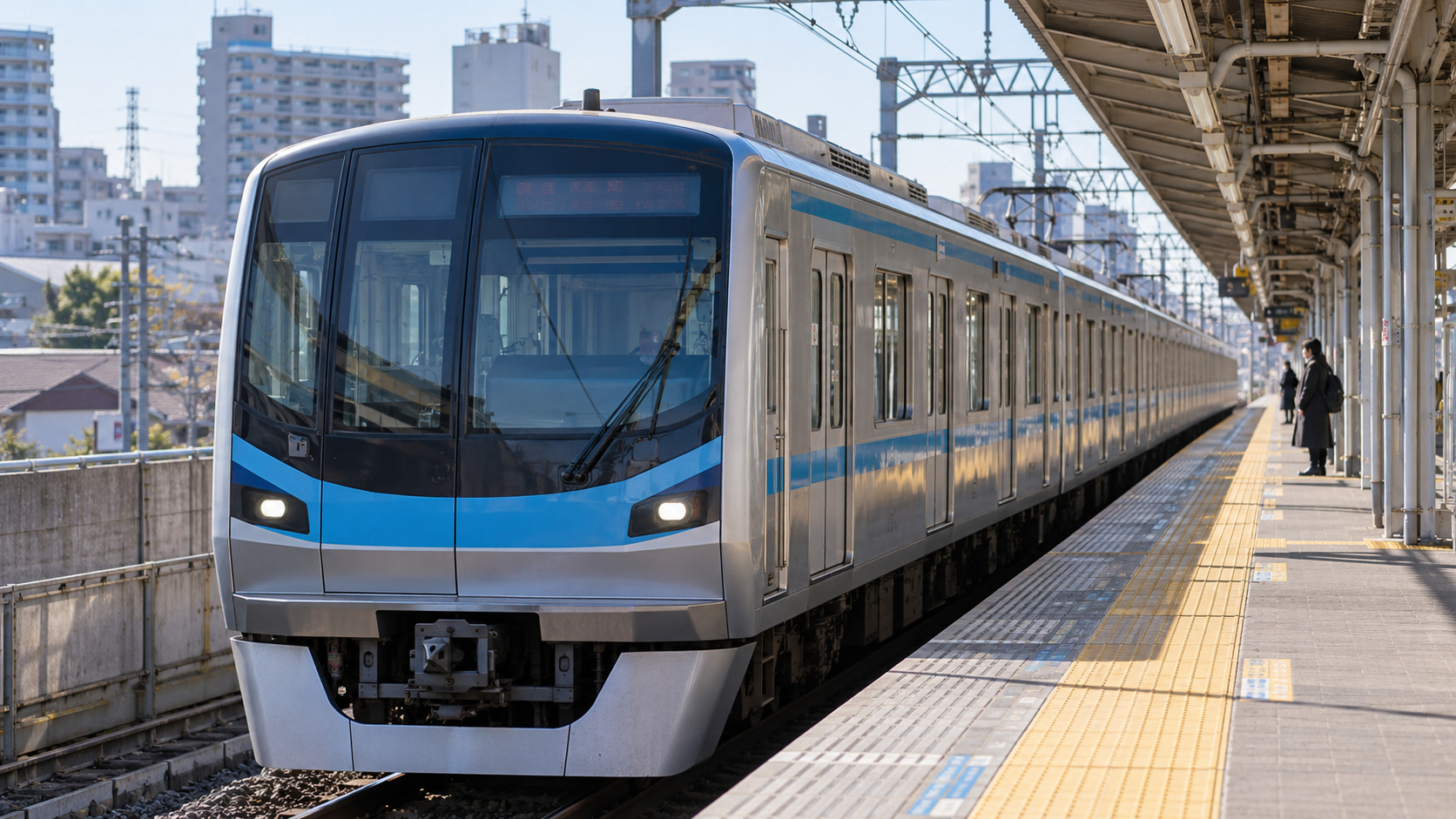
For Nishi-kasai, Kasai or Minami-sunamachi, do not board a Tozai Rapid just because it is going in the right direction. A Rapid skips those stations. A Local is the straightforward choice when you need one of them, provided its destination is far enough along the route.
For a journey entirely between Nakano and Toyocho, the distinction is less dramatic: the standard Tozai Rapid pattern stops at every station in that section. The mistake is assuming that the same all-stop behavior continues east of Toyocho.
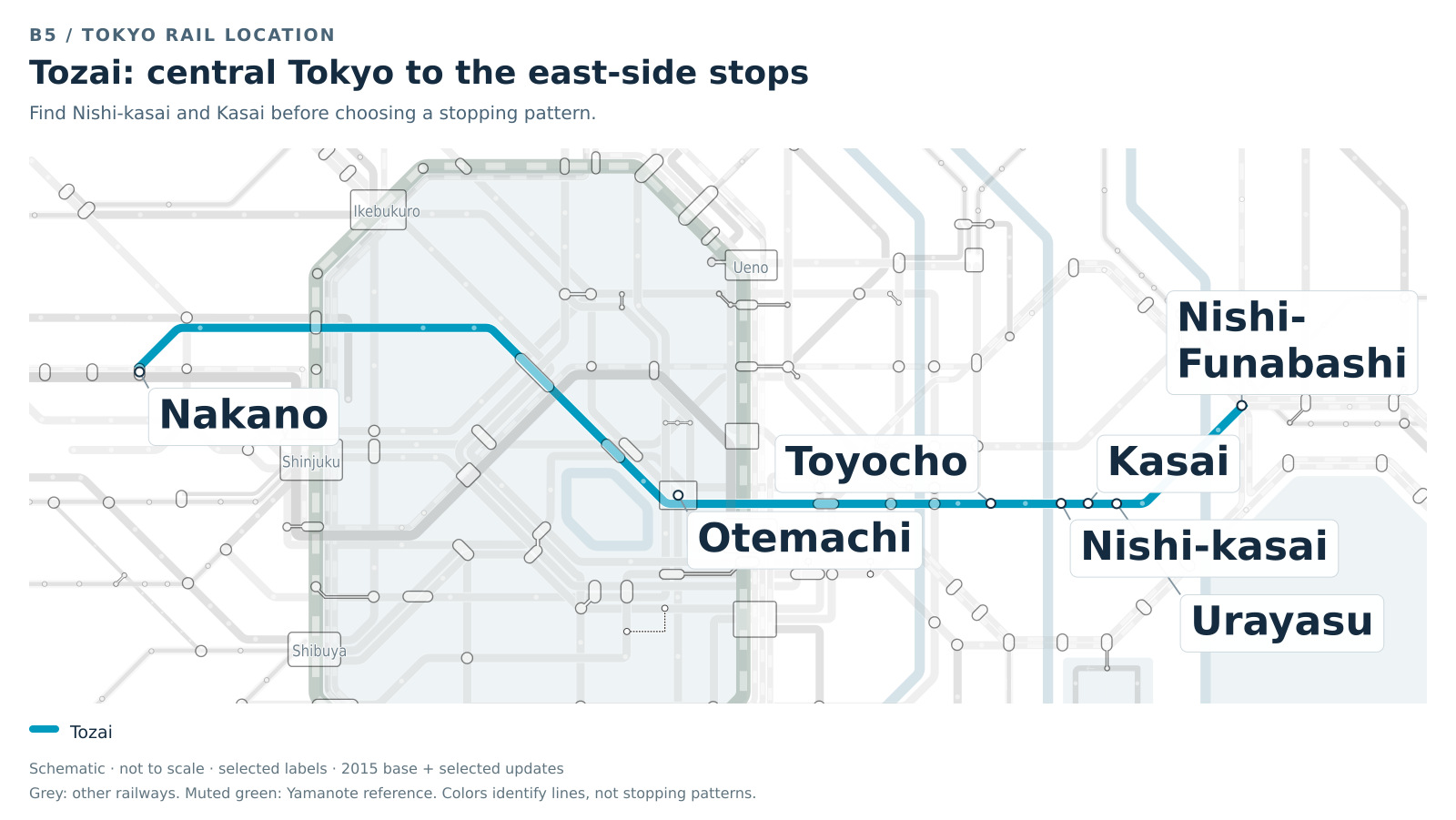
Where the stopping patterns differ
Metro’s official Tozai stop table distinguishes Local, Rapid and Commuter Rapid. For the eastern section, read it in three groups:
- Toyocho, Urayasu and Nishi-funabashi: Rapid stops.
- Minami-sunamachi, Nishi-kasai and Kasai: Rapid passes; Local and Commuter Rapid stop.
- Minami-gyotoku, Gyotoku, Myoden and Baraki-nakayama: both Rapid and Commuter Rapid pass; use a Local that reaches your station.
Commuter Rapid is a separate pattern, not an interchangeable name for Rapid. Its additional stops between Urayasu and Toyocho are particularly important if you have been told that “rapid trains never stop at Kasai.” The exact train type and your travel direction still need checking; a stop table is not a promise that every type runs whenever you want it.
Central Tokyo example: Iidabashi to Nihombashi
For this journey, an ordinary Tozai Rapid does not skip Nihombashi or the intervening central stations. You do not need to reject it simply because the display says Rapid.
You do need the correct direction and a destination beyond your stop. Read the actual train display rather than treating the line name as the whole instruction. If the train is terminating before your destination, choose a suitable later departure or follow the planner’s change.
For a base around Iidabashi or Kagurazaka, this is a useful difference from an eastern hotel stay: the same service label has different practical consequences depending on the part of the line you use. Our Kagurazaka and Iidabashi hotel-base guide helps with the station and neighborhood choice; it does not replace a departure check.
East-side hotel example: returning to Nishi-kasai
Henn na Hotel Tokyo Nishikasai directs guests to Nishi-kasai Station’s North Exit and gives a three-minute walking estimate from there. The practical rail target is therefore Nishi-kasai T16, not whichever larger stop a Rapid reaches next.
Suppose you are at Toyocho heading east after sightseeing. Metro’s March 2026 Toyocho timetable illustrates the choice: in the weekday eastbound table, 12:10 is an ordinary unmarked-destination departure for Nishi-funabashi, while 12:14 is a red-marked Rapid for Toyo-katsutadai. The Local reaches Nishi-kasai; the Rapid runs past it. A later departure with a faster label is not a substitute for checking the stop.
These are examples from the published timetable, not live departure advice. Use the current board and your travel date. The hotel’s short walk also begins after you leave the station; it does not include the ride or the platform-to-exit movement.
Kasai is not Nishi-kasai
The two names are adjacent on the route, but they are separate stops: Nishi-kasai T16 and Kasai T17. Save the exact name with your hotel address.
For example, Hotel Lumiere Kasai’s access page identifies Kasai as its railway approach. That does not make it the same arrival as a hotel whose directions start at Nishi-kasai. A Rapid skips both, so neither station is rescued by choosing the other name in a route search.
If you are going farther east to Myoden, a Commuter Rapid is not the solution either: the official pattern skips Myoden. Select a Local and confirm the destination. A train ending at Myoden can work for Myoden itself, but cannot take you onward to Baraki-nakayama or Nishi-funabashi.
Destination and train type answer different questions
“Rapid” answers which stations the train stops at along the relevant section. “For Toyo-katsutadai” answers where that particular train is going. Read both.
The current Toyocho timetable lists several possible eastern destinations, including Nishi-funabashi, Toyo-katsutadai and, in the weekday table, Tsudanuma. You do not need to memorize all of them to reach a station before Nishi-funabashi. You need to know that the departure passes through your part of the line, stops at your station and does not finish early.
Beyond Nishi-funabashi, the route can continue onto another railway. Tokyo Metro’s through-service network distinguishes the JR and Toyo connections. A train going toward Toyo-katsutadai is not simply a Tozai train that stays inside the subway fare area indefinitely.
“Toyo Rapid Railway” is also a company/line name. It is not, by itself, the answer to whether your train will call at Nishi-kasai. Check the Tozai stopping pattern before boarding.
If you realize you boarded a Rapid
If the train has not yet passed your last useful stop, follow the current route display and get off where it stops. For an eastbound ride approaching Toyocho, that may allow you to switch to a Local before the skipped section.
If it has already passed Nishi-kasai or Kasai, do not try to recover by getting off at a station where it does not stop. Use the next stopping station shown for that train, then check the return direction and the correct stopping pattern. Urayasu is a Rapid stop in the standard pattern, but follow the actual service information rather than assuming disruption-day operations are identical.
Ask station staff if you are unsure about changing platforms or ticket treatment after riding beyond your intended stop. Do not assume backtracking is free or exit the gates purely to reset the route. Explain where you boarded, where you meant to get off and which ticket or IC card you used.
Pass coverage and luggage are separate decisions
The Tokyo Subway Ticket covers Metro and Toei. Remaining on a Tozai through train beyond the Metro section does not extend that ticket onto JR or Toyo. Check how to pay for travel beyond the covered lines with station staff for the ticket medium you hold.
For a hotel trip within the Tozai section, the first task is still catching a train that stops. After that, compare the exit route and the time you travel. Old commuter discussions are not reliable measurements of today’s crowding on your departure. See our rush-hour guide for broader luggage planning, and use current operator information for the service itself.
Quick answers
Does Tozai Rapid stop at Otemachi and Nihombashi?
Yes, in the standard published pattern. Both are in the all-stop section west of Toyocho.
Can I take Rapid to Nishi-kasai or Kasai?
A standard Rapid passes them. Choose a Local that reaches your stop; a Commuter Rapid is a different pattern and must be checked as such.
Is Rapid always the fastest choice for my hotel?
No. It can skip your arrival station. Compare the complete journey, including any change or backtrack, rather than the service label.
Research checked 11 October 2026. Stop patterns and March 2026 timetable examples come from Tokyo Metro; hotel walking estimates remain the properties’ own estimates.