Private rail guide
Setagaya Line: Where to Pay, Which Door to Use and When to Tap
By Coverstories Editorial
Official sources checked 11 October 2026 UTC / 12 October 2026 JST.
Pay for the Setagaya Line before you board or as you enter the tram, depending on the stop. Once you have paid, you do not pay or tap again when getting off. That is the important difference from the entry-and-exit gates on many Tokyo trains.
The short Tokyu route links Sangen-jaya and Shimo-takaido, with neighborhood stops in between. It can be a useful part of a west-Tokyo outing, but its boarding system deserves a moment of attention before you follow the person ahead.
Start with the payment point, not the nearest door
There are two everyday boarding cases:
- There is a fare gate at the entrance: pay there, then follow the platform’s boarding signs. Do not automatically make a second payment inside the tram.
- There is no entrance fare gate: use the onboard fare box as you board through the designated entrance.
Staff may collect fares on the platform during busy periods. If you have already paid and are uncertain what a second reader is for, ask before tapping again. A platform without a conventional ticket machine is not a free-travel area.
Tokyu’s Setagaya riding instructions show the different door arrangements. Follow the signs for your stop, direction and time of day. “Always use the front door” is not a reliable rule for this line.
Choose the connection that fits your starting point
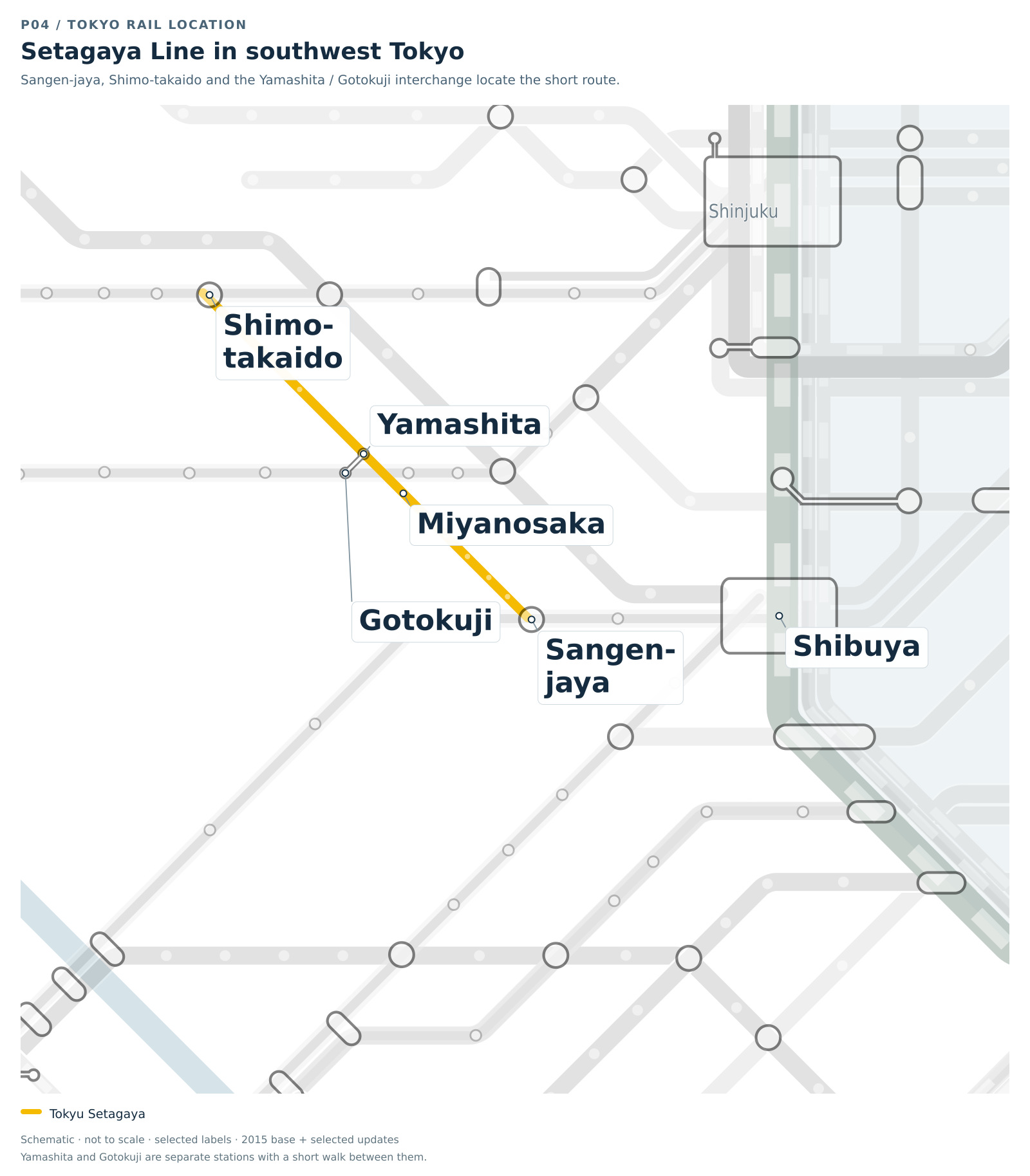
The official Setagaya Line information is the place to check individual stops and current service. Think of the line as a link between three railway approaches:
- Sangen-jaya connects with the Den-en-toshi Line.
- Shimo-takaido connects with Keio.
- Yamashita is the Setagaya stop beside Odakyu’s Gotokuji area; the two names refer to different stations.
For a traveler based around Shibuya, a route through Sangen-jaya is a starting point to compare. Someone already approaching on Keio should also check Shimo-takaido rather than first detouring through Shibuya. These are route choices, not claims that one connection is always quicker.
Put your actual destination into the route search. If you are visiting Gotokuji temple, do not assume the station called Gotokuji is the temple entrance, or that Yamashita and Miyanosaka are interchangeable stops. Compare the final walk on the destination’s current access map before choosing where to leave the tram.
A worked boarding example: Shimo-takaido to Miyanosaka
Suppose your route brings you to Shimo-takaido on Keio and continues on the Setagaya Line toward Sangen-jaya. Complete the Keio part of your journey using its gates and follow the Setagaya signs. At the Setagaya entrance, make the payment required there, then join the marked boarding queue.
Keep Miyanosaka as your alighting target. When you reach it, use the signed exit door without tapping out. You are not looking for the second gate tap that would normally close a distance-based train journey.
Before starting home, decide whether you are returning through Shimo-takaido or continuing to Sangen-jaya. The tram’s destination sign answers that direction question. Your earlier outward ride does not determine the best return connection.
Suica, bank cards and day tickets are different things
Tokyu currently lists transport IC cards, supported credit-card touch payment, Q SKIP and cash for this line. That does not mean every payment method uses an identical reader or that any pass containing the word “Tokyo” covers the ride. Use the device and instructions for the product you actually hold.
For an IC ride, have the card or phone ready before reaching the payment point. For cash, check the operator’s accepted denominations and prepare the fare before boarding. For a day ticket, follow its presentation instructions rather than paying a second ordinary fare by reflex. Ask staff first if one person is paying for a group.
A credit card used to buy a ticket and a credit card tapped to pay the journey are also different transactions. Look for the supported payment symbols instead of assuming a normal IC reader will accept your bank card.
Getting off, stopping for a walk and boarding again
The flat fare is for a ride, not a day of unlimited hop-on, hop-off travel. If you plan several neighborhood stops, compare individual journeys with the current Setagaya day-ticket conditions. Count actual boardings: a café break followed by another tram is another boarding, even when you continue in the same direction.
Keep the doorways clear while traveling. If you need assistance or a particular boarding position, speak to staff or the crew before attempting to board. A short route does not by itself establish a step-free connection from your incoming railway.
For the larger stations on either side of your trip, our Tokyo station navigation guide explains how to match an exit and transfer route to your destination.
Questions at the stop
I tapped before boarding. Do I tap inside as well?
No. Do not pay twice for the same boarding. If the arrangement is unclear or staff are collecting on the platform, tell them where you paid.
Do I tap when I get off?
No. The Setagaya fare is paid before or on boarding, and Tokyu says no payment or IC tap is needed when alighting.
Can I use instructions for the Tokyo Sakura Tram?
Use the operator’s instructions for the line you are riding. The Setagaya Line is Tokyu’s service; the Tokyo Sakura Tram is a separate Toei route with its own boarding arrangements and ticket products.