Private rail guide
Keio Line or Keio New Line at Shinjuku? Choose the Right Platform
By Coverstories Editorial
Official sources checked 11 October 2026 UTC / 12 October 2026 JST.
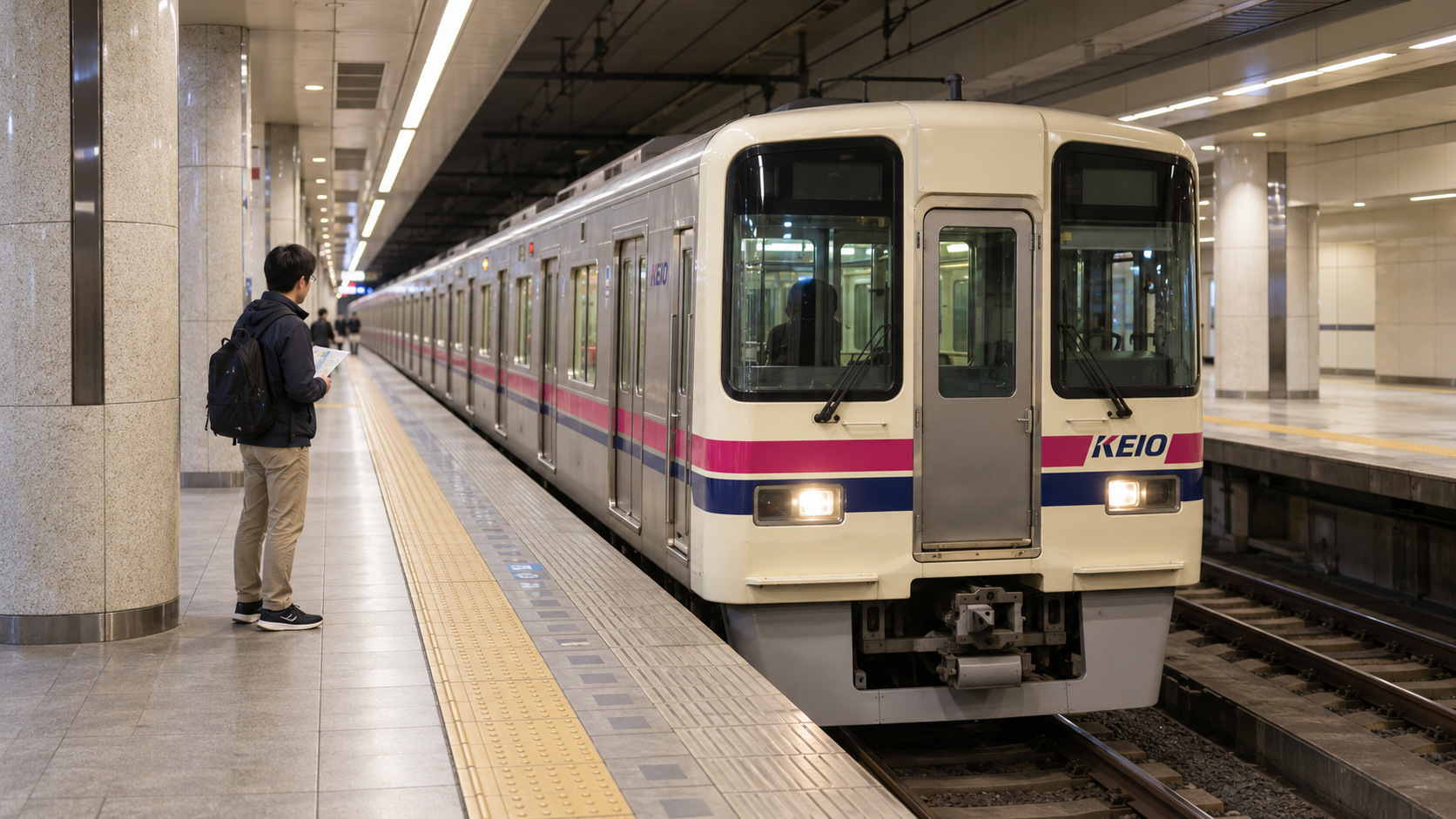
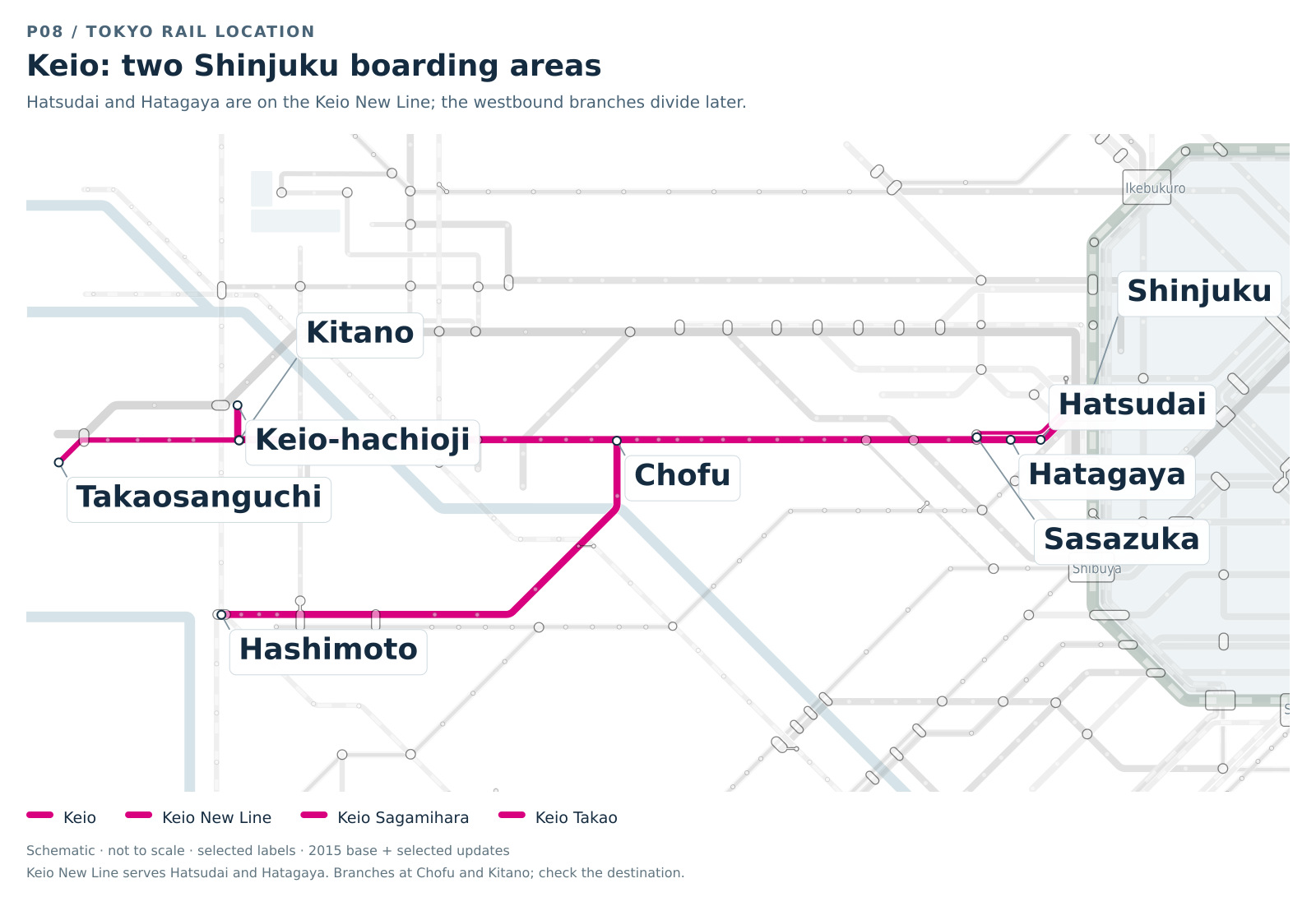
For Hatsudai or Hatagaya, follow signs for the Keio New Line, not the main Keio Line terminal platforms. Keio’s Shinjuku map explicitly warns that trains leaving platforms 1, 2 and 3 do not stop at those two stations; it directs passengers to New Line platform 4.
For a longer trip toward Takaosanguchi, Keio-hachioji or Hashimoto, read both the train’s destination and its stopping pattern. The word “Keio” alone does not tell you which branch it will take.
For a hotel-side comparison, use the Shinjuku hotel-base guide, then match the hotel entrance to the specific Keio boarding area.
The two Shinjuku boarding areas
The main Keio Line terminal and the Keio New Line/Toei Shinjuku Line platforms are different parts of the station. The official Shinjuku station page has separate maps and timetables for them.
- Main Keio Line, platforms 1–3: departures toward the Keio network west of Shinjuku. These trains bypass Hatsudai and Hatagaya.
- Keio New Line/Toei Shinjuku Line, platforms 4–5: the connected route through Hatsudai and Hatagaya on the west side and into the Toei Shinjuku Line on the east side.
For Hatsudai and Hatagaya, Keio’s current linked main-line station map identifies platform 4. Confirm the destination board on the day: platform numbers are a useful cross-check, not permission to ignore temporary signs.
If you have reached a main-line platform by mistake, stop before boarding. Follow the New Line/Toei Shinjuku Line transfer signs or show a staff member your destination. Do not assume that taking an ordinary Local from the wrong platform will solve it. This is a route distinction, not simply a fast-versus-slow train distinction.
Hatsudai: the short trip with the biggest naming trap
Imagine you are leaving a hotel near Shinjuku for a venue whose access page says Hatsudai. Write down “Hatsudai, Keio New Line” before entering the station. Follow New Line signs and check the platform display for that stop.
The return can be confusing in a different way. A train approaching Shinjuku on the New Line may continue into the Toei subway rather than terminate in the main Keio terminal. If your goal is Shinjuku, get off there. A through train continuing east is not taking you to a more central “Keio Shinjuku” later.
Allow time to reach the right station area before a timed performance. The distance between a hotel entrance, ticket gate and platform matters more than the short rail ride. Use our station navigation guide for the transfer and exit checks that route-search results can hide.
Takao, Hachioji and Hashimoto are different destinations
For the Mount Takao approach, search for Takaosanguchi if that is the station your destination specifies. Takao is a different station, and Keio-hachioji is a different branch destination. A train to Keio-hachioji is not a direct Takaosanguchi train just because it heads west from Shinjuku.
For Keio-tama-center or Hashimoto, check the Sagamihara Line branch. If the next departure has another destination, let a current route search identify the transfer instead of improvising from the train color. Keio’s station and route directory is useful for checking the exact station spelling before you buy or board.
A practical departure-board routine is: destination first, your stop second, departure time third. The earliest train leaving your platform is not always the earliest arrival at your destination, and a faster service may require a connection.
Does “Limited Express” cost extra on Keio?
Keio’s ordinary Limited Express and Express services do not carry an additional limited-express or express charge. Its ordinary ticket guidance confirms this. You still need a valid base-fare ticket or supported journey payment.
Keio Liner and Mt. TAKAO are named reserved-seat services. Do not apply the ordinary Limited Express rule to them. Check the reserved-seat service guidance and the exact train you intend to use. From Shinjuku, a seat reservation is an additional requirement for the relevant reserved-seat service; paying the ordinary fare does not reserve a seat.
Read the service name on your reservation as carefully as the destination. A reservation for one departure is not a flexible right to board any Keio train with similar branding.
Continuing onto the Toei Shinjuku Line
The New Line connection is also relevant when traveling toward central and eastern Tokyo. Choose the Toei-bound direction and check whether the train stops at your station. Do not assume that a through train has the same stopping pattern across every operator’s section.
For a smaller Toei stop, choosing a Local is a straightforward option when the destination and route match. If a route search offers an Express, check its actual stop list rather than relying on the color of the line. Our Tokyo Metro vs Toei guide explains why these are different subway operators.
A subway ticket’s validity does not automatically extend west onto Keio. Conversely, the same train can continue across the boundary without requiring passengers with the correct fare to change vehicles. Train continuity and fare coverage are separate questions.
Paying with a bank card
Keio now lists bank-card touch travel with interoperability across specified operators. It is not accurate to say Tokyo trains never take contactless bank cards. Check Keio’s current touch-payment coverage before using it for a through journey, especially if part of your trip uses another ticket or pass. Suica/PASMO compatibility and bank-card compatibility are different systems.
Before you leave Shinjuku
Check four details: the correct Keio boarding area, the exact destination, whether your stop is served, and whether you selected an ordinary or reserved-seat service. If any one is uncertain, show staff the station name rather than asking only for “the Keio train.”