Japan hotel guide
Sending Luggage Between Hotels in Japan
Send your suitcase ahead to another hotel in Japan. Confirm that the hotel can receive it, agree on delivery timing and keep essentials with you.
Start with your itinerary
Send ahead when it makes the journey easier
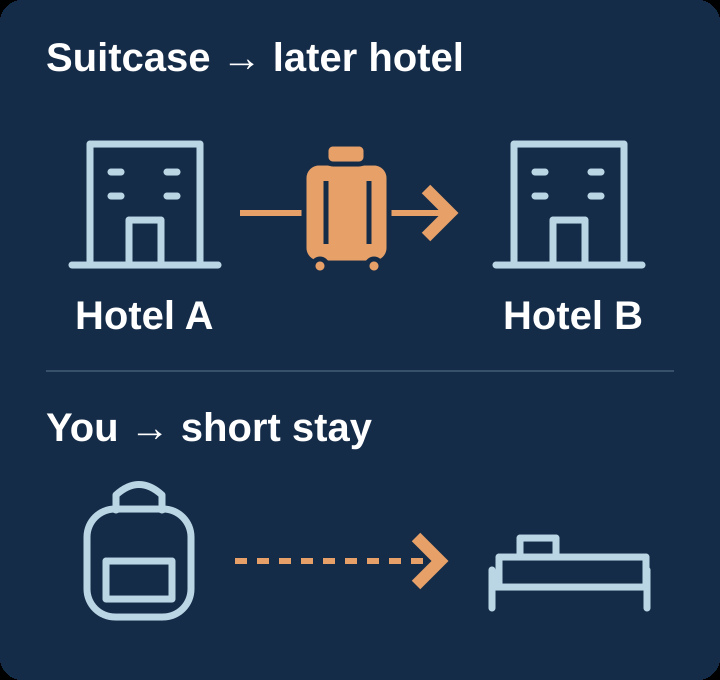
Forwarding is most useful when it removes a difficult stretch of your journey: several transfers, a short side trip, or a stay where you only need a change of clothes. The destination can be a later hotel rather than your very next night’s accommodation, provided the delivery and storage arrangements work.
A longer stay next
Ask whether the hotel will accept the bag before check-in and where you will collect it. Leave room for a delay instead of relying on arrival just before you leave again.
One or two nights in between
Consider sending to the hotel after that stop. Pack for every night without the suitcase, plus the time until you can collect it.
A tight one-night change
If you need the contents that evening or leave early the next morning, carrying the suitcase may be simpler. Do not build the stay around an unconfirmed arrival.
This guide covers domestic hotel-to-hotel forwarding. Airport delivery, departure-day storage and international shipping use different arrangements.
Confirm the receiving end first
Check what the receiving hotel will accept
Yamato’s hotel-delivery guidance (Japanese) says some properties cannot accept parcels, while others restrict the receiving place or hours. Ask your specific property before sending anything.
- Will you accept this shipment? Give the carrier, number of bags and planned arrival date. Ask whether shipping must be prepaid.
- Who can receive it? Check staffed hours, any closed days and the correct delivery entrance.
- Can it arrive before me? Agree the dates and ask about storage limits or charges.
- What should the label say? Confirm the full property name, branch, postcode, address and contact number, plus the guest name and check-in date.
For example, MIMARU’s published guidance asks guests sending luggage ahead to include the full English name used for the reservation and the check-in date. Treat that as a useful example, then follow your own hotel’s instructions.
Self-check-in accommodation needs a different plan
For self-check-in apartments, establish whether staff can receive a delivery. Yamato’s traveler notice excludes pickup and delivery at Airbnb-style accommodation without reception staff. It directs travelers to its sales offices for collection and warns against addressing the parcel to a convenience store. Confirm the exact office, collection process and hours with Yamato before choosing that alternative.
Three separate dates
Work backward from when you need your suitcase
Write down your hotel check-in date, the agreed delivery date, and the day the suitcase must leave the first hotel. The carrier’s pickup cutoff at the first hotel can be earlier than your checkout time.
Yamato describes ordinary TA-Q-BIN as generally arriving the next day or the day after, with regional exceptions. Its hotel-arrival instructions (Japanese) call for sending in time to reach the accommodation by the day before the stay, and note that earlier arrival and hotel storage charges are possible. Ask the desk or carrier which arrangement applies to your itinerary.
Get an actual dispatch plan
Give the carrier both addresses and your check-in date. Confirm the service, the handover cutoff and the expected arrival date before paying.
Example: Tokyo → a short stop → Kyoto
Suppose you leave Tokyo on Monday, spend Monday and Tuesday nights elsewhere, and check into Kyoto on Wednesday. You could ask the Kyoto hotel to receive a suitcase on Tuesday while you travel with a small bag. This is a planning example, not a verified delivery schedule.
On small screens, swipe the table sideways to see all three columns.
| When | You | Suitcase |
|---|---|---|
| Before leaving Tokyo | Confirm Kyoto’s receiving and storage arrangements. | Hand over by the carrier-confirmed cutoff. This may be before Monday. |
| Monday and Tuesday | Travel with your smaller bag for two nights. | Target Tuesday arrival at Kyoto, if the hotel and carrier agree. |
| Wednesday | Check in at Kyoto and collect the suitcase. | The hotel holds it until your agreed collection time. |
Pack for both nights and Wednesday until collection, plus a little extra for a delay. If the dates do not work, choose another receiving hotel or carry the suitcase.
Yamato’s hotel-arrival flow lets you set the stay date up to 10 days after dispatch. For a longer gap, check the carrier’s available arrangements rather than treating forwarding as long-term storage.
Date selection depends on the service
If the desk uses Sagawa, its date/time options (Japanese) distinguish delivery-date selection from time slots aimed at private homes. Do not assume a hotel shipment has the same selectable windows. Weather and other disruptions can also affect arrival.
Before checkout day
Arrange the handover while the desk still has time to help
Ask the first hotel about forwarding before the morning you leave. Confirm whether it handles your chosen carrier, its collection cutoff and the payment method. If it cannot dispatch the bag, ask the carrier about a suitable nearby service office and its own deadline.
- Check the destination together. Use the exact receiving hotel’s details and your booking name. Similar hotel names or branches are easy to confuse.
- Confirm the bag and contents are accepted. Yamato’s ordinary TA-Q-BIN limit is 200 cm for the three dimensions combined and 30 kg. Its service page includes further size and packaging conditions; the particular drop-off point must also accept your bag.
- Describe the contents accurately. Yamato asks for a detailed contents description on the waybill. Ask staff how to list your actual items rather than inventing a generic description.
- Check the price and terms before paying. Confirm the total for all bags, any cover or handling charge, and the carrier’s current compensation conditions.
- Keep the evidence with you. Retain the receipt and tracking number. Photograph the suitcase and completed label for your private reference.
Ask the sending desk whether a suitcase cover or other protection is needed.
Pack for the whole gap
Keep essentials out of the forwarded suitcase
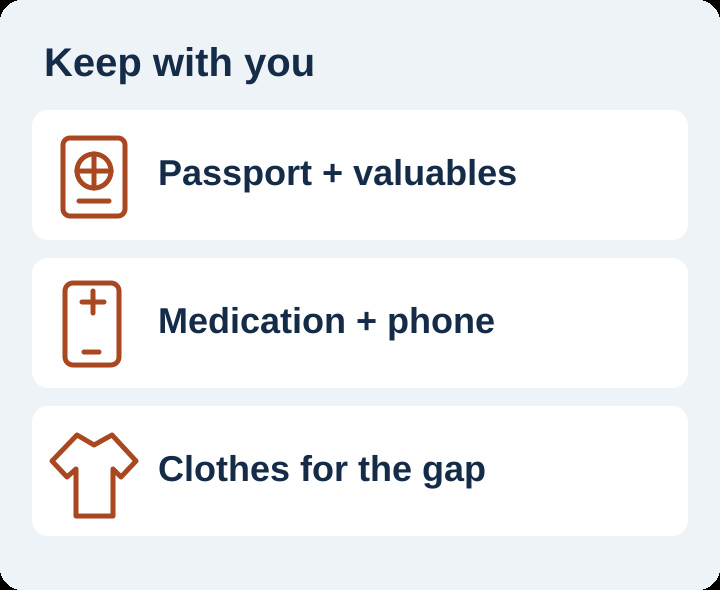
Yamato lists passports, cash and bank or credit cards among items it does not carry by TA-Q-BIN. Keep those with you. Check its full restrictions for your other belongings; airline baggage rules do not establish courier acceptance.
If an intermediate stop is a capsule hotel, check its suitcase storage rules separately.
For practical reasons, also keep your phone, charging essentials, keys, medication you will need, toiletries and enough clothes for the gap. If something would be difficult to replace before the suitcase arrives, keep it accessible.
Keep the medicine you will need before collection with you. Yamato’s medicine FAQ (Japanese) allows domestic shipping subject to conditions, including packaging and possible transport restrictions.
For sprays, perfume, lighters, batteries or other potentially restricted items, describe them to the carrier and follow its current rules. Some routes use air transport, so an item may affect acceptance or transit time.
Until you collect it
Keep the receipt until the suitcase is back in your hands
Use the tracking reference to follow the shipment. Contact the carrier with the reference and tell the receiving hotel as soon as a problem appears, especially if the suitcase may arrive after you check out of the receiving hotel.
For separate reservations at the same property, first confirm whether you can keep the same room.
If you change accommodation after sending, ask the carrier about the available options and charges. Do not assume the hotel will forward it onward or that a redirection will be immediate or free.
At the receiving hotel, give the booking name and show the shipment details. Match the label to your receipt before leaving with the bag. Keep the receipt if you need to raise a delivery or damage issue.
Common questions
Hotel-to-hotel luggage forwarding FAQ
Can I send luggage to a hotel before checking in?
Often, but get that property’s agreement for the bag count and dates first. Confirm where staff receive it, how long they can hold it and whether there is a charge.
Can I skip a one-night stop and send to a later hotel?
It can be a useful plan if the carrier can meet the agreed delivery date and the later hotel will hold the bag. Pack for the entire interval until collection, including a possible delay.
Will my suitcase arrive the next day?
Do not assume it. Route, service, dispatch cutoff and disruptions matter. Get the plan for your addresses and hotel dates before handing it over.
Can any hotel send and receive luggage?
No. Ask both properties separately. A staffed front desk is useful, but it does not by itself confirm dispatch services or permission to receive a courier shipment.
Do I need to use the same hotel chain?
The important checks are the carrier’s accepted destination and the receiving property’s agreement. Do not assume shared branding is required, or that it guarantees acceptance.
Can I leave payment to the receiving hotel?
Do not do that unless both the service and the hotel explicitly agree. Confirm the payment arrangement at the sending desk and ask the next hotel whether it requires prepaid shipping.
Source notes
How this guide was checked
Official Yamato, Sagawa and MIMARU guidance linked above was checked on October 6, 2026. Confirm acceptance with your hotels and timing with your carrier. The itinerary is a planning example.
Keep planning